01. Edit your form online
Type text, add images, blackout confidential details, add comments, highlights and more.

Type text, add images, blackout confidential details, add comments, highlights and more.

Draw your signature, type it, upload its image, or use your mobile device as a signature pad.

Send it via email, link, or fax. You can also download it, export it or print it out.
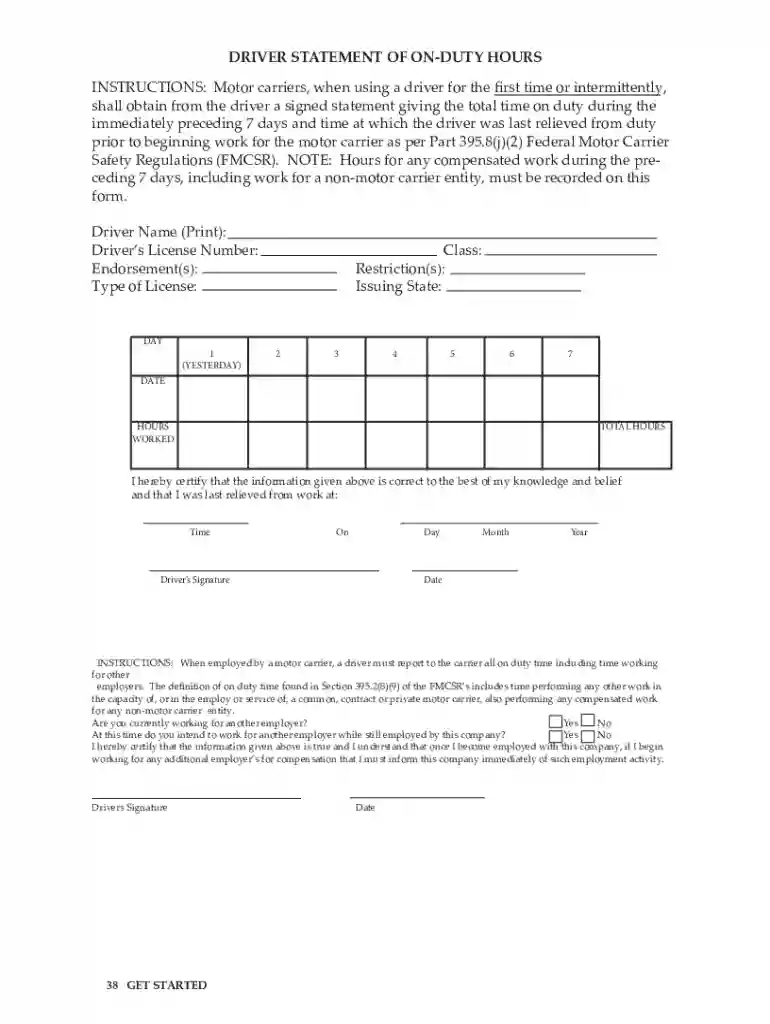
The Driver Statement of On-Duty Hours Instructions is a detailed document specifying the required steps and regulations that drivers must follow to record and report their on-duty hours. This statement is necessary to comply with federal guidelines intended to ensure drivers do not exceed safe working hours. It outlines how to complete the form accurately, which is mandatory for drivers prior to undertaking duties for a motor carrier. The document aims to ensure drivers maintain accurate records of their working hours to avoid overwork and fatigue, enhancing road safety and compliance.
Understanding how to use the Driver Statement of On-Duty Hours Instructions is crucial for both new and experienced drivers. The instructions guide drivers in tracking their working hours accurately. The process entails entering start and end times for each shift worked. It's essential for these entries to be precise to prevent discrepancies that can lead to non-compliance issues. Drivers must also account for any additional employment or duties performed, which need to be detailed in the statement. By following the instructions carefully, drivers ensure they remain within the legal work limits specified by federal regulations.
Read the Form Thoroughly: Begin by carefully reading all sections of the form to understand what information is required.
Enter Personal Information: Fill in your personal details, including your name, driver's license number, and contact information.
Detail On-Duty Hours: Accurately record your start and end times for each working period. Make sure the total hours are clear and easy to verify.
Certify Accuracy: Sign the form to certify that all information provided is truthful and accurate.
Submit to Employer: Submit the completed form to your motor carrier employer before commencing any duties.
These precise steps help ensure that all drivers complete the form in compliance with employer and federal requirements.
Personal Details: Essential personal information such as the driver's full name and license details.
On-Duty Hours Section: Where drivers log their total hours worked for specific timeframes.
Certification Section: A mandatory section where drivers verify the accuracy of the information provided by signature.
Additional Employment Disclosure: Fields for disclosing other employment that might impact total work hours.
Each element is crucial for the document's integrity and legal compliance.
The primary users of the Driver Statement of On-Duty Hours Instructions are commercial drivers working for motor carriers. Employers, including transportation companies and logistics firms, also use the form to ensure compliance with legal standards. Additionally, regulatory bodies may review these forms during audits or inspections to ensure that companies adhere to federal transportation safety regulations.


Legally, the Driver Statement of On-Duty Hours is used to enforce compliance with the Federal Motor Carrier Safety Administration (FMCSA) regulations. It obligates drivers to adhere to specified on-duty limits and rest requirements, preventing fatigue-related accidents. Non-compliance can lead to penalties, fines, or legal action against both the driver and the motor carrier. Therefore, understanding the legal implications is paramount for those responsible for driver safety.
While the Driver Statement of On-Duty Hours Instructions is grounded in federal law, some states may impose additional rules or variations concerning on-duty hours and rest periods. It is crucial for drivers and employers to be aware of both federal and any state-specific requirements to ensure comprehensive compliance. For example, some states may have stricter regulations on rest periods, demanding careful adjustment to work schedules.
Failure to accurately complete the Driver Statement of On-Duty Hours or adhere to the documented times and limits can result in significant consequences. Penalties may include fines, suspension, or revocation of a driver's commercial license, and potential legal action against the motor carrier. Repeat violations can lead to severe legal ramifications, emphasizing the importance of meticulous record-keeping and adherence to outlined instructions.
The Driver Statement of On-Duty Hours is available in both digital and paper formats. Each version has its advantages; digital forms allow for easy corrections and the efficiency of electronic storage, while paper forms may be requisite for certain organizations transitioning from traditional systems. Drivers and employers should choose the format that ensures accuracy and ease of access, maintaining a record that is both reliable and verifiable.
We've got more versions of the DRIVER STATEMENT OF ON-DUTY HOURS INSTRUCTIONS form. Select the right DRIVER STATEMENT OF ON-DUTY HOURS INSTRUCTIONS version from the list and start editing it straight away!
At DocHub, your data security is our priority. We follow HIPAA, SOC2, GDPR, and other standards, so you can work on your documents with confidence.