






Definition and Purpose of Excel Goal Seek
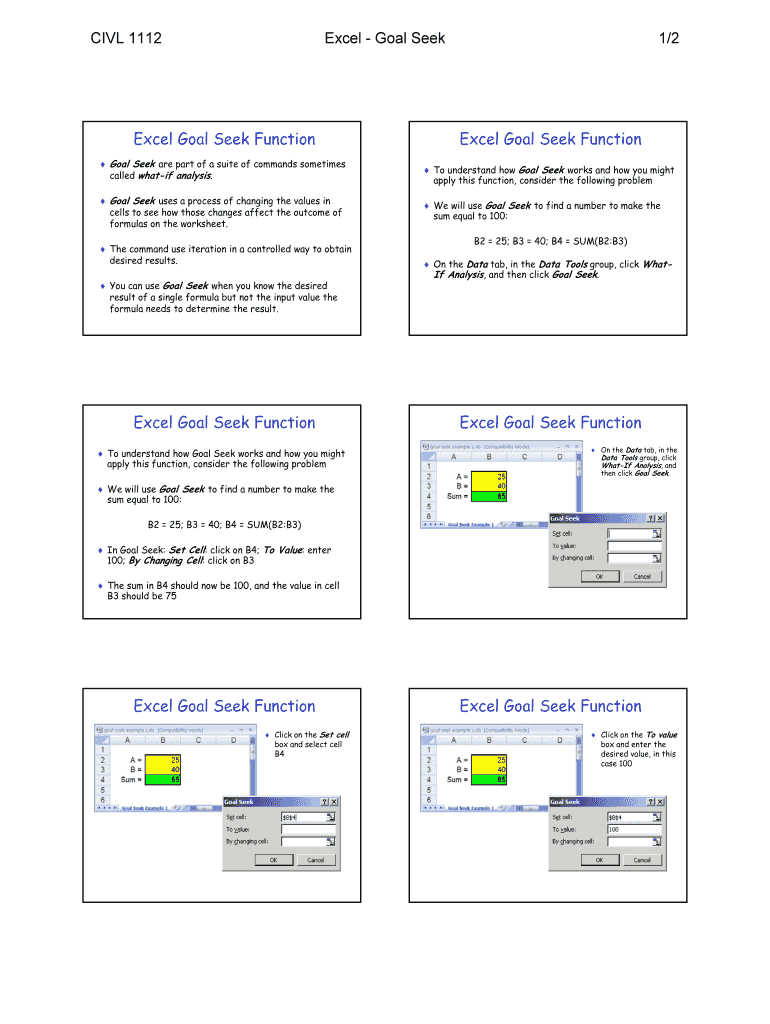
The Excel Goal Seek feature is a powerful tool designed to help users find the necessary input value needed to achieve a desired output in a formula. As part of Excel's what-if analysis tools, it focuses on scenarios where achieving a specific result is desired, allowing users to work backward and determine the input required for this desired outcome. In practice, Goal Seek adjusts one variable to find the optimal solution, making it ideal for situations where you need to achieve precise financial metrics, scientific results, or efficiency benchmarks. By doing so, it supports the functionality of productivity portfolios by highlighting which factors need adjustment to meet specific performance indicators.
Steps to Use Excel Goal Seek for Problem Solving
-
Identify the Target Cell: This is the cell containing the formula which needs a specific outcome. For example, if you want the sum of two cells to be 100, you would target the cell holding this sum formula.
-
Define the Set Value: Decide the value you want the target cell to reflect. Continuing the example, this would be setting the sum cell to 100.
-
Choose the Cell to Change: Select the input cell that Excel will adjust to reach your desired set value.
-
Using Goal Seek: Navigate to the 'Data' tab, select 'What-If Analysis,' and then 'Goal Seek.' Fill in the dialog with your target cell, set value, and cell to change.
-
Execute the Analysis: Click 'OK' and let Excel calculate the necessary value for the input cell to meet the criteria defined.
Practical Example: Using Excel Goal Seek
Imagine a scenario where a company needs its revenue and costs to result in a specific profit margin. Goal Seek can be set to adjust the sales figure until the desired profit margin is achieved. By entering the profit margin formula into a cell, and setting this as the target cell in Goal Seek, users can backtrack to the necessary sales number needed for their target.
Common Use Cases for Excel Goal Seek
- Financial Forecasting: Adjusting sales targets to reach specific revenue goals.
- Resource Planning: Determining required labor hours to meet production demands.
- Budgeting: Modifying expense allocations to achieve desired savings or spending caps.
- Academic Applications: Solving equations or conditions needed to reach specific research results.
Advantages of Using Excel Goal Seek
- Efficiency: Quickly find precise solutions without manual trial and error.
- Flexibility: Can adjust any numeric input variable.
- User-Friendly: Intuitive user interface and easy-to-follow steps.
- Integration: Works seamlessly with other Excel features and functions.
Tips for Effective Use of Excel Goal Seek
- Ensure Correct Formula Structure: The targeted cell must have a valid and evaluative formula.
- Simplify the Problem: Start with formulas that depend on single input values for a more straightforward analysis.
- Check Solution Feasibility: Ensure the value Excel calculates is practical and implementable in real-world settings.
Common Issues and Troubleshooting
- Convergence Problems: Sometimes Goal Seek cannot find a solution. This may require checking for formula errors or adjusting constraints.
- Non-numeric Values: Goal Seek works only with numeric data. Ensure all referenced cells contain numbers.
- Overlapping Constraints: Simplify and make adjustments to avoid conflicting constraints.
Excel Goal Seek vs. Solver
While both tools serve to optimize inputs to reach target outputs, Solver offers more complex capabilities, accommodating multiple variables and constraints. Goal Seek is ideal for single-variable adjustments when simplicity and speed are key, whereas Solver is preferable for comprehensive multi-variable problems.
Versions and Alternatives
Excel consistently updates, and while Goal Seek functionality remains mostly unchanged, newer Excel versions might have enhanced computational capabilities. Alternatives for more complex scenarios include the Solver add-in or third-party data analytics tools widely compatible with Excel outputs.
Enhancing Productivity With Goal Seek
Incorporating Excel Goal Seek into business workflows empowers teams to model scenarios and anticipate operational requirements swiftly. Whether in finance, operations, or strategic planning, Goal Seek provides real-time insights, allowing for dynamic and data-driven decision-making that aligns with productivity goals.