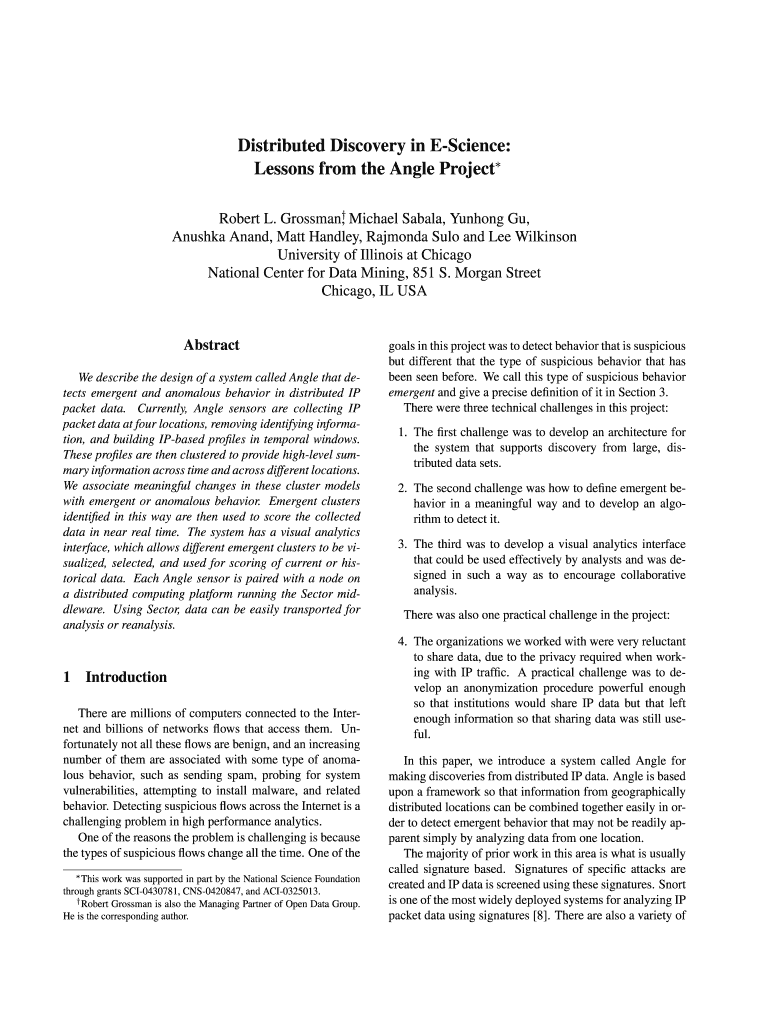







Definition and Meaning of Distributed Discovery in E-Science
Distributed Discovery in E-Science involves using distributed computing methods to facilitate scientific research and data analysis. The focus is on employing advanced algorithms and computational frameworks to handle and interpret vast datasets from diverse sources. This field is essential in E-Science as it allows researchers to extract meaningful insights from complex data without being constrained by geographic or technical barriers.
- Distributed computing refers to a model where processing power is shared across multiple locations, enhancing resource efficiency and speed.
- E-Science is the application of computational techniques to scientific inquiry, greatly benefiting fields like genomics, climate modeling, and physics.
How to Use the Distributed Discovery Framework
To effectively use the Distributed Discovery framework in E-Science projects, one must first identify the specific scientific questions or problems that require data analysis. Here's a step-by-step procedure:
- Define your research objective: Clearly outline the scientific question you aim to answer or the hypothesis you wish to test.
- Data Collection: Gather relevant data from various scientific databases or experiments.
- Select appropriate computational tools: Choose software and algorithms compatible with distributed computing to process and analyze the data.
- Execute analysis: Run the chosen tools on distributed systems, allowing for parallel processing and faster computation.
- Interpret results: Use visual analytics to understand and interpret the outcomes, ensuring that the insights align with your scientific objectives.
Key Elements of Distributed Discovery
The key elements of Distributed Discovery in E-Science involve several integral components that ensure efficient data analysis.
- Sensor Nodes: These are deployed to collect data from various environmental or experimental sources.
- Edge Nodes: Process the initial data closer to the source, enhancing speed and reducing latency.
- Pooled Nodes: Handle more intensive computational tasks, employing shared resources from multiple locations.
Other elements include:
- Statistical algorithms to identify patterns or emergent behaviors within the data.
- Visual analytics interfaces that support user-friendly interaction with complex datasets.
Important Terms Related to Distributed Discovery in E-Science
Understanding certain terminologies can enhance comprehension and application:
- Emergent Behavior: Patterns that arise from interactions within a network that are not directly programmed.
- Sector: A distributed computing framework that manages large datasets efficiently.
- Visual Analytics: Combining automated analysis techniques with interactive visualizations for comprehensive understanding.
Steps to Complete Distributed Discovery Projects
To conduct a distributed discovery project in E-Science successfully, follow these steps:
- Project Initiation: Define the scope and objectives.
- System Setup: Prepare the computational and network infrastructure.
- Data Integration: Import and integrate datasets from relevant sources.
- Analysis Execution: Use appropriate models and algorithms to analyze the data.
- Review and Interpretation: Evaluate the results and refine the approach as needed.
- Reporting: Document findings and contribute to scientific literature.
Who Typically Uses Distributed Discovery?
Distributed Discovery in E-Science is widely used by:
- Researchers and scientists in fields like genomics, climatology, and physics.
- Data analysts looking to draw insights from large-scale experiments or studies.
- Academic institutions and research organizations engaged in collaborative science projects.
Why Should You Use Distributed Discovery in E-Science?
Using Distributed Discovery in E-Science offers several benefits:
- Enhances computational efficiency by leveraging distributed resources.
- Facilitates real-time data processing and analysis, allowing for quicker scientific discovery.
- Supports collaborative research by allowing multiple users to contribute and access data simultaneously.
Examples of Using Distributed Discovery in E-Science
Distributed Discovery is applied in various real-world scenarios, such as:
- Chemical Research: Identifying new compounds by analyzing molecular data from multiple laboratories.
- Climate Studies: Using distributed weather station data to model climate change impacts.
- Genomics: Analyzing genetic data from various populations to study health implications and evolutionary patterns.
The effective use of Distributed Discovery can significantly advance scientific understanding by making complex data more manageable and actionable.