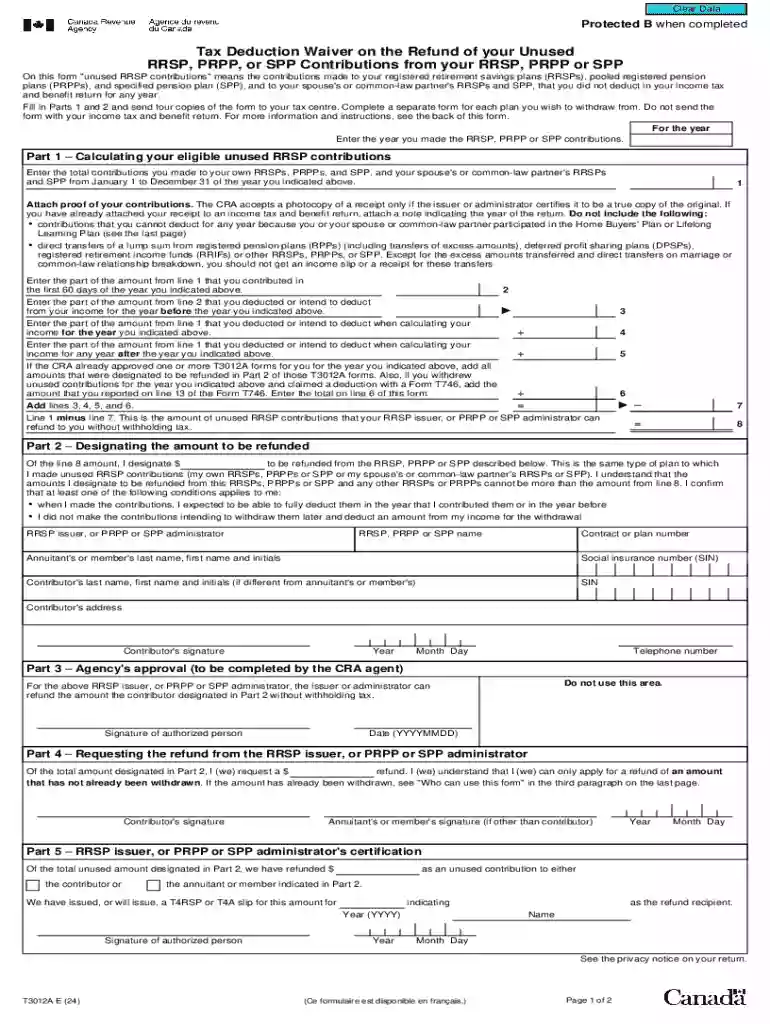
Tax Deduction Waiver on the Refund of Your Unused Rrsp, Prpp, or Spp Contributions 2026

Get Form
Tax Deduction Waiver on the Refund of Your Unused Rrsp, Prpp, or Spp Contributions Preview on Page 1

Here's how it works

01. Edit your form online
Type text, add images, blackout confidential details, add comments, highlights and more.

02. Sign it in a few clicks
Draw your signature, type it, upload its image, or use your mobile device as a signature pad.

03. Share your form with others
Send it via email, link, or fax. You can also download it, export it or print it out.

Definition and Meaning of the Tax Deduction Waiver

A "Tax Deduction Waiver" allows individuals or entities who have unused contributions in registered retirement savings plans (RRSPs), pooled registered pension plans (PRPPs), or specified pension plans (SPPs) to request a refund of these amounts without being subject to withholding taxes. These waivers serve to alleviate the immediate tax burden that typically accompanies refunds of unused contributions, ensuring taxpayers can recover their funds efficiently. Understanding the intricate criteria for such waivers is crucial for maximizing financial benefits within the regulatory framework defined by tax authorities.

Eligibility Criteria

To qualify for a tax deduction waiver, taxpayers must meet specific eligibility criteria. These often include but are not limited to:


  • Verification of unused contributions within the RRSP, PRPP, or SPP accounts.
  • Demonstrating that the contributions exceed annual limits or were made erroneously.
  • Complying with timelines set by tax authorities for filing the waiver request. Taxpayers should carefully review these requirements to determine their eligibility and prepare the necessary documentation to support their claims.
decoration image ratings of Dochub

Steps to Complete the Waiver Process

  1. Document Verification: Review your account statements to confirm unused contributions.
  2. Form Acquisition: Obtain the appropriate tax deduction waiver form from your local tax authority or online.
  3. Complete Required Information: Fill out personal details, contribution amounts, and other relevant financial information on the form.
  4. Attach Necessary Documentation: Include records and statements that substantiate your claim for a waiver.
  5. Submit the Form: Depending on the jurisdiction, submission methods may include online portals, mailing the form, or delivering it in-person to the tax office.
  6. Await Confirmation: After submission, wait for acknowledgment and approval from tax authorities.

These steps ensure thorough preparation and adherence to procedural requirements, minimizing the risk of delays or rejections.

Required Documents

Essential documentation includes:

  • Recent RRSP, PRPP, or SPP account statements showing unused contributions.
  • Copies of previous tax returns if reclaiming contributions from past tax years.
  • Identification documents, such as a driver's license or Social Security card.
  • Form confirmations of contributions made in error or exceeding annual limits.

Having a comprehensive set of documents ready facilitates a smoother application process and supports the credibility of the waiver request.

IRS Guidelines for Waivers

While tax deduction waivers are common, guidance from authorities such as the IRS provides clarity on permissible practices. The IRS offers detailed directives on how to assess eligibility, the process for refund applications without withholding implications, and compliance with federal tax laws. It is critical to consult these guidelines to ensure that the waiver submission aligns with IRS standards and avoids potential legal complications.

Application Process and Approval Time

The application process for a tax deduction waiver involves meticulous form completion and submission within specified deadlines. Approval times can vary depending on the completeness of the application and the volume of requests processed by the tax authority. Typically, decisions are communicated within several weeks but can extend to a few months during peak tax seasons. Proactively managing expectations and preparing for such timelines is advised.

Legal Use of the Waiver

A tax deduction waiver must be used within the parameters set by relevant tax legislation. Legal use entails:

  • Ensuring the waiver is only applied to qualified excess contributions.
  • Utilizing waivers for legitimate refund claims without tax manipulation.
  • Maintaining accurate records for future tax audits or inquiries.

Understanding and adhering to these legal frameworks protects against legal pitfalls and financial penalties.

Examples of Using the Waiver

Practical examples highlight scenarios where tax deduction waivers could be beneficial:

  • Scenario 1: An individual discovers excess contributions to their RRSP due to a payroll error. A waiver allows recovery of this amount without withholding tax, aligning contributions with legal limits.
  • Scenario 2: A taxpayer nearing retirement reassesses their financial plan, identifying unused contributions within their PRPP. By applying for a waiver, they maximize their accessible funds in accordance with tax regulations.

These examples shed light on how waivers can be strategically employed in diverse financial circumstances to optimize tax outcomes.

Penalties for Non-Compliance

Failure to comply with tax deduction waiver regulations can result in significant penalties, such as:

  • Financial fines for excess contribution violations.
  • Additional taxes on unreported or improperly claimed refunds.
  • Potential legal action for fraudulent waiver submissions.

Taxpayers must remain vigilant and informed about compliance obligations to avoid costly repercussions or adverse tax consequences.

be ready to get more

Complete this form in 5 minutes or less

Get form

Got questions?

We have answers to the most popular questions from our customers. If you can't find an answer to your question, please contact us.
Contact us
registered retirement savings plan (RRSP) pooled registered pension plan (PRPP) specified pension plan (SPP) spouses or common-law partners RRSP or SPP.
Your registered retirement savings plan (RRSP) deduction limit, is the maximum amount you can deduct from contributions made to your RRSPs, PRPP, SPP and to your spouses or common-law partners RRSP or SPP for a year.
Unused contributions are RRSP contributions you made in previous years, or in the first 60 days of the current year, that were not deducted on a prior year income tax return.
A refund of premiums is a payment that is paid or deemed to have been paid from a deceased annuitants RRSP to a qualifying survivor. This payment can be included in the income of the qualifying survivor who receives it instead of the income of the deceased annuitant or the annuitants estate.
If you made RRSP/PRPP contributions in a previous year and reported them on that years return but didnt deduct all of these from your income to lower your tax payable, you will have unused RRSP/PRPP contributions. You can claim your unused RRSP/PRPP contributions in a future year to lower your taxes for that year.

Security and compliance

At DocHub, your data security is our priority. We follow HIPAA, SOC2, GDPR, and other standards, so you can work on your documents with confidence.
Learn more
ccpa2
pci-dss
gdpr-compliance
hipaa
soc-compliance

People also ask

If you meet all of the previous conditions and have not already withdrawn the unused RRSP contributions, you can withdraw them without having tax withheld. To do this, fill out Form T3012A, Tax Deduction Waiver on the Refund of Your Unused RRSP, PRPP, or SPP Contributions from your RRSP, PRPP or SPP.
You can leave the funds in your RRSP and deduct part or all of it on your 2024 return (or a future return) up to your deduction limit. Be sure to show your contributions on Schedule 7 when you file your 2024 return so the funds will be available for 2024 or to carry forward for future years.
Lifelong Learning Plan (LLP) The withdrawal is not taxable as long as the funds are paid back to your RRSP over a 10-year period, typically starting five years after your first withdrawal. Up to $10,000 can be withdrawn annually with a maximum lifetime withdrawal of up to $20,000 if you meet the criteria.