Definition & Meaning
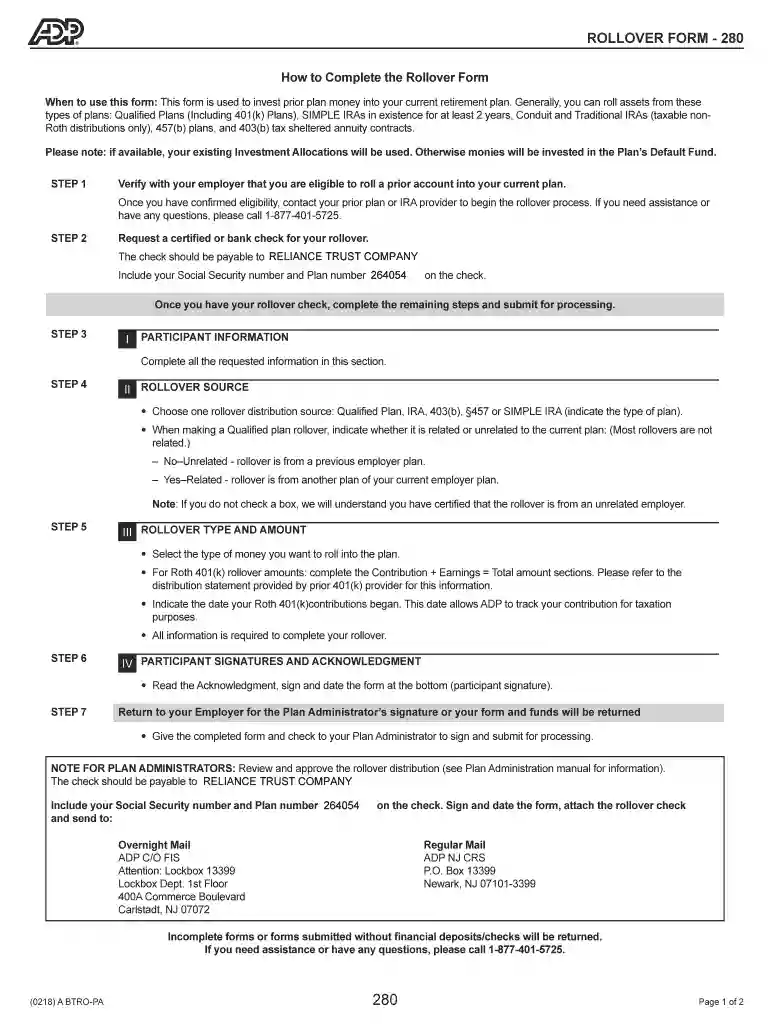
The ADP Rollover Form 280 is a critical document used to facilitate the transfer of funds from previous retirement plans into a current retirement account. The form serves as a structured guide, laying out the necessary steps and requirements for participants who wish to consolidate their retirement savings. By using this form, individuals can efficiently manage their retirement assets, ensuring that funds from various retirement plans are transferred seamlessly into one consolidated account. This process not only simplifies financial management but also aids in the strategic planning of retirement savings.
Key Elements of the ADP Rollover Form 280
Understanding the essential components of the ADP Rollover Form 280 is fundamental for successful completion and submission. Key elements typically include:
- Participant Information: This section requires the personal details of the individual initiating the rollover, such as name, address, and contact information.
- Rollover Source: Details of the previous retirement plan from which the funds are being transferred.
- Type and Amount of Funds: Exact amounts and types of funds being rolled over, such as pre-tax, after-tax, or Roth funds.
- Plan Provisions Acknowledgment: A section where participants acknowledge their understanding of the terms and conditions associated with their new retirement plan.
- Payment Details: Instructions on submitting a certified check, usually made payable to Reliance Trust Company, which acts as the custodian for the transferred funds.
Steps to Complete the ADP Rollover Form 280
Successfully completing the ADP Rollover Form 280 involves several crucial steps:
- Gather Necessary Information: Ensure you have all participant details, previous plan information, and fund types at your disposal.
- Fill Out Participant Information: Enter your personal information accurately to avoid any discrepancies.
- Specify Rollover Details: Provide details of the source plan and the type and amount of funds to be rolled over.
- Review Plan Provisions: Carefully read and understand the plan provisions before acknowledging your understanding.
- Submit the Form: Once completed, submit the form along with a certified check payable to the specified trustee.
How to Obtain the ADP Rollover Form 280
Securing a copy of the ADP Rollover Form 280 can be done through several channels:
- Employer: Request the form directly from the human resources or benefits department of your employer.
- Financial Advisor: Financial professionals can provide guidance on obtaining and completing the form.
- Online: Some plans may offer downloadable versions of the form through their official websites.
Important Terms Related to ADP Rollover Form 280
Understanding the terminology associated with rollovers can streamline the process:
- Rollover: The act of transferring funds from one retirement account to another.
- Plan Administrator: The entity or individual responsible for managing retirement plan transactions.
- Qualified Plan: A retirement plan that meets the requirements of the IRS, such as a 401(k) or IRA.
IRS Guidelines
Adhering to IRS guidelines is crucial when completing the ADP Rollover Form 280:
- Tax Implications: The IRS rules determine how rollovers are taxed, which can vary based on the type of funds.
- Reporting Requirements: Ensure proper reporting of rollovers on your tax return to avoid penalties.
- Time Limit: Typically, rollovers must be completed within 60 days to avoid tax liabilities.
Legal Use of the ADP Rollover Form 280
Using the ADP Rollover Form 280 in compliance with legal standards is imperative:
- ESIGN Act Compliance: Ensures electronic signatures on the form are legally binding.
- Privacy Protection: Maintaining confidentiality of participant information in accordance with privacy laws.
- Fiduciary Responsibility: Ensures that plan administrators act in the best interest of participants.
Form Submission Methods (Online / Mail / In-Person)
Participants may select from different submission methods for the ADP Rollover Form 280:
- Online Submission: Some platforms offer the capability to submit forms digitally for expedited processing.
- Mail: Traditional submission via post, often accompanied by required documents.
- In-Person: Deliver directly to the plan administrator or through a financial institution for validation and processing.