Aoc e 203b 2026

Get Form
aoc e 203b Preview on Page 1

Here's how it works

01. Edit your form online
Type text, add images, blackout confidential details, add comments, highlights and more.

02. Sign it in a few clicks
Draw your signature, type it, upload its image, or use your mobile device as a signature pad.

03. Share your form with others
Send it via email, link, or fax. You can also download it, export it or print it out.

How to use or fill out aoc e 203b with our platform

Form edit decoration
9.5
Ease of Setup
DocHub User Ratings on G2
9.0
Ease of Use
DocHub User Ratings on G2
  1. Click ‘Get Form’ to open the aoc e 203b in the editor.
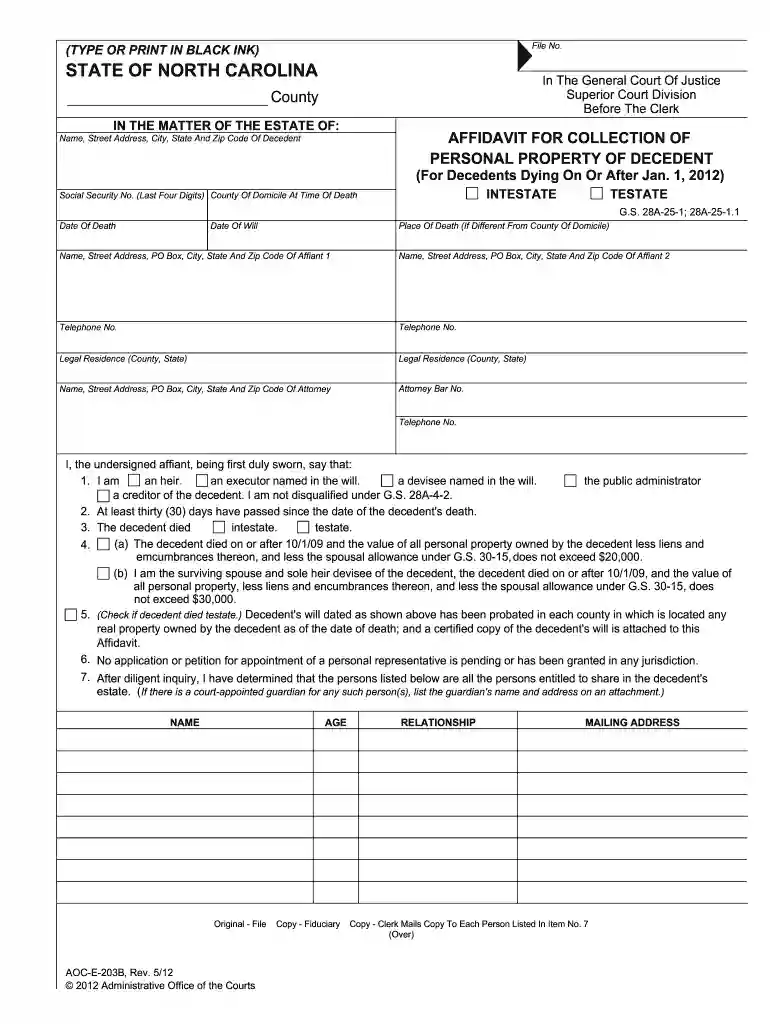
  2. Begin by filling in the 'File No.' and 'County' at the top of the form. Ensure you type or print in black ink for clarity.
  3. In the section labeled 'IN THE MATTER OF THE ESTATE OF', provide the decedent's full name, address, and social security number (last four digits).
  4. Indicate whether the decedent died intestate or testate by checking the appropriate box. Fill in relevant dates such as date of death and date of will if applicable.
  5. Complete the affiant's information, including names, addresses, and telephone numbers for both affiants listed on the form.
  6. In Section 7, list all individuals entitled to share in the estate along with their ages and relationships to the decedent.
  7. Proceed to fill out the Preliminary Inventory section by providing estimated market values for each category of property owned by the decedent.
  8. Finally, ensure all signatures are completed where indicated, including those of any authorized persons administering oaths.

Start using our platform today to easily complete your aoc e 203b form online for free!

be ready to get more

Complete this form in 5 minutes or less

Get form

Got questions?

We have answers to the most popular questions from our customers. If you can't find an answer to your question, please contact us.
Contact us
If the decedent has none of these relatives, assets generally are distributed to family members in the following order of priority: 1) parents; 2) siblings and the children, grandchildren, etc., of deceased siblings; 3) grandparents; 4) aunts and uncles and, if deceased, their descendants.
If you are single your Next of Kin would be any direct offspring you have. If you do not have any children, your Next of Kin would be determined by your states succession laws. Typically that would include parents, siblings, and nieces, or nephews.
Theyll need to provide an affidavit, which is a notarized legal document that establishes their relationship. Once this is complete, the next of kin will receive a letter of testamentary from the probate court. This gives them the executive powers to act on the estates behalf.
A persons next of kin is their closest living blood relative , including spouses and adopted family members. The designation as next of kin is important in the context of intestate succession , as a decedent s next of kin is prioritized in receiving inheritance from the decedents estate .
Proving who is next of kin also requires proof of identity, such as a birth certificate or government-issued photo ID. You may also need an affidavit from someone who can swear to the blood relationship with the decedent.

Security and compliance

At DocHub, your data security is our priority. We follow HIPAA, SOC2, GDPR, and other standards, so you can work on your documents with confidence.

Learn more
be ready to get more

Complete this form in 5 minutes or less

Get form

People also ask

Proving next of kin Theyll need to provide an affidavit, which is a notarized legal document that establishes their relationship. Once this is complete, the next of kin will receive a letter of testamentary from the probate court. This gives them the executive powers to act on the estates behalf.
The form is fairly straightforward and requires the following information: Name, address, and date of death of the decedent. Whether the deceased person was ever married. Names of the surviving heirs. Statement that the deceased did not leave a will. Statement that you are an heir under your state intestacy law.
What is The Affidavit for Collection of Personal Property? ing to the North Carolina statute 28A-25-1, a heir can settle a deceased persons estate without going through probate by applying for the Affidavit for Collection of Personal Property of the Decedent (form AOC-E-203B).

Related links