
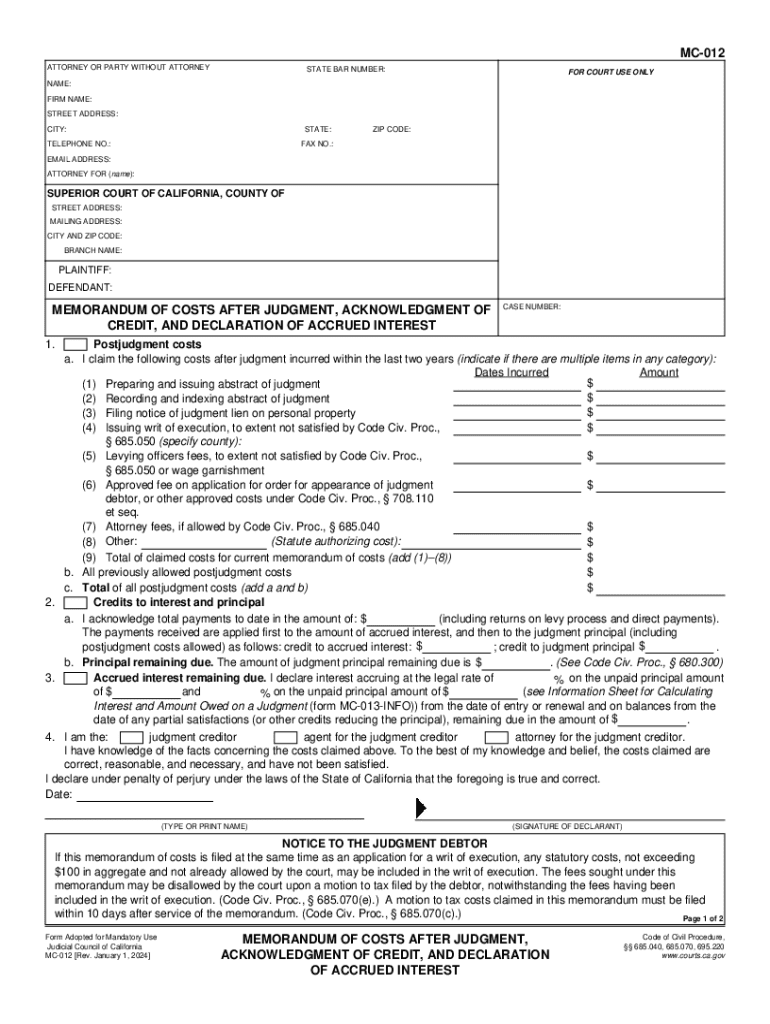







Definition and Purpose
The MC-012, known as the "Memorandum of Costs After Judgment, Acknowledgement of Credit, and Declaration of Accrued Interest," is a legal documentation utilized in the Superior Court of California. It is instrumental for judgment creditors to outline postjudgment costs that have accrued, identify any payments made towards the judgment, and declare the interest accumulated on any unpaid amounts.
The form serves multiple purposes, primarily helping creditors record additional expenses incurred after the judgment, such as fees associated with enforcement measures. It also ensures transparency by documenting payments acknowledged by the debtor and calculating the interest accrued on the principal amount still owed. This transparent ledger of postjudgment financial activity ensures that creditors can justifiably claim costs and interest.
Steps to Complete the MC-012 Memorandum
-
Filling Out the Cover Page:
- Start by providing the case information, including case number and court location.
- Input your personal or company information and indicate if an attorney is filing on your behalf.
-
Detailing Postjudgment Costs:
- List each cost directly related to enforcement after the judgment, supported by receipts or invoices.
- Include costs such as wage garnishments, bank levy fees, or sheriff's office fees.
-
Acknowledging Credits:
- Accurately list payments received from the judgment debtor to date.
- Subtract these credits from the outstanding judgment amount to reflect the current balance.
-
Declaring Accrued Interest:
- Calculate interest accrued from the date of judgment to the present, following the interest rate established in the original judgment.
- Document the calculations clearly to ensure accuracy and accountability.
-
Proof of Service:
- Serve a copy to the judgment debtor and document your method of service (e.g., personal, mail).
- Fill out the proof of service section, including the server's information.
This form requires meticulous entry to avoid legal complications and ensure fair claims for costs and interest.
Who Typically Uses the MC-012
Judgment creditors are the primary users of the MC-012. This includes individuals, businesses, or entities that have obtained a favorable judgment and are seeking enforcement. The form is often filed by attorneys representing creditors or by creditors themselves.
Given its role in recording costs and accrued interest, this form is crucial for anyone wanting to ensure a seamless collection process postjudgment. It is often utilized by businesses involved in commercial litigation, financial institutions recovering debts, or individuals seeking compensation following legal proceedings.


Legal Use and Compliance
The legal use of the MC-012 is tightly regulated, and accuracy is paramount. Proper completion and filing of this form are governed by the California Code of Civil Procedure, which outlines the specific costs that are recoverable and the procedures for accounting interest.
Non-compliance, such as failing to accurately report postjudgment costs or not serving the debtor properly, can result in penalties or denial of cost recovery. Therefore, staying within legal guidelines and double-checking calculations and entries is critical for the document's acceptance by the court.
Key Elements of the Form
- Cost Documentation: Specifies incurred postjudgment expenses with supporting documentation.
- Credit Acknowledgement: Lists all payments made by the debtor, ensuring transparency.
- Interest Declaration: Fully details the interest computed on the remaining balance.
- Proof of Service: Details on serving a copy of the form to the debtor, validating proper notification.
These key elements all work together to create a comprehensive record of postjudgment activities, ensuring creditors are justly paid for costs and interests.
State-Specific Rules
While the MC-012 is standard across California, specific superior courts may have variations in procedural requirements. For example, differences can occur regarding how creditors must calculate interest or specific local court rules about form submission.
It is advisable for creditors to consult local court websites or seek legal advice to ensure compliance. Understanding these state-specific rule nuances can prevent unnecessary delays or court rejections.
Filing Deadlines and Important Dates
Filing the MC-012 promptly is crucial. Typically, creditors have within two years from the judgment date to file for postjudgment costs and accrued interests. Missing these deadlines can result in the waiving of rights to claim these costs in particular circumstances.
Keeping track of relevant filing deadlines, both for the initial submission and any necessary amendments, is an important practice for maintaining the claim's validity.
Comparison of Digital and Paper Versions
DocHub offers innovative solutions for managing forms like MC-012 digitally. With its comprehensive suite of editing and signing tools, completing and filing the form electronically becomes efficient. It cuts down on time compared to paper methods while maintaining compliance with legal standards.
Utilizing the digital version facilitates quick documentation and immediate sharing with relevant parties. However, some legal scenarios may still necessitate paper submissions or specific formats, depending on court requirements or litigant preference. Therefore, understanding when to alternate between these versions is key for strategic document management.




