




01. Edit your form online
Type text, add images, blackout confidential details, add comments, highlights and more.

Type text, add images, blackout confidential details, add comments, highlights and more.

Draw your signature, type it, upload its image, or use your mobile device as a signature pad.

Send it via email, link, or fax. You can also download it, export it or print it out.
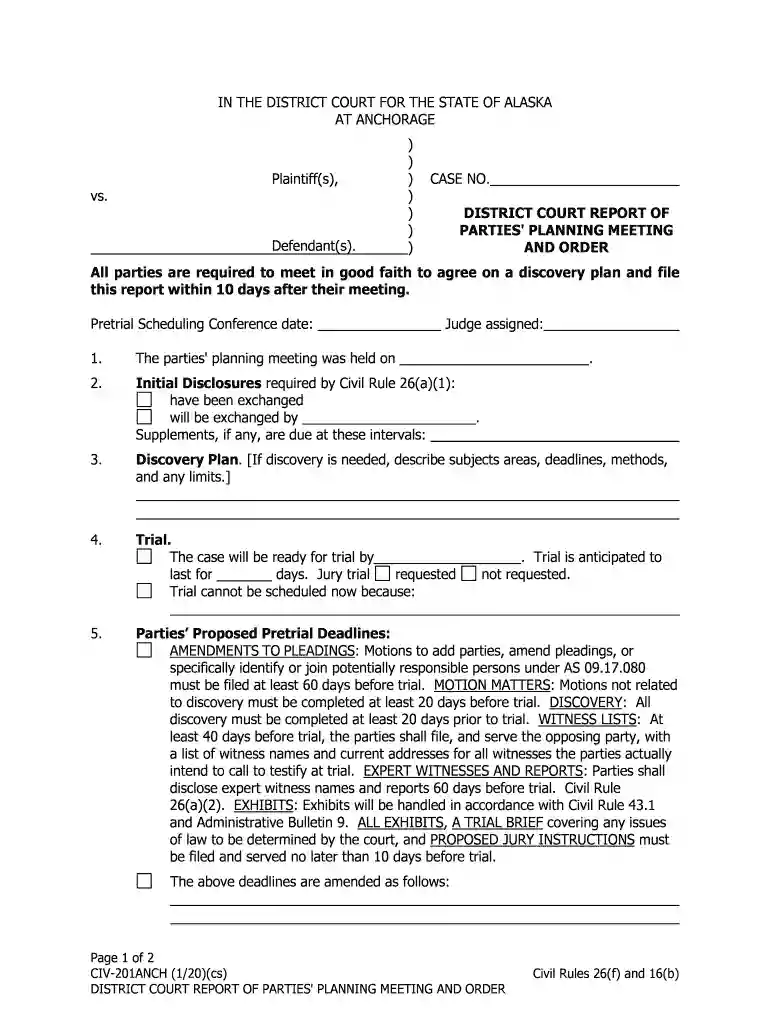
The CIV-201 ANCH District Court Report of Parties, specific to the State of Alaska, is a critical document utilized in civil cases to facilitate planning meetings mandated by the state's judicial system. This form serves to outline the requirements for parties involved in a civil case to convene and concur on a comprehensive discovery plan. Key elements typically covered include establishing deadlines for initial disclosures, completing discovery, and submitting witness and expert reports. Further, the document delves into trial readiness, the likelihood of settlement discussions, and scheduling pretrial conferences. The objective is to streamline court proceedings by ensuring clarity and agreement on how the case will progress.
Gather Required Information: Collect all necessary details regarding case timelines, involved witness lists, and identified expert testimonies.
Schedule a Planning Meeting: Coordinate with all parties to ensure they are available to discuss and fill out the sections pertaining to discovery plans and deadlines.
Complete Each Section: Address each component of the form, from setting disclosure deadlines to discussion of settlement possibilities.
Consult with Legal Counsel: Seek assistance from a lawyer to ensure all legal requirements are met.
Submit to the Court: Once completed and reviewed, submit the form to the court to obtain approval for the outlined plans.
Filing the CIV-201 ANCH is crucial as it establishes transparency and structured communication between parties involved in a civil suit. By aligning on deadlines and discussing strategic elements such as witness preparation and expert submissions, this report helps avoid misunderstandings and ensures the smooth operation of legal processes. Failure to submit this form correctly can impede the progression of a case, delaying justice and increasing litigation expenses.
The legal framework underpinning the CIV-201 ANCH demands adherence to state compliance laws in Alaska. This form acts as a contract wherein each party agrees to the terms set forth for managing the case schedule, strategic planning, and potential resolution steps. The court’s approval of this report reflects consent across all parties involved, solidifying an enforceable agreement.
This form is predominantly used by attorneys representing clients in civil cases within Alaska. It also involves direct input from the parties engaged in litigation, including defendants and plaintiffs. Judges and court clerks utilize the form to monitor compliance with agreed-upon timelines and strategies during the litigation process.


Consider a scenario involving a contractual dispute: Both businesses involved would complete the CIV-201 ANCH to agree on deadlines for exchanging evidence, listing potential expert witnesses who might testify about industry standards, and scheduling a pretrial conference. Alternatively, in a personal injury case, the parties might utilize the form to set deadlines for obtaining expert medical opinions and exploring settlements before moving to trial.
Depending on the jurisdiction and the court’s preferences, submission methods may include:
Unique to Alaska’s legal landscape are specific mandates dictating the preparation and submission timelines of the CIV-201 ANCH. These rules are designed to align with the state’s broader civil procedure regulatory framework, ensuring due process and efficiency. Alaskan statutes may call for additional information or modifications based on the type of civil case involved, which attorneys must be apprised of to properly comply.
The distinction between using digital versus paper versions of the CIV-201 ANCH involves both logistical and environmental considerations. Digital forms facilitate ease of access and amendment before submission, significantly speeding up communication between parties and the court. However, traditional paper versions may be necessary in instances requiring original signatures or in jurisdictions lacking comprehensive digital infrastructure.
We've got more versions of the CIV-201 ANCH District Court Report of Parties - State of Alaska form. Select the right CIV-201 ANCH District Court Report of Parties - State of Alaska version from the list and start editing it straight away!
At DocHub, your data security is our priority. We follow HIPAA, SOC2, GDPR, and other standards, so you can work on your documents with confidence.


