01. Edit your form online
Type text, add images, blackout confidential details, add comments, highlights and more.

Type text, add images, blackout confidential details, add comments, highlights and more.

Draw your signature, type it, upload its image, or use your mobile device as a signature pad.

Send it via email, link, or fax. You can also download it, export it or print it out.
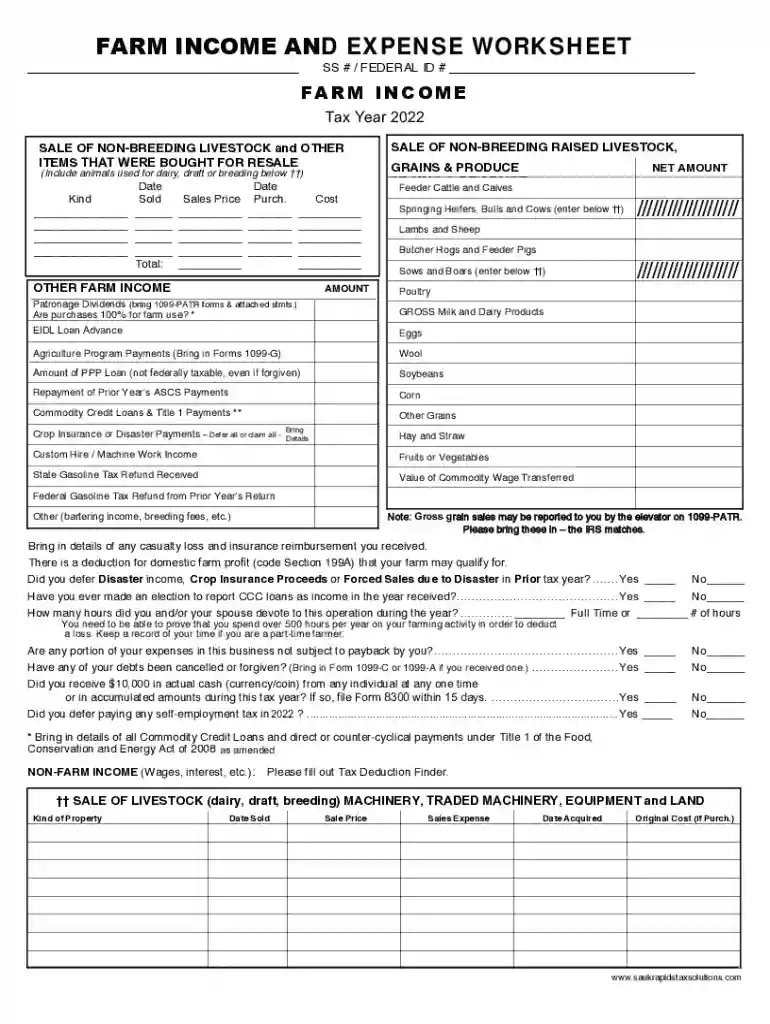
The 2023 Farm Income and Expense Worksheet is a detailed tool that assists farmers in managing their finances. Key components of this worksheet include:
Income Recording: Accounts for revenue from livestock sales, crop sales, government payments, and other farm-related income.
Expense Tracking: Details costs such as feed, chemicals, fuel, utilities, and veterinary expenses.
Deductions: Highlights tax-deductible expenses to aid in minimizing taxable income.
Year-End Summary: Provides a comprehensive look at net farm income, crucial for tax preparation.
Each element serves to give a holistic view of a farming operation's financial health, aiding in both short-term and strategic long-term planning.
A methodical approach to filling out the worksheet maximizes its utility:
By following these steps, users can maintain precise records and benefit from informed financial decision-making.
The worksheet primarily serves:
Farm Owners and Operators: For tracking financial performance and preparing tax documents.
Accountants and Tax Preparers: As a resource for creating accurate financial summaries for their clients.
Agricultural Consultants: To offer informed guidance on fiscal health and operational improvements.
These users rely on the worksheet for its comprehensive view of a farm’s financial status, aiding in both daily management and strategic planning.


Adhering to IRS guidelines is crucial for the lawful use of the worksheet:
Record Accuracy: Ensure all earnings and expenses are exact and match supporting documents.
Documentation: Maintain receipts and records for all entries, as the IRS may require verification.
Timeliness: Stay aware of annual changes in IRS regulations concerning deductions and reporting.
Compliance ensures legitimacy and reduces the risk of audits or penalties.
For optimal use of the worksheet in tax preparation, be mindful of these dates:
April 15: Generally the deadline for individual income tax returns and payments.
January 31: Due date for sending estimated tax payments related to farm income.
Mid-December: Ideal for completing year-end financial reviews to identify any pending issues.
Meeting these timelines helps prevent late fees and ensures smooth tax filing.
Various submission options cater to user preferences:
Online Filing: Through platforms like DocHub, providing easy integration and quick processing.
Mail Submission: Offers a traditional option, often for those less comfortable with digital tools.
In-Person Submission: Though less common, some prefer direct delivery to tax preparers for personalized service.
Choosing the right method can enhance ease and efficiency in fulfilling tax obligations.
Failing to complete or submit the worksheet correctly can result in penalties:
Monetary Fines: For underreporting income or overestimating deductions.
Audit Risks: Increased scrutiny from the IRS, potentially leading to additional assessments.
Legal Repercussions: In severe cases, non-compliance may lead to prosecution.
These risks underscore the importance of careful completion and adherence to IRS regulations.
Integrating the worksheet with software can streamline financial management:
TurboTax: Supports importing data for seamless tax filing.
QuickBooks: Facilitates ongoing financial tracking with periodic synchronizations.
Farm-Specific Software: Tools designed for agriculture may offer additional contextual insights.
Selecting compatible software amplifies the worksheet's utility by connecting it to broader financial systems and analytics.
We've got more versions of the 2023 FARM INCOME and EXPENSE WORKSHEET form. Select the right 2023 FARM INCOME and EXPENSE WORKSHEET version from the list and start editing it straight away!
At DocHub, your data security is our priority. We follow HIPAA, SOC2, GDPR, and other standards, so you can work on your documents with confidence.