






Definition and Meaning
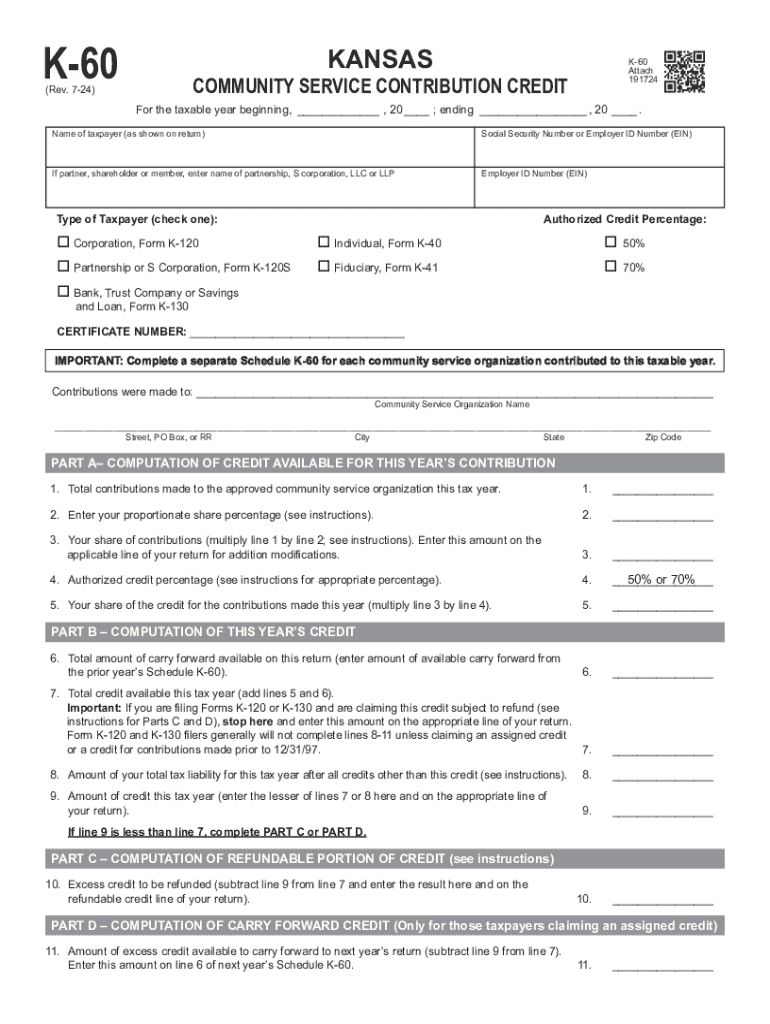
The Schedule K-60 form relates to the Kansas Community Service Contribution Credit. It is designed to facilitate tax credits for individuals and businesses who contribute to approved community service organizations in Kansas. The form is governed by K.S.A. 79-32,195 et seq., which outlines the guidelines and regulations for qualifying contributions. The primary objective of the form is to provide incentives by granting a state tax credit for donations that benefit community service efforts. This encourages more participation in philanthropic activities by effectively reducing the tax liability of contributors.
How to Use the K-60 Kansas Community Service Contribution Credit
Using the Schedule K-60 form involves the calculation of potential tax credits based on the amount contributed to eligible organizations. Contributors should ensure that donations meet the criteria set by Kansas legislation. The form assists taxpayers in documenting their contributions, computing the appropriate credit percentage—either 50% or 70%, depending on the organization—and applying this to their state tax returns. Documentation from the receiving organizations should be retained as proof of contributions to facilitate the form's completion and verification.
Steps to Complete the K-60 Kansas Community Service Contribution Credit
-
Identify Eligible Contributions:
- Ensure that your contributions were made to organizations approved by the Kansas Department of Commerce.
- Check the list of qualifying organizations to confirm eligibility.
-
Calculate Credit Amount:
- Determine whether the contribution qualifies for a 50% or 70% credit.
- Use the guidelines provided in the form to compute the total credit based on your contribution total.
-
Gather Necessary Documentation:
- Obtain acknowledgment receipts from the organizations receiving your contributions.
- Ensure these documents outline the amount and date of each contribution.
-
Fill Out the Schedule K-60 Form:
- Enter the required information accurately, including personal data and details of the contributions.
- Complete separate forms for each organization contributed to.
-
Submit with Kansas Tax Return:
- File the Schedule K-60 form alongside your state tax return.
- Keep copies of all submitted materials for your records.
Required Documents
To accurately complete the Schedule K-60 form, specific documents are required. These include:
- Contribution Receipts: Documentation from the receiving organization validating the donation amount and date.
- Approval Verification: Proof that the receiving organization is on the list approved by the Kansas Department of Commerce.
- Previous Tax Filings: Copies of prior year tax returns if credit carry forwards are being claimed.
Maintaining these documents ensures a smooth filing process and support in case of any audits or queries from tax authorities.
Eligibility Criteria
Eligibility for the Community Service Contribution Credit is strictly defined:
- Eligible Organizations: Contributions must be made to organizations approved under Kansas law.
- Minimum Contribution: Check if there is a minimum contribution limit to qualify for the credit.
- Type of Contribution: Only monetary contributions are typically eligible unless specified otherwise.
- Contribution Timing: The timing of donations matters, as contributions must be made within the relevant tax year.


Form Submission Methods
The Schedule K-60 form can be submitted along with your state tax return through a variety of channels:
- Online Submission: Many taxpayers prefer to file electronically for quicker processing.
- Mail Submission: Paper forms can be mailed directly to the Kansas Department of Revenue.
- In-Person Delivery: Although less common, some may choose to deliver documents directly to a tax office.
Ensuring your chosen submission method aligns with Kansas requirements will aid in the timely processing of your tax credit.
Penalties for Non-Compliance
Failure to comply with the regulations surrounding the K-60 form can lead to penalties:
- Denial of Tax Credit: Incomplete or misrepresented information can result in credit denial.
- Fines or Additional Reporting: Erroneous submissions may invoke fines and necessitate further documentation.
- Audit Risks: Inaccuracies could increase the likelihood of a tax audit and further investigation by tax authorities.
Adhering to form guidelines and ensuring all data is accurate helps avoid these potential downsides.
Examples of Using the K-60 Kansas Community Service Contribution Credit
Taxpayers can benefit from real-world examples of how the Schedule K-60 form operates:
- Small Business Contribution: A small business donates $5,000 to an approved local food bank. They qualify for a 50% tax credit and can claim $2,500 against their state taxes.
- Individual Donor Scenario: A state resident makes a $10,000 payment to a community healthcare provider that qualifies for a 70% credit. This results in a $7,000 credit on their state tax return.
- Corporate Philanthropy: A corporation's $20,000 charitable contribution yields a substantial tax credit, encouraging ongoing philanthropic efforts.
Key Elements of the K-60 Kansas Community Service Contribution Credit
Understanding the key components of the Schedule K-60 form is crucial for effective use:
- Credit Calculation: Determining the percentage based on organization type and contribution.
- Documentation: Maintaining adequate records to justify the credit amounts claimed.
- Filing Deadlines: Adhering to submission timelines correlates with regular tax return filings.
These elements ensure that the tax credit benefits are fully maximized while maintaining compliance with Kansas tax laws.