






Definition and Meaning
Session VUsing and Reporting Evaluation Results - Bad Request relates to handling instances where data evaluation and reporting sessions encounter issues, specifically "Bad Request" errors. This scenario can occur when a request to access or generate data evaluation results is formatted incorrectly or does not meet protocol requirements. Understanding how to address these errors is essential for maintaining the integrity and continuity of data sessions, particularly in environments dependent on seamless data flows.
Importance of Addressing Bad Request Errors
- Data Integrity: Ensuring accuracy and completeness in evaluation results by preventing miscommunication between systems.
- Workflow Continuity: Avoiding unnecessary delays or disruptions in data reporting processes.
- Technical Understanding: Enhancing one's knowledge of system protocols and data validation requirements.
Key Elements of the Session VUsing and Reporting Evaluation Results - Bad Request
The form involves critical components that users must adhere to ensure effective data evaluation and reporting sessions. Recognizing these elements helps in both identifying the root cause of errors and implementing solutions.
Protocol Compliance
- Correct Formatting: Ensures requests are properly structured according to predefined standards.
- Data Authenticity: Verification of data source integrity and reliability.
- Access Permissions: Ensuring users have valid credentials and appropriate permissions for data access and manipulation.
Steps to Complete the Session VUsing and Reporting Evaluation Results - Bad Request
Effectively managing a "Bad Request" scenario involves a series of systematic steps designed to diagnose and rectify issues.
- Identify Error Source: Examine logs to pinpoint where the request failed.
- Review Request Structure: Ensure compliance with required request formats and parameters.
- Validate Authentication: Confirm valid user credentials and correct token or key usage.
- Resubmit Request: Once corrections are made, reattempt the data request.
Practical Tips
- Use Testing Tools: Leverage tools to simulate request environments and identify potential issues.
- Refer to Documentation: Check detailed API or system documentation for guidelines and troubleshooting advice.
Common Causes of "Bad Request" Errors
Understanding the common causes of "Bad Request" errors can help in preemptively addressing issues and enhancing error resolution.
Errors in Data Entry
- Typos or Misspellings: Can lead to mismatched parameters and failed requests.
- Incomplete Fields: Omitting required data can disrupt processing.
Misconfigured Parameters
- Incorrect Identifiers: Usage of wrong IDs, names, or tags can mislead the system.
- Unsupported Formats: Sending data in an incompatible file format can result in rejection.
How to Use the Session VUsing and Reporting Evaluation Results
Appropriately utilizing the form involves not just resolving errors but also optimizing the overall evaluation process for maximum efficiency and accuracy.
Data Analysis
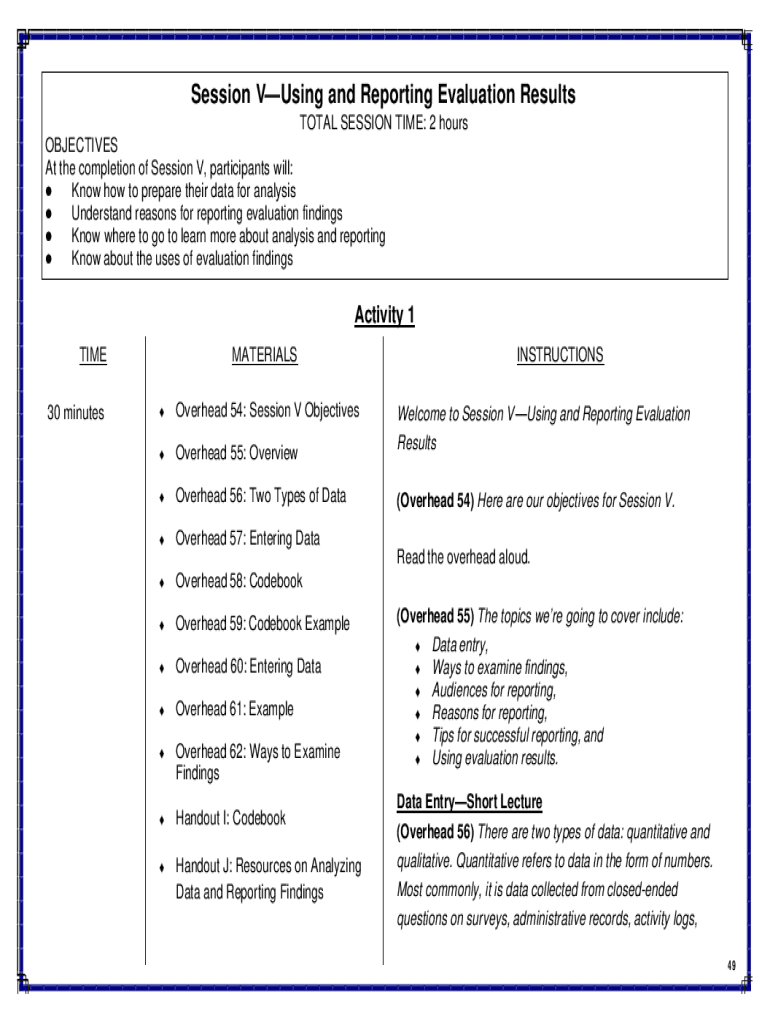
- Utilize Codebooks: Ensure consistent data interpretation.
- Examine Findings: Employ statistical tools to assess quantitative data.
Engaging Stakeholders
- Tailored Reporting: Customize reports according to audience needs and insights.
- Feedback Incorporation: Gather stakeholder feedback for continuous improvement.
Who Typically Uses the Session VUsing and Reporting Evaluation Results - Bad Request
This process is primarily relevant to professionals working in data analytics, project management, and IT systems management. Such roles often involve interfacing with data management systems where the need to generate and report evaluation results is frequent.


Specialized Roles
- Data Analysts: Require precise, error-free data for analysis and decision-making.
- IT Administrators: Handle system configurations and maintenance, including troubleshooting request errors.
- Project Managers: Oversee data operations, ensuring timely and accurate reporting of findings.
Examples of Using the Session VUsing and Reporting Evaluation Results - Bad Request
Real-world scenarios can illustrate the complexities involved and the approaches employed to handle these challenges.
Case Study: Financial Reporting Platform
- Challenge: A financial firm faced repeated "Bad Request" errors during quarterly reporting submissions.
- Resolution: Conducted a thorough system audit to update outdated request parameters and aligned data formatting with current standards.
Education Sector Insight
- Scenario: A university's analytics team struggled with generating annual evaluation reports due to frequent misconfigured requests.
- Solution: Implemented an automated validation tool that pre-checks requests before submission, significantly reducing error rates.
Software Compatibility and Integration
Understanding the technological compatibility of systems that support these forms can smooth the process of addressing "Bad Request" errors.
Compatible Platforms
- DocHub Integration: Seamlessly work within existing document workflows for amending requests and re-evaluating data.
- Google Workspace: Leverage its integration for direct access and amendment capabilities with immediate cloud benefits.
Version Control and Updates
- Continuous Software Updates: Keep system software up-to-date to benefit from the latest compatibility improvements and error handling features.
- Version History: Use version control tools to track changes and understand how different versions handle requests.
Legal Use of the Session VUsing and Reporting Evaluation Results
Ensuring compliance with legal standards while managing evaluation results is critical. Mismanaged requests or results could have legal implications, especially concerning data privacy and reporting accuracy.
Compliance Measures
- Data Protection Laws: Adhere to regulations like GDPR where applicable, ensuring data privacy and security.
- Auditable Trails: Maintain records of all requests and resolutions for future reference and accountability.
Important Terms Related to Session VUsing and Reporting Evaluation Results
Understanding key terms is essential for navigating "Session VUsing and Reporting Evaluation Results - Bad Request" scenarios successfully.
Essential Vocabulary
- API: Application Programming Interface, which facilitates data requests within systems.
- OAuth 2.0: A protocol for secure authorization across interconnected systems.
- Codebook: A guide that outlines variable codes for data entry and analysis.