




01. Edit your form online
Type text, add images, blackout confidential details, add comments, highlights and more.

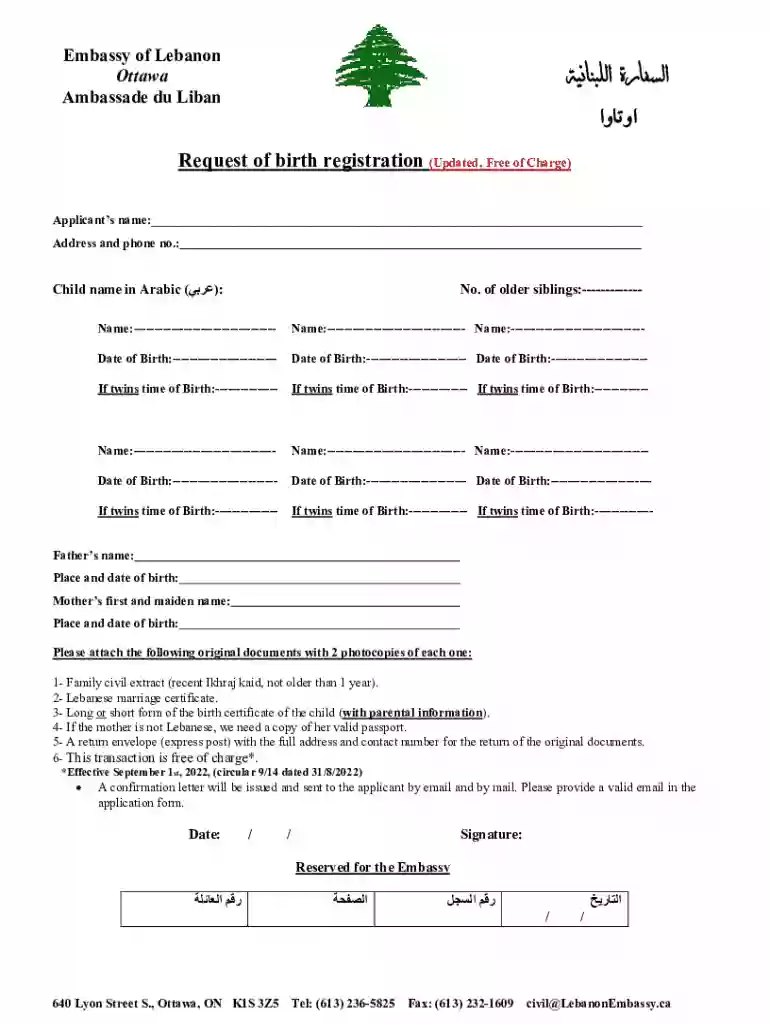
Type text, add images, blackout confidential details, add comments, highlights and more.

Draw your signature, type it, upload its image, or use your mobile device as a signature pad.

Send it via email, link, or fax. You can also download it, export it or print it out.
The request of birth registration is a formal process whereby parents officially record the birth of their child with a government authority. This document ensures that the child's birth is legally recognized, providing a basis for the issuance of a birth certificate and access to rights and services. Birth registration is a critical step that establishes a child's legal identity, essential for various civic activities, such as enrolling in school or obtaining a passport.
Recognition of a birth provides legal documentation needed for accessing benefits like healthcare, education, and social services. Therefore, understanding what a birth registration request entails is crucial for parents and legal guardians.
Using the birth registration form involves filling out necessary information accurately and submitting it to the relevant authority. This form can typically be obtained from hospitals at the time of birth, municipal offices, or online through government portals.
Collect Necessary Information: Gather personal details about the child and parents, ensure accuracy to avoid future discrepancies.
Complete the Form: Use clear and legible writing or type your information electronically if submitting online. Double-check for errors.
Submit Required Documentation: Include supporting documents like proof of birth, identity verification for parents, and any additional legal documents as instructed.
Submission: Decide whether to submit the form online, in person, or via mail. Online submissions might be faster, but some places might still require a physical copy.
An example would be using the form right after the birth of your child at a hospital. Many hospitals help parents complete and file the initial birth registration form directly, streamlining the process.
Completing the birth registration form involves several definitive steps to ensure the submission is accurate and timely. This process typically requires the collaboration of both parents and, at times, healthcare professionals.
Initial Registration: Begin within a few days after birth; most states have a deadline, such as thirty days.
Verification: Confirm all details provided on the form, such as names of parents and the child's date of birth, are correct.
Documentation: Include any necessary supplementary documents, such as marriage certificates or legal adoption papers, if relevant.
Signatures: Every form requires signatures from both parents or legal guardians, confirming consent and accuracy of the provided information.
Submission to Authorities: Deliver the form to the designated local authority, whether online or paper-based, as instructed on the registration guidelines.
To complete a birth registration, various documents are required to verify the identities of the child and parents, as well as other relevant information. These documents must be current and legally recognized.
For children born outside the hospital, a sworn statement from the parents or a healthcare provider might be needed to confirm details of the birth and ensure accuracy in the registration process.
Maintaining a birth registration is not only a legal requirement but also confers numerous benefits. It is essential for establishing a child's legal identity and is a foundational document affecting many future legal and social interactions.
Failure to register a birth can lead to a child facing legal hurdles later in life, such as proving identity or age, which can restrict opportunities and access to rights.
While the process of birth registration is generally similar across the U.S., specific states may have additional rules or requirements. Understanding these variations is important to ensure accuracy and compliance.
The form is available in both digital and physical formats, each with advantages depending on the convenience, ease of access, and the parent's preference.
Consider factors such as processing times, comfort with technology, and local regulations when choosing the format for submission. Many find the digital version more convenient, but the paper option remains a valid and sometimes more universally accepted format.
The request of birth registration has varied applications and its importance transcends mere legal formality. It is instrumental in diverse scenarios where legal identification or age verification is required.
Consider a scenario where a parent is registering a newborn. Following registration, they can obtain a birth certificate, apply for a SSN, and set the foundation for various legal protections and benefits available to the child.
We've got more versions of the Request of Birth Registration form. Select the right Request of Birth Registration version from the list and start editing it straight away!
| Versions | Form popularity | Fillable & printable |
|---|---|---|
| 2025 | 4 Satisfied (34 Votes) | |
| 2025 | 4.8 Satisfied (31 Votes) | |
| 2025 | 4.3 Satisfied (34 Votes) | |
| 2025 | 4.2 Satisfied (34 Votes) | |
| 2025 | 4.6 Satisfied (55 Votes) | |
| 2025 | 4.5 Satisfied (44 Votes) | |
| 2025 | 4.2 Satisfied (37 Votes) | |
| 2025 | 4.7 Satisfied (34 Votes) | |
| 2024 | 4.3 Satisfied (21 Votes) | |
| 2024 | 4.6 Satisfied (51 Votes) | |
| 2024 | 4.5 Satisfied (23 Votes) | |
| 2024 | 4.8 Satisfied (29 Votes) | |
| 2024 | 4.1 Satisfied (28 Votes) | |
| 2024 | 4.9 Satisfied (51 Votes) | |
| 2024 | 4.4 Satisfied (31 Votes) |
At DocHub, your data security is our priority. We follow HIPAA, SOC2, GDPR, and other standards, so you can work on your documents with confidence.


