Definition & Meaning
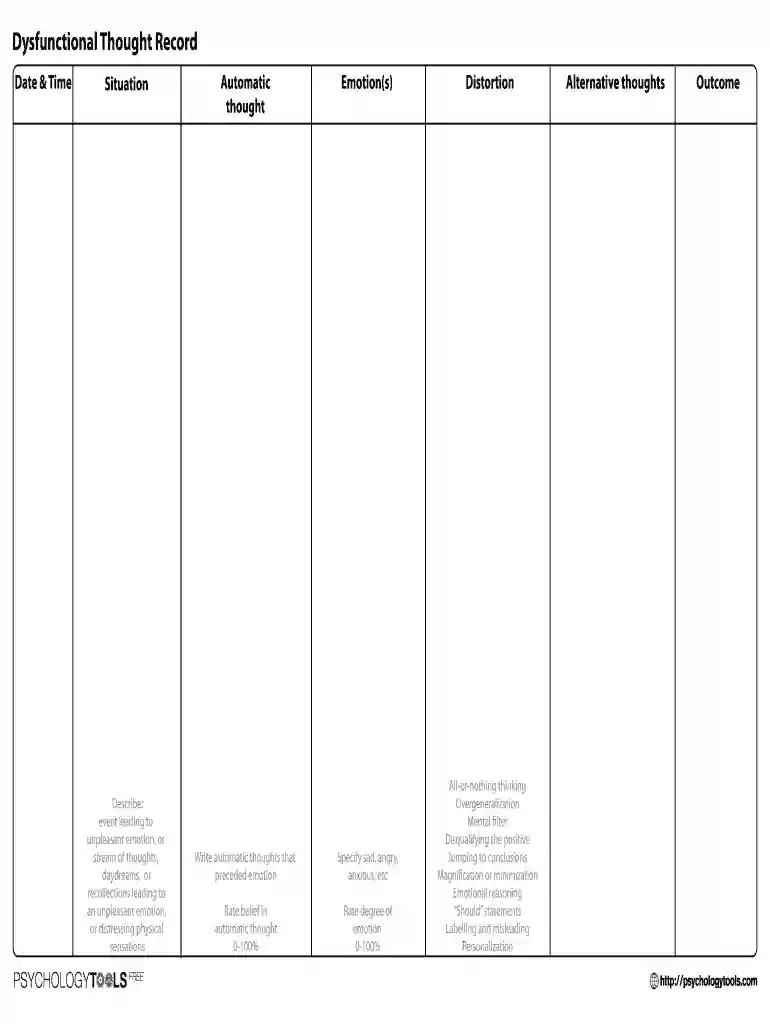
The term "Dysfunctional Thought Record" refers to a tool commonly used in cognitive-behavioral therapy (CBT) to help individuals analyze and understand the automatic thoughts that lead to negative emotions. This record-keeping form allows individuals to document situations that provoke distressing emotions and to explore the underlying thought processes. By systematically identifying these automatic thoughts, cognitive distortions can be recognized and challenged, paving the way for healthier, alternative thinking patterns that improve emotional well-being.
Key Elements of the Dysfunctional Thought Record
A Dysfunctional Thought Record comprises several essential components that facilitate thorough examination of thought patterns:
- Situation Description: Clearly outlines the event or circumstances leading to the distressing emotion.
- Automatic Thoughts: Lists the immediate, often unchallenged thoughts that come to mind in the situation.
- Beliefs and Emotions Ratings: Quantifies the intensity of the belief in these thoughts and the associated emotional response on a scale from one to nine.
- Cognitive Distortions Identification: Recognizes common cognitive errors such as all-or-nothing thinking, overgeneralization, or catastrophizing.
- Alternative Thoughts Generation: Constructs a more balanced or rational viewpoint to counteract the original automatic thoughts.
How to Use the Dysfunctional Thought Record
Using a Dysfunctional Thought Record involves a reflective process that includes several steps:
- Identify the Triggering Situation: Focus on recent events that caused emotional distress.
- Capture Automatic Thoughts: Write down spontaneous thoughts without filtering.
- Evaluate the Emotions and Beliefs: Assign numerical values to how strongly you feel and believe in your automatic thoughts.
- Spot Cognitive Distortions: Determine any distortions present in your thinking.
- Formulate Alternative Thoughts: Develop balanced thoughts and re-rate the emotional and belief intensity.
This structured approach aids individuals in shifting their mindset, reducing negative emotions, and fostering resilience.
Steps to Complete the Dysfunctional Thought Record
Completing a Dysfunctional Thought Record effectively requires methodical attention:
- Record the Date and Time: Contextualize your entry to promote accurateness in tracking patterns.
- Detail the Situation: Objectively recount the event or conversation that elicited emotional turmoil.
- List Automatic Thoughts: Capture all thoughts that arise without censorship.
- Assign Ratings: Use a one-to-nine scale to rate the intensity of your beliefs and emotions.
- Identify Distortions: Cross-reference with common cognitive distortions to uncover biases.
- Develop Alternatives: Thoughtfully create responses that challenge and neutralize initial distortions.
- Re-evaluate Emotions and Beliefs: Reassess and re-rate using the new perspective.
By following these structured steps, individuals can methodically dissect and transform their reactions to stressors.
Examples of Using the Dysfunctional Thought Record
Consider real-world scenarios where a Dysfunctional Thought Record proves beneficial:
- Work-related Anxiety: An employee worried about a presentation might recognize automatic thoughts like "I'll fail," identify it as catastrophizing, and generate an alternative thought: "I've prepared well and can handle questions."
- Social Situations: Someone uncomfortable in groups might document automatic thoughts like "Everyone is judging me," spot the mind-reading distortion, and replace it with "I can't presume others' thoughts and it's likely they're focused on themselves."
Such examples showcase how restructured thoughts provide a more balanced outlook.
Important Terms Related to the Dysfunctional Thought Record
To fully utilize the Dysfunctional Thought Record, understanding related terms is crucial:
- Cognitive Distortions: Types of biased thinking patterns, like overgeneralization or personalization, which skew perception.
- Automatic Thoughts: Immediate, involuntary thoughts that arise from stimulus.
- Alternative Thoughts: Rational, constructive thoughts developed as counterweights to cognitive distortions.
- Emotional Rating Scale: A measurement tool for gauging intensity of beliefs and emotions.
Familiarity with these terms enhances the effective application of the record.
Versions or Alternatives to the Dysfunctional Thought Record
While the traditional Dysfunctional Thought Record is extensively used, various adaptations exist:
- Simplified Versions for Children: Tailored forms that use simple language and scaling suited for younger users.
- Digital Formats: Mobile and software apps that provide interactive records and automated analysis.
- Custom Record Forms: Personalized versions that reflect individual triggers or goals, adjusted by therapists for client needs.
Exploring these variants allows for flexibility in addressing diverse user needs and contexts.
Digital vs. Paper Version
The format choice for a Dysfunctional Thought Record can impact its usability:
- Digital Versions: Offer ease of access, automatic saving, and convenient sharing between therapists and users, often integrated with therapy platforms.
- Paper Versions: Provide tactile engagement and manual reinforcement, beneficial for some in processing thoughts more slowly and deliberately.
Each format has distinct advantages, and one's personal preference or circumstance often dictates which is most effective.