01. Edit your form online
Type text, add images, blackout confidential details, add comments, highlights and more.

Type text, add images, blackout confidential details, add comments, highlights and more.

Draw your signature, type it, upload its image, or use your mobile device as a signature pad.

Send it via email, link, or fax. You can also download it, export it or print it out.
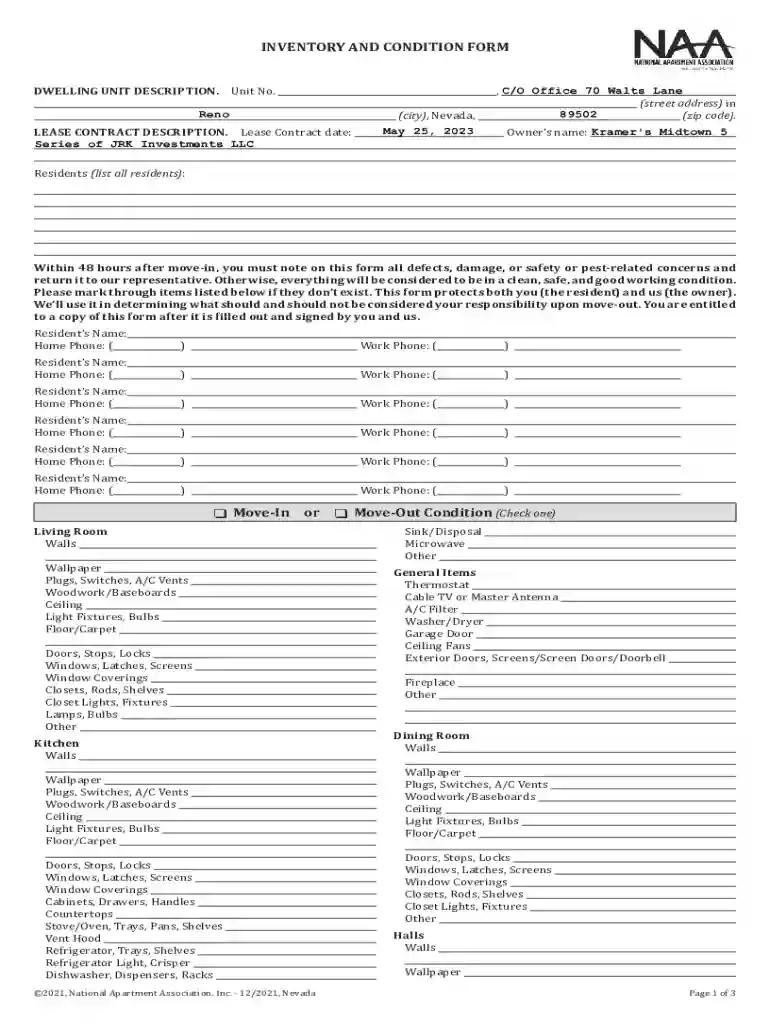
The "Inventory and Condition Form" is a crucial document used primarily for recording the condition of rental properties during move-in and move-out processes. It serves as a detailed checklist to document the existing state of a property, including the condition of rooms, fixtures, appliances, and any furniture. This documentation helps ensure a transparent agreement regarding the property's condition between landlords and tenants at the beginning of the rental term. By establishing a clear record, the form protects both parties against potential disputes over damages or wear and tear when the tenant vacates the property.
To effectively use the Inventory and Condition Form during a move-in, both landlords and tenants should collaboratively review each section of the property. This process involves walking through all areas, such as the living room, kitchen, bedrooms, and bathrooms. Each part of the form should have detailed notes regarding the current state of walls, floors, ceilings, and any included equipment or furnishings. Moreover, any pre-existing damages or issues must be noted meticulously. Both parties should sign the form upon completion to confirm the accuracy of the recorded information.
This form is predominantly used by landlords, property managers, and tenants within the residential rental sector. Landlords and property managers utilize the form to protect their property investments by documenting its condition. Tenants use the form to safeguard their security deposit by providing evidence of the property's initial state. In some instances, real estate professionals may also assist with filling out the form to ensure compliance with industry standards.


The form typically includes sections for:
The Inventory and Condition Form is legal documentation that can be used in dispute resolutions related to damaged property. Should disagreements arise regarding the return of a security deposit, this form serves as evidence of the property’s condition at move-in. It is endorsed by various state rental laws in the U.S. as a vital aspect of the landlord-tenant relationship. Its legal standing underlines the importance of ensuring its accuracy and comprehensiveness upon completion.
Consider a tenant moving into a furnished apartment in Reno, Nevada. The landlord uses the form to list everything from the condition of the kitchen appliances to the living room's furniture. If a scratch on the hardwood floor exists prior to move-in, it is documented to prevent future disputes. Meanwhile, in a college town, a student tenant might use the form to note pre-existing wear in a shared house, thus protecting their security deposit from deductions when they move out.
While the fundamental purpose of the Inventory and Condition Form remains consistent across the United States, some state-specific regulations can affect its use. For example, certain states may require the form to be submitted within a specified number of days after move-in or include additional provisions for furnishings or fixtures. It's essential for landlords and tenants to understand their state's specific laws to ensure compliance and protect their rights effectively.
Modern property management often involves the choice between digital and paper versions of the Inventory and Condition Form. Digital forms are advantageous for their convenience and ease of storage; they can be completed on tablets or smartphones and saved in the cloud for easy access. This digital flexibility supports image attachments and electronic signatures, streamlining the documentation process. Conversely, paper versions offer tangibility and reassurance through physical copies that may be preferable for those less technologically inclined. Each version has its merits, and the choice depends on individual preferences and technological capabilities.
In summary, the "Inventory and Condition Form" is essential for maintaining clear communication and understanding between landlords and tenants regarding the condition of a rental property at move-in. By utilizing this form, both parties can ensure a fair and transparent approach to property management.
At DocHub, your data security is our priority. We follow HIPAA, SOC2, GDPR, and other standards, so you can work on your documents with confidence.