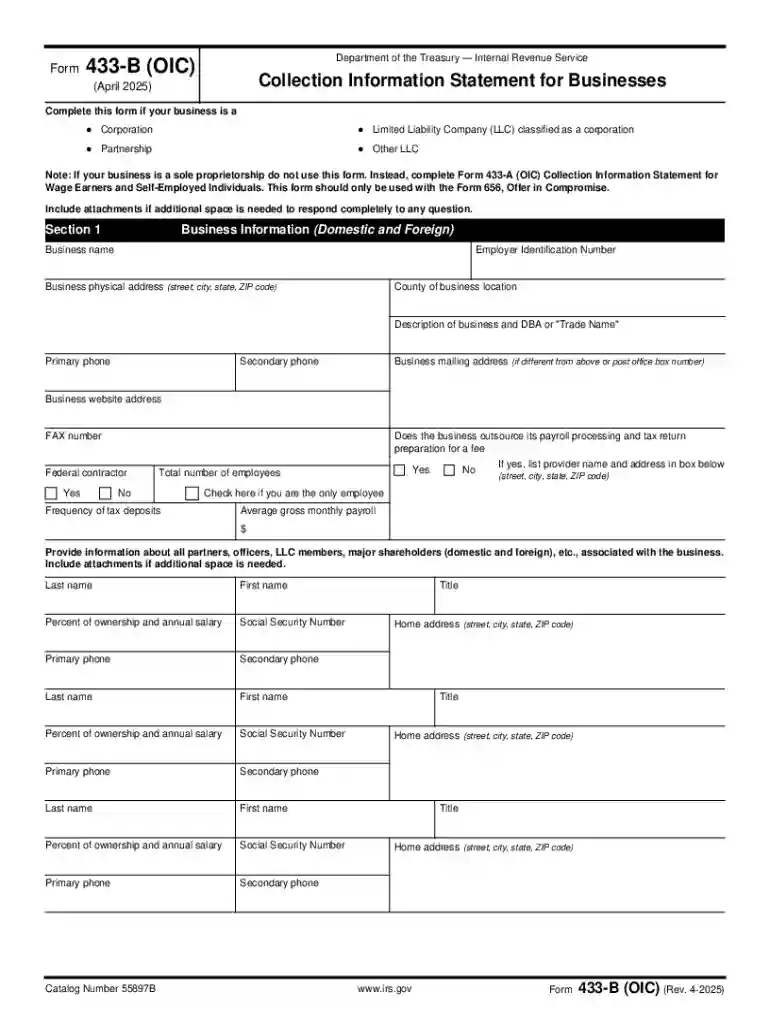
433-b (oic) 2026

Get Form
433-b (oic) Preview on Page 1

Here's how it works

01. Edit your form online
Type text, add images, blackout confidential details, add comments, highlights and more.

02. Sign it in a few clicks
Draw your signature, type it, upload its image, or use your mobile device as a signature pad.

03. Share your form with others
Send it via email, link, or fax. You can also download it, export it or print it out.

Definition and Purpose of Form 433-B (OIC)

Form 433-B (OIC) is officially designated as a Collection Information Statement for Businesses, issued by the Internal Revenue Service (IRS). This form is an integral component of the Offer in Compromise (OIC) application process, which allows businesses to propose settling their tax liabilities for less than the full amount owed. The primary objective of Form 433-B (OIC) is to collect detailed financial information from businesses, including assets, income, expenses, and any legal issues or affiliations. It is applicable to corporations, partnerships, and limited liability companies (LLCs) whether classified as corporations or not.

Steps to Complete the 433-b (OIC)

Completing the Form 433-B (OIC) involves several meticulous steps to ensure accuracy and the successful processing of the Offer in Compromise.

  1. Gather Financial Records: Prioritize gathering comprehensive financial documentation like balance sheets, profit and loss statements, and records of assets and liabilities.

  2. Fill Out Business Information: This section requires details about the business's structure, including its legal name, EIN, and type of business entity.

  3. Report Assets: List all business assets, including real estate, vehicles, and other significant assets. Accurate valuation is crucial for each item.

  4. Disclose Income and Expenses: You need to provide a detailed account of the business's monthly income and expenses. This includes reporting gross receipts, costs, and net income.

  5. Legal and Affiliation Issues: Reveal any ongoing legal proceedings or affiliations that could impact the financial status of the business.

  6. Final Review: Conduct a meticulous review to ensure all provided information is complete and accurate before submission.

Required Documents for Form 433-B (OIC)

Several documents are necessary to support the financial information provided in Form 433-B (OIC):

  • Recent bank statements and income tax returns.
  • Documentation for all listed assets, like property deeds or vehicle titles.
  • Proof of monthly expenses, such as lease agreements and utility bills.
  • Legal documents related to any disclosed proceedings or affiliations.

These supporting documents are pivotal in validating the details listed on the form, enabling the IRS to assess the Offer in Compromise accurately.

Eligibility Criteria for 433-B (OIC)

Eligibility for utilizing Form 433-B (OIC) depends on multiple criteria that focus on financial capability and circumstances.


  • Current Tax Status: The business must have all required tax returns filed.
  • Financial Hardship: Demonstrating that paying the full tax liability would cause financial hardship or insolvency is essential.
  • Offer Amount Documentation: Must reflect some reasonable potential for payment based on financial condition, proven through exhaustive documentation.
decoration image ratings of Dochub

IRS Guidelines and Legal Use

The IRS sets specific guidelines governing the submission of Form 433-B (OIC), ensuring that each Offer in Compromise is evaluated consistently.

  • Adherence to the IRS's legal framework is compulsory, which mandates full disclosure of accurate financial information.
  • Misrepresentation or omitting crucial information can lead to legal ramifications, including the rejection of the OIC and potential penalties.

Common Use Cases for Form 433-B (OIC)

Businesses utilize Form 433-B (OIC) in various contexts to manage tax debt effectively.

  • Financial Distress: A viable option when companies face severe financial difficulties, allowing them to reduce tax liabilities.
  • Limited Cash Flow: Suitable for businesses with restricted cash flow, making full tax payments unfeasible.
  • Reorganization Needs: Used during corporate restructuring when financial realignment is necessary, and tax obligations cannot be met fully.

Penalties for Non-Compliance

Failure to accurately complete Form 433-B (OIC) or comply with IRS requirements can lead to significant penalties.

  • Penalty and Interest Accumulation: Unpaid tax amounts continue to accrue penalties and interest until settled.
  • Denial of Offer: Incomplete or inaccurate form submission often results in the OIC being rejected.
  • Potential Legal Action: Deliberate misrepresentation of financial information can lead to legal proceedings initiated by the IRS.

Digital vs. Paper Version of Form 433-B (OIC)

The choice between using a digital versus paper version of Form 433-B (OIC) hinges on convenience and accessibility.

  • Digital Submission: Benefits include faster processing times, easier access to digital records, and seamless revisions or corrections before submission.
  • Paper Form Submission: Preferred by some for its tangible nature, though it may involve slower processing and logistical hurdles in mailing or hand delivery.

Completing and submitting the form via any method requires strict adherence to instructions and thorough accuracy in detail to facilitate smooth processing by the IRS.

be ready to get more

Complete this form in 5 minutes or less

Get form

Got questions?

We have answers to the most popular questions from our customers. If you can't find an answer to your question, please contact us.
Contact us
More In Help An offer in compromise (OIC) is an agreement between a taxpayer and the Internal Revenue Service that settles a taxpayers tax liabilities for less than the full amount owed.
1:15 3:00 Its also important to keep a copy of the form. And any confirmation you receive from the IRS. AsMoreIts also important to keep a copy of the form. And any confirmation you receive from the IRS. As this will help you keep track of your payments. And ensure everything is in order.
What is the Purpose of Form 433-A? The IRS uses this form to assess your collection potential and to determine your eligibility for IRS relief programs. If this form indicates that you can truly not afford to pay your taxes, the IRS may stop collection actions against you or agree to a very low monthly payment.
Form 433-B, Collection Information Statement for Businesses. IRS Form 433-B is used to obtain financial information about a business to determine its ability to satisfy an outstanding IRS tax debt. This includes income and assets, as well as any business expenses and debts.
Form 433-A (OIC) is a special version of the standard 433-A form, and its specifically used for people who are applying for an office in compromise (OIC).

Security and compliance

At DocHub, your data security is our priority. We follow HIPAA, SOC2, GDPR, and other standards, so you can work on your documents with confidence.
Learn more
ccpa2
pci-dss
gdpr-compliance
hipaa
soc-compliance

People also ask

An Offer in Compromise (OIC) provides an alternative for individuals who are unable to pay their outstanding California income tax liabilities, and who wont be able to in the foreseeable future .
Youre eligible to apply for an offer in compromise if you: Filed all required tax returns and made all required estimated payments. Arent in an open bankruptcy proceeding. Have a valid extension for a current year return (if applying for the current year).
Form 433-A is a collection information statement for wage earners and self-employed individuals. 433 A Form (OIC) is a specific version used when applying for an Offer in Compromise, which is an agreement with the IRS to settle your tax liabilities for less than the full amount owed.

Related links