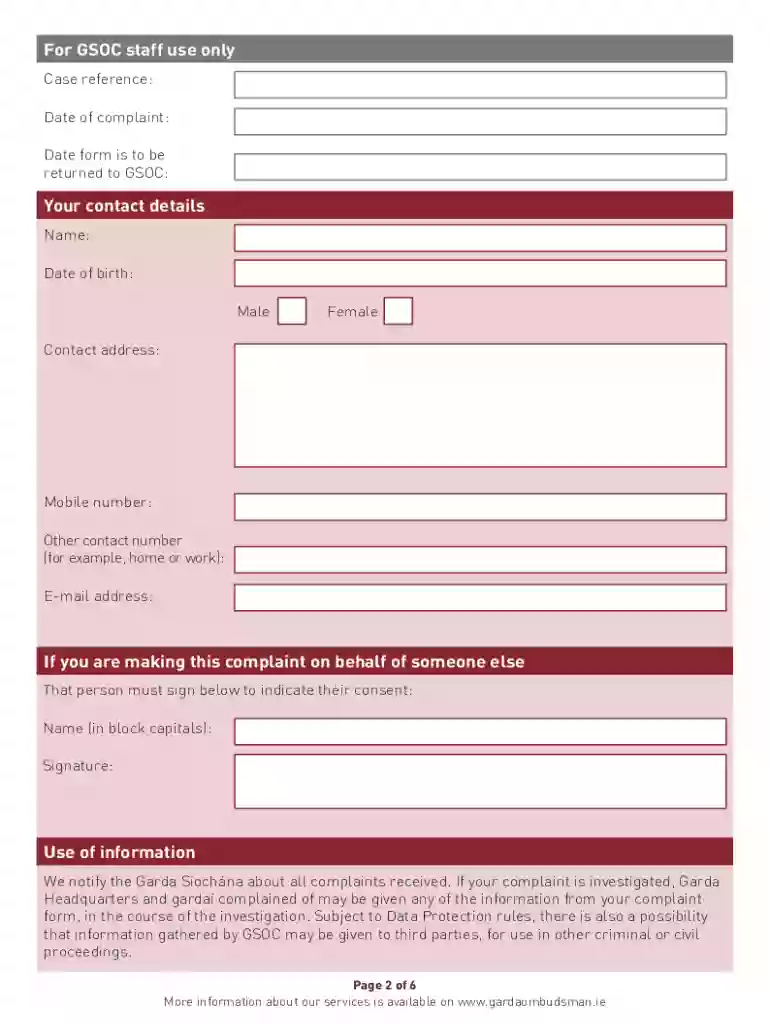
Garda ombudsman complaint form 2026

Get Form
garda ombudsman complaint form Preview on Page 1

Here's how it works

01. Edit your garda ombudsman complaint form online
Type text, add images, blackout confidential details, add comments, highlights and more.

02. Sign it in a few clicks
Draw your signature, type it, upload its image, or use your mobile device as a signature pad.

03. Share your form with others
Send gsoc complaint form via email, link, or fax. You can also download it, export it or print it out.

Definition & Meaning

The Garda Ombudsman Complaint Form is a structured document intended for individuals who wish to report grievances against members of the Garda Síochána, the national police service of Ireland. This form facilitates the submission of complaints to the Garda Síochána Ombudsman Commission (GSOC), ensuring that incidents involving alleged misconduct or malpractice are officially recorded and investigated. The form plays a critical role in maintaining accountability within the police force by enabling the public to report instances that undermine the ethos of law enforcement. It requires detailed information about the complainant, the specific incident, and any witnesses, thereby structuring the complaint for thorough evaluation.

How to Obtain the Garda Ombudsman Complaint Form

Securing a Garda Ombudsman Complaint Form can be straightforward, owing to multiple access points. Individuals can acquire the form online through the official GSOC website, ensuring ease of access regardless of geographical location. Alternatively, the form is available at local Garda stations, where guidance on its completion can also be sought from officers. For those who prefer in-person interactions, visiting a GSOC office provides an opportunity to collect the form and address procedural inquiries. These options ensure that individuals have the ability to secure the form in a manner most convenient to them.

Steps to Complete the Garda Ombudsman Complaint Form

Filling out the Garda Ombudsman Complaint Form requires attention to detail to ensure that all pertinent information is accurately captured. The process involves:

  1. Personal Information: Begin by providing your full name, contact details, and any relevant identification numbers.
  2. Incident Details: Describe the specific event, including the date, time, and location, alongside a detailed narrative of what occurred.
  3. Garda Member Involved: Identify the officer(s) involved, presenting badge numbers if available, to facilitate the investigation.
  4. Witness Information: List any individuals who witnessed the event, including their contact information if consent is given.
  5. Supporting Evidence: Attach any relevant documentation, such as photographs or video recordings, that substantiates the claim.

Each section must be completed meticulously to ensure the complaint is processed without unnecessary delays.

Key Elements of the Garda Ombudsman Complaint Form

Several critical elements are integral to the Garda Ombudsman Complaint Form, providing the structure necessary for comprehensive complaint processing:

  • Complainant Details: Captures personal data to ensure proper identification and follow-up communication.
  • Incident Description: A narrative section allowing for a detailed account of the event, setting the foundation for investigative proceedings.
  • Officer Identification: Fields dedicated to listing the involved Garda members to target the right personnel during investigations.
  • Witness Information: Space to include eyewitness accounts, which can corroborate the complainant's statement.
  • Attachments Section: Allocates space for submitting additional evidence, reinforcing the complaint's validity.

These components collectively ensure that the complaint is comprehensive and actionable.

Legal Use of the Garda Ombudsman Complaint Form

The legal framework governing the use of the Garda Ombudsman Complaint Form is rooted in upholding justice and accountability. This form acts as a formal mechanism to report potential breaches of conduct by Garda members, ensuring that complaints are addressed systematically and professionally. Individuals are legally protected when submitting truthful complaints, and the GSOC is obligated to investigate credible allegations. It is important to note that false reporting can have legal repercussions, emphasizing the importance of honesty and accuracy when completing the form.

Examples of Using the Garda Ombudsman Complaint Form

Practical scenarios where the Garda Ombudsman Complaint Form might be utilized include:

  • Allegations of excessive force during an arrest, providing a means for the public to seek redress.
  • Instances of perceived discrimination during routine police operations, where individuals feel their rights were infringed.
  • Situations where improper conduct or language by Garda members is observed by civilians or other law enforcement.

These examples illustrate the diverse contexts in which the form serves as a tool for seeking justice and ensuring accountability.

Who Typically Uses the Garda Ombudsman Complaint Form

The primary users of the Garda Ombudsman Complaint Form are civilians who have interacted with the Gardaí in a manner that raises concerns over conduct or ethics. This includes witnesses to misconduct, victims of alleged police abuse, or individuals instructed by legal representatives to document grievances. Additionally, the form may be used by community advocacy groups representing individuals who need assistance in voicing their complaints. This widespread applicability ensures that any aggrieved parties have the means to initiate a formal inquiry into alleged police misconduct.


decoration image ratings of Dochub

Required Documents

To support a claim made using the Garda Ombudsman Complaint Form, several documents may be required, including:

  • Identification Proof: Such as a passport or driving license to verify the complainant's identity.
  • Incident Evidence: Photographs, videos, or audio recordings that capture the event in question.
  • Medical Records: In cases involving physical harm, medical reports may strengthen the complaint.
  • Witness Statements: Written accounts from those who observed the incident can add credibility and depth to the claim.

Gathering these documents upfront ensures that the complaint is both credible and appropriately substantiated, facilitating a smoother investigative process.

Form Submission Methods (Online / Mail / In-Person)

The Garda Ombudsman Complaint Form can be submitted through several channels to accommodate different preferences:

  • Online Submission: Allows users to fill out and submit the form electronically via the GSOC website, offering convenience and speed.
  • Mail Submission: Provides an alternative for those who prefer traditional methods, ensuring that completed forms are sent directly to the GSOC's postal address.
  • In-Person Submission: Enables individuals to deliver forms directly to a GSOC office, affording the opportunity for immediate clarification or assistance.

These methods ensure accessibility and flexibility, empowering individuals to choose the most suitable mode of submission for their circumstances.

be ready to get more

Complete this form in 5 minutes or less

Get form

Got questions?

We have answers to the most popular questions from our customers. If you can't find an answer to your question, please contact us.
Contact us
General enquiries. For general enquiries you can call us on 01 639 5600. You can also submit your enquiry through our Make an enquiry form below. If you do not wish to use our online complaint form , you can request a hard copy complaint form, and we will post it to you.
Fill out the online form below, by clicking on Complain to an Ombudsman. Call the WISE Healthy Aging Long-Term Care Ombudsman Program on our Hotline: (800) 334-WISE (9473). Hotline Hours: 8:30 a.m. to 5 p.m. Monday through Friday. Call the State of California CrisisLine at (800) 231-4024.
How to complain to an ombudsman. Check the ombudsmans website to see how to make a complaint - most of them have an online form. Tell the ombudsman if you need extra support making a complaint - for example help filling out forms or making the complaint in a language that isnt English.
Ombudsman schemes are independent, free and impartial so they dont take sides. You should try and resolve your complaint with the organisation before you complain to an ombudsman. The ombudsman might be able to deal with your complaint more quickly in some situations.
You can approach the Ombudsman with complaint if: Your complaint to the Ombudsman can be about: a Delay in settlement of claims, beyond the time specified in the regulations, framed under the IRDAI Act, 1999.

Security and compliance

At DocHub, your data security is our priority. We follow HIPAA, SOC2, GDPR, and other standards, so you can work on your documents with confidence.
Learn more
ccpa2
pci-dss
gdpr-compliance
hipaa
soc-compliance
be ready to get more

Complete this form in 5 minutes or less

Get form

People also ask

5 Steps in Detail Step 1: Get the correct contact details for the relevant public service provider. Step 2: Prepare your complaint and make it. Step 3: Wait. Step 4: Prepare your complaint to the Office of the Ombudsman. Step 5: Contact the Ombudsmans office with your complaint.
The most common complaints include: Costs: the costs were unclear or different from the original estimate. Delay: no clear reason for the work taking longer than expected.
You can contact Fiosr directly and they will send a form by post to you or you can get it from your local Garda station. You can phone Fiosr on 0818 600 800 if you need help filling out the complaint form.

Related links