Definition & Meaning
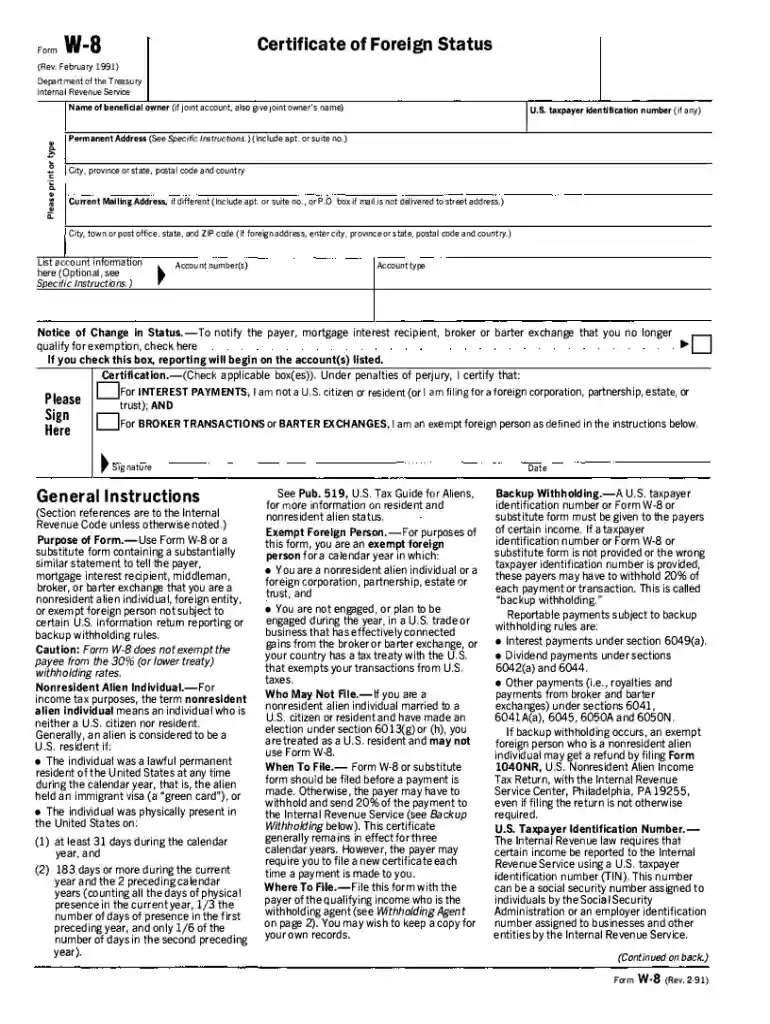
The W-8 form, specifically the 1991 version, is a Certificate of Foreign Status used by nonresident aliens and foreign entities to certify their tax status with the IRS. It informs U.S. payers about the foreign entity's exemption from certain domestic reporting and backup withholding requirements. This form is vital for ensuring that the recipients comply with IRS regulations concerning the collection and reporting of taxpayer data.
Key Elements of the FORM W-8 (1991)
The W-8 form includes several essential components necessary for compliance:
- Personal Identification Information: This section requires the completion of personal details such as name, address, and country of residence.
- Tax Identification Number (TIN): Foreign individuals or entities must provide a U.S. taxpayer identification number if required.
- Certification of Foreign Status: This serves as a declaration that the entity or individual is a nonresident for tax purposes.
- Exemption Criteria: Specifies the conditions that exempt the filer from U.S. reporting standards.
How to Use the FORM W-8 (1991)
To maximize the utility of the W-8 form, individuals must understand when and how to use it:
- Determine Eligibility: Verify if the individual or entity meets the criteria to be considered a foreign person or entity.
- Complete All Sections: Fill out the form accurately, ensuring that all necessary information is provided.
- Submit to Payer: Deliver the completed form to the U.S. entity or payer from whom the income is sourced.
Steps to Complete the FORM W-8 (1991)
Completing the FORM W-8 involves several stages that ensure it meets IRS standards:
- Provide Identification Details: Enter all required personal or entity identification information.
- Select Exemption Reason: Choose the applicable category that explains why you are exempt.
- Certification: Sign the form, certifying that all information provided is accurate and truthful.
- Review: Double-check for accuracy and completeness before submitting to the U.S. payer.
Filing Deadlines / Important Dates
While the W-8 form does not have a set expiration date, it must be renewed periodically to ensure ongoing compliance:
- Renewal Timing: Typically, the form should be renewed every three years, or sooner if there are significant changes to the information provided.
- Submission with Payments: Submit the form before receiving any applicable payments to ensure tax exemptions are properly applied.
Required Documents
To accurately complete the W-8 form, several documents may be necessary:
- Passport or Identification Card: These documents confirm the individual's foreign status.
- Documentary Evidence: For businesses, legal documents demonstrating the organization's formation and operational status may be required.
- Previous Tax Forms: Prior submissions related to U.S. tax obligations might be beneficial for ensuring accuracy.
IRS Guidelines
The IRS provides specific instructions to guide individuals and entities in filling out the W-8 form:
- Comprehensive Guidance: Follow the official IRS instructions to avoid common errors.
- Online Resources: Utilize the IRS portal for additional help, FAQs, and examples.
- Professional Advice: Consulting tax professionals can be helpful for complex cases.
Penalties for Non-Compliance
Failure to accurately complete or submit the W-8 form can result in severe consequences:
- Backup Withholding: Incorrect or incomplete forms may lead to backup withholding at the default rate on payments received.
- Penalties and Fines: The IRS may impose fines for non-compliance with filing requirements, which can impact financial dealings.
Examples of Using the FORM W-8 (1991)
To understand the application of the W-8 form, consider scenarios involving different entities:
- Foreign Investor: A nonresident investor using the form to certify foreign status for withholding tax reductions.
- International Business: An overseas corporation engaged in business within the U.S. that uses the form to avoid domestic reporting requirements.
Business Entity Types that Benefit Most
The W-8 form is particularly advantageous for certain business entities:
- Foreign LLCs and Corporations: These entities potentially reduce withholding of U.S.-sourced income.
- Partnerships and Trusts: Entities structured outside the U.S. can utilize the form to declare exemption from domestic tax rules.