Definition and Meaning
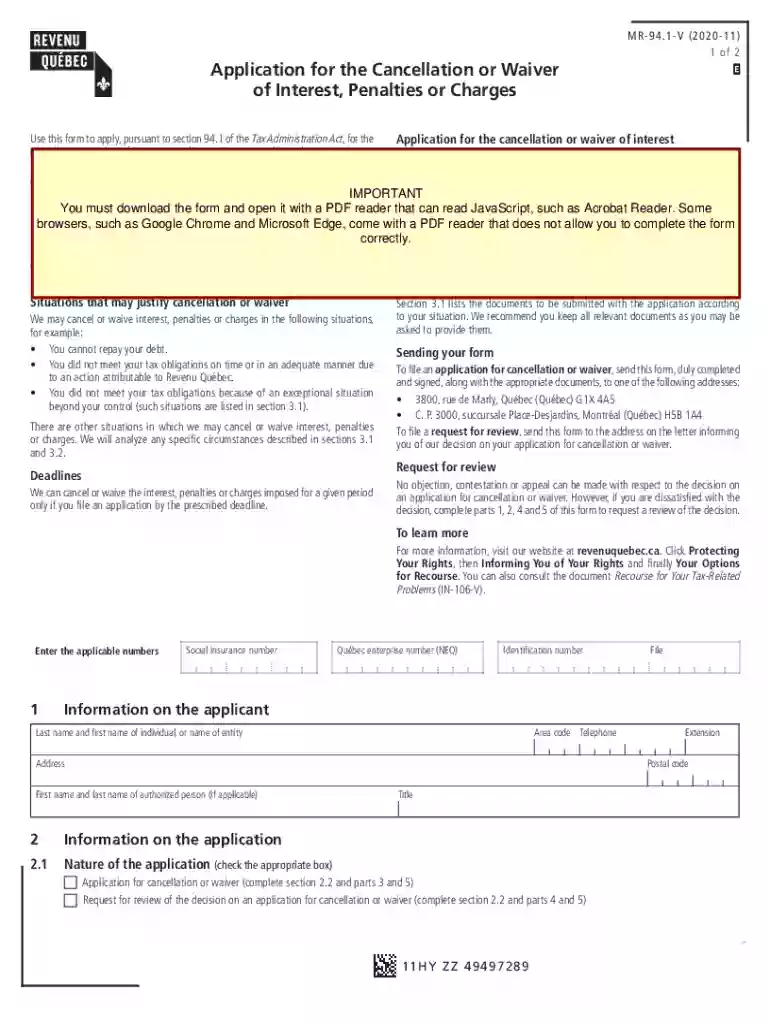
The MR-94 1-V(2020-11) Application for the Cancellation or Waiver of Interest, Penalties, or Charges is a specific form used in Québec under the Tax Administration Act. Its primary function is to allow taxpayers to apply for the cancellation or waiver of additional charges incurred due to late payments or other tax-related penalties. This application can be an essential tool for individuals and businesses facing financial hardships or errors in tax computations.
Context and Purpose
- Legislative Basis: The form operates under section 94.1, designed to ensure that taxpayers are not unduly penalized due to circumstances beyond their control.
- Financial Hardship: Taxpayers who experience significant financial difficulty can use this form to seek relief from penalties that would further exacerbate their situation.
- Rectification: Facilitates the correction of miscalculations in interest or penalties previously imposed.
Steps to Complete the MR-94 1-V(2020-11) Application
- Gather Necessary Documentation: Collect all relevant financial documents, including notices from Revenu Québec regarding penalties and interests.
- Complete Personal Information: Fill out sections requiring your personal information, including name, address, and taxpayer identification number.
- Detail the Request: Clearly describe the penalties or interest charges you are contesting and the reasons for the waiver request.
- Provide Supporting Evidence: Include relevant documentation that supports your claim for cancellation or waiver due to financial hardship or administrative errors.
- Review and Sign: Carefully review completed sections for accuracy before signing the application.
- Submit the Application: Send the completed form and all attachments to the specified Revenu Québec office via mail or online submission portal.
Common Mistakes to Avoid
- Incomplete Information: Ensure every section of the form is filled out completely.
- Lack of Evidence: Submit comprehensive evidence to substantiate claims of hardship or error.
Who Typically Uses the MR-94 1-V(2020-11) Application
This form is mainly used by taxpayers within Québec who are subject to the Tax Administration Act. It caters to various groups who may encounter interest or penalty issues:

- Individuals: Those experiencing sudden loss of income or catastrophic expenses.
- Businesses: Entities facing unforeseen downturns or inaccuracies in financial reporting.
- Accountants and Tax Advisors: Professionals assisting clients with complex financial structures.
Eligibility Criteria
Eligibility for utilizing the MR-94 1-V(2020-11) centers around a series of predetermined factors:

- Financial Instability: Demonstrable evidence of financial distress, such as medical emergencies or natural disasters.
- Administrative or Clerical Errors: Identification of miscalculations or administrative errors in initial assessments.
- Reasonable Cause: Situations where the taxpayer can establish a reasonable cause for the non-compliance rather than willful neglect.
Documentation for Eligibility
- Financial Statements: Presenting altered financial conditions.
- Communication Records: Copies of correspondence with tax authorities.
Submission Methods
The MR-94 1-V(2020-11) application can be submitted via several channels, ensuring flexibility and accessibility:
- Online Submission: Direct upload through the Revenu Québec website for expedited processing.
- Postal Submission: Traditional mailing method with a recommended tracking for confirmation.
- In-Person: If preferred, visit local offices equipped to receive tax forms and applications.
Pros and Cons of Submission Methods
- Online: Fast processing but requires digital proficiency.
- Mail: Accessible for those without reliable internet access, though slower in confirmation.
- In-Person: Immediate handling assistance but can be time-consuming.
Application Process and Approval Time
The application process typically involves the assessment of the submitted information by the tax authorities:
- Initial Review: Verification of completeness and accuracy upon submission.
- Evaluation Phase: Detailed examination of the justifications and supporting documents.
- Decision Making: Based on criteria, the tax authority decides on approval or denial.
Expected Timeframes
- Regular Cases: Generally processed within six to eight weeks.
- Complex Applications: Cases requiring additional scrutiny may extend beyond the typical timeframe.
Examples of Using the MR-94 1-V(2020-11) Application
The application is used in various practical scenarios. For instance:
- A self-employed individual facing unforeseen hospital expenses and unable to pay expected tax dues within the defined timeline can apply to waive associated penalties.
- A small business discovering that their accounting software malfunctioned, consequently mispresenting financial data and incurring penalties, can use this form to seek redress.
- A retiree whose pension payments have been delayed, resulting in late tax remittances, can appeal for a waiver, showcasing the supporting documentation of delay.
Case Study
- Company A, facing electronic communication issues leading to late submissions, applied for relief using robust documentation demonstrating the systemic fault, resulting in a successful waiver approval.
Important Terms Related to the MR-94 1-V(2020-11)
Understanding relevant terminology is essential for successfully navigating the application:
- Interest Charges: Financial fees attached to late tax payments or underpayment.
- Penalties: Additional charges on top of outstanding dues for non-compliance.
- Waiver Request: Petitioning for the formal relinquishment of penalties or interest.
Nuances of Terminology
- "Charges": Can encompass both penalties and administrative costs related to tax duties.
- "Cancellation": Unlike a waiver, implies complete removal of impositions under certain conditions.
This structured context provides a solid foundation for anyone engaging with the MR-94 1-V(2020-11) form, ensuring they can navigate tax obligations smoothly and efficiently.