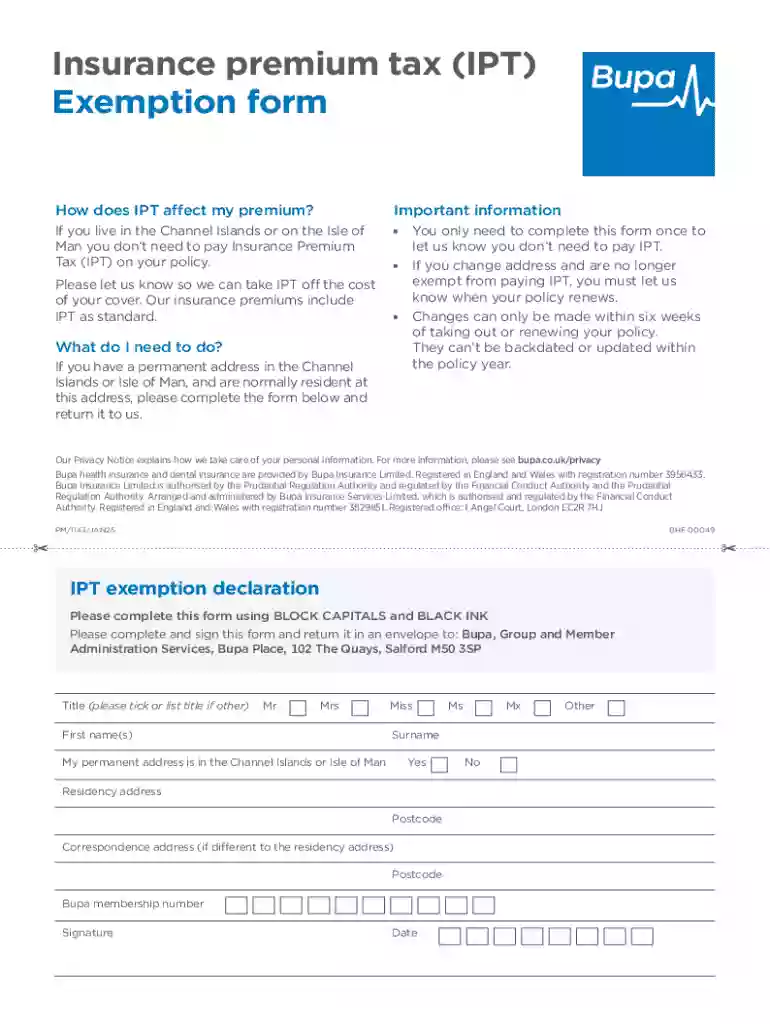
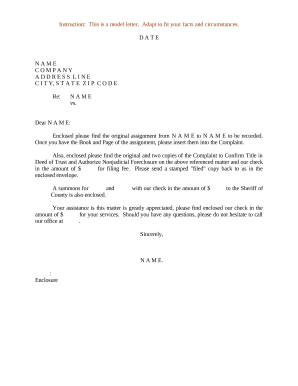
Insurance Premium Tax (ipt) Exemption Form 2026

Get Form
Insurance Premium Tax (ipt) Exemption Form Preview on Page 1

Here's how it works

01. Edit your form online
Type text, add images, blackout confidential details, add comments, highlights and more.

02. Sign it in a few clicks
Draw your signature, type it, upload its image, or use your mobile device as a signature pad.

03. Share your form with others
Send it via email, link, or fax. You can also download it, export it or print it out.

Definition & Meaning

The Insurance Premium Tax (IPT) Exemption Form is a specialized document that serves to exempt qualified individuals or entities from paying the standard insurance premium tax. This tax is typically levied on insurance policyholders but can be exempted under specific conditions, primarily for residents in designated areas such as the Channel Islands and the Isle of Man. Understanding this form's role in tax exemptions is crucial for eligible individuals seeking financial relief from standard insurance-related tax obligations.

How to Use the Insurance Premium Tax (IPT) Exemption Form

Using the IPT Exemption Form involves a series of steps designed to accurately declare and verify one's eligibility for the tax exemption. Typically, this form requires the applicant to:

  1. Identify Eligibility: Ensure that they qualify for the exemption based on residency or other specified criteria.
  2. Gather Necessary Information: Collect all required personal and insurance-related details to complete the form.
  3. Fill Out the Form: Input the gathered data into the appropriate sections of the form, ensuring all requested information is accurate and up-to-date.
  4. Submission: Submit the completed form to the appropriate tax or insurance authority as specified within the instructions, either through mail or available online platforms.

How to Obtain the Insurance Premium Tax (IPT) Exemption Form

Obtaining the IPT Exemption Form can typically be done through several channels. These include:

  • Online Downloads: Many tax authorities provide the form for download on their official websites, allowing users to access it quickly and fill it out in a digital format.
  • Mail Requests: Individuals can request a physical copy by contacting the tax authority directly and requesting the form to be sent via mail.
  • In-Person Visits: Forms are often available at local tax offices or insurance regulators' offices where they can be picked up in person.

Steps to Complete the Insurance Premium Tax (IPT) Exemption Form

Completing the IPT Exemption Form requires attention to detail. Here's a step-by-step guide:

  1. Review Instructions: Carefully go over the accompanying guidelines to understand what information is necessary.
  2. Enter Personal Information: Fill in personal details such as name, address, and residency status.
  3. Provide Insurance Details: Record the relevant insurance policy information, including policy numbers and issuers.
  4. Declare Residency: Confirm your residency status and reason for exemption.
  5. Sign and Date: Verify all information is accurate before signing and dating the form.
  6. Attach Required Documents: Attach any necessary supporting documents as outlined in the form instructions.
  7. Submit Form: Follow the submission guidelines, choosing either online, mail, or in-person options as available.

Legal Use of the Insurance Premium Tax (IPT) Exemption Form

The legal use of the IPT Exemption Form is governed by specific regulations and guidelines. It is primarily used to:

  • Document Eligibility: Officially declare one's eligibility for the tax exemption based on provided criteria.
  • Facilitate Exemptions: Legally enable individuals or entities to benefit from the tax exemption on insurance premiums.
  • Ensure Compliance: Ensure the process is compliant with laws surrounding tax filings and insurance regulations.

Failure to comply with these guidelines may result in the denial of exemption applications or penalties.

Key Elements of the Insurance Premium Tax (IPT) Exemption Form

The IPT Exemption Form is composed of several crucial elements:

  • Applicant Information: Details about the applicant, including name and contact details.
  • Insurance Policy Data: Information about the insurance policy to which the exemption would apply.
  • Residency Declaration: A section for detailing the applicant's residency status, often pivotal in determining eligibility.
  • Signature and Certification: Mandatory signature sections to certify the information provided is true and accurate.

State-Specific Rules for the Insurance Premium Tax (IPT) Exemption Form

While the primary function of the IPT Exemption Form is consistent, variations may exist depending on state-specific regulations:

  • Eligibility Criteria: Some states may have unique eligibility requirements, impacting who can apply for an exemption.
  • Submission Guidelines: Submission processes and deadlines can vary, necessitating awareness of state-specific instructions.
  • Form Versions: Updated or alternative forms could be applicable depending on state laws.

Applicants are advised to check with state authorities to ensure compliance with local regulations.

Eligibility Criteria

The criteria for eligibility to use the IPT Exemption Form typically revolve around a few key factors:

  • Residency: Primarily, individuals must be residents of exempt areas like the Channel Islands or the Isle of Man.
  • Insurance Ownership: Candidates must have active insurance policies potentially subject to IPT.
  • Regulatory Compliance: Applicants must comply with other specific regulatory requirements that may influence eligibility.

Fulfilling all criteria is essential to successfully apply for the exemption and avoid potential penalties for non-compliance.


decoration image ratings of Dochub
be ready to get more

Complete this form in 5 minutes or less

Get form

Got questions?

We have answers to the most popular questions from our customers. If you can't find an answer to your question, please contact us.
Contact us
Principal French IPT rates include: General liability: 9% Motor: 18% Compulsory motor third-party liability: 33%
On average, car insurance in Florida is $3,268 annually ($272 monthly) for full coverage and $1,589 annually ($132 monthly) for minimum coverage.
as set forth in Section 624.509, F.S. (a) A tax at the rate of 1.75 percent of the gross amount of receipts for insurance premiums and assessments shall be applied to the following types of policies: 1. Life and health insurance policies covering Florida residents.
To be eligible to receive the premium tax credit in 2025, individuals must have annual household income at or above 100% of the federal poverty level; not be eligible for certain types of health insurance coverage, with exceptions; file federal income tax returns; and enroll in a plan through an individual exchange.
Any contributions made by you (or someone other than your employer) are fully deductible from your federal income taxes, even if you dont itemize your deductions. Any contributions to an HSA made by your employer including contributions made through a cafeteria plan will be excluded from your taxable income.

Security and compliance

At DocHub, your data security is our priority. We follow HIPAA, SOC2, GDPR, and other standards, so you can work on your documents with confidence.
Learn more
ccpa2
pci-dss
gdpr-compliance
hipaa
soc-compliance
be ready to get more

Complete this form in 5 minutes or less

Get form

People also ask

Tax Rate 2.35% on most insurers gross premiums. 5% on ocean marine insurers on the share of underwriting profit representing gross premiums of ocean marine insurance written within California to gross premiums of ocean marine insurance written within the United States.
Premium Tax refers to a state-imposed tax on insurance premiums, including those paid for Indexed Universal Life (IUL) policies. This tax is typically a percentage of the premium amount and can vary from state to state.
2022 Florida Statutes (Including 2022C, 2022D, 2022A, and 2023B) Premium tax; rate and computation. (c) An amount equal to 1.75 percent of the direct written premiums for bail bonds, excluding any amounts retained by licensed bail bond agents or appointed managing general agents.

Related links