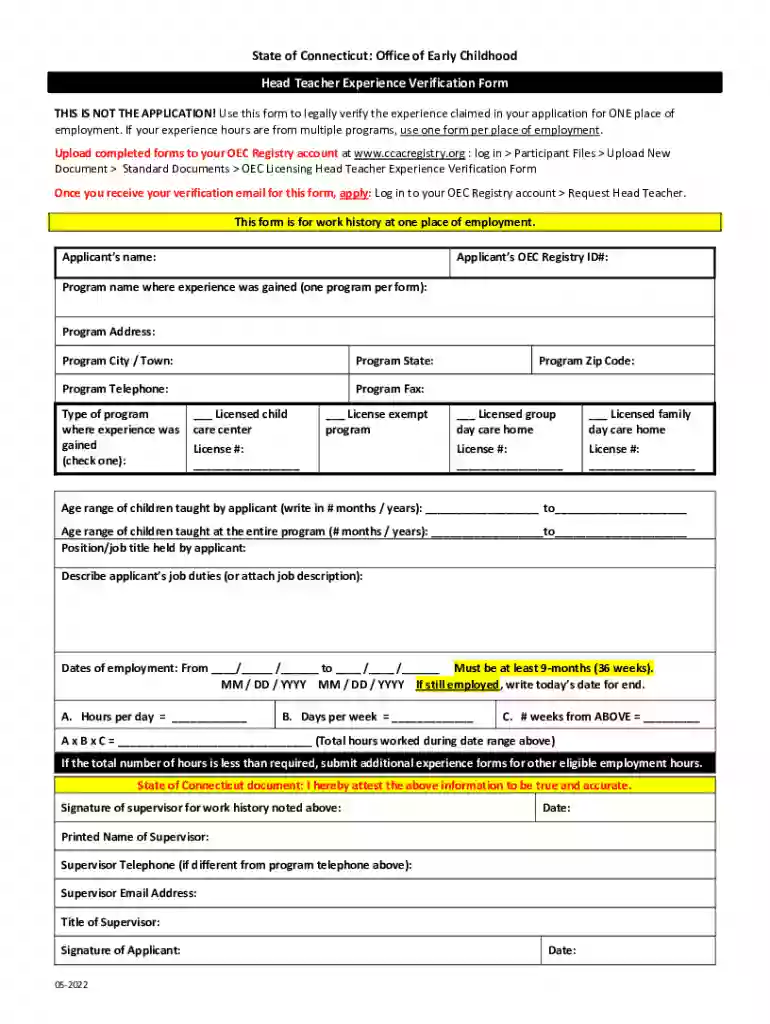
Head Teacher Experience Verification Form 2026

Get Form
Head Teacher Experience Verification Form Preview on Page 1

Here's how it works

01. Edit your form online
Type text, add images, blackout confidential details, add comments, highlights and more.

02. Sign it in a few clicks
Draw your signature, type it, upload its image, or use your mobile device as a signature pad.

03. Share your form with others
Send it via email, link, or fax. You can also download it, export it or print it out.

Definition and Meaning of the Head Teacher Experience Verification Form

The Head Teacher Experience Verification Form is a crucial document utilized by the State of Connecticut's Office of Early Childhood. This form is integral for applicants who are seeking certification as Head Teachers in child care settings. It serves as a mechanism to verify the applicant’s work experience, ensuring that they meet the educational and practical requirements needed for the position. The form requires detailed information about the applicant's employment history, including the specifics of program participation, job responsibilities, and the total hours worked. This documentation is essential in affirming the qualifications of potential Head Teachers, thereby maintaining high standards in child care services.

Purpose and Function

  • Verification of Experience: The primary function of this form is to confirm the documented work experience of individuals aiming to become Head Teachers.
  • Qualification Assurance: Ensures that candidates possess the necessary supervised experience with children, which is crucial for maintaining quality in educational environments.

Steps to Complete the Head Teacher Experience Verification Form

Completing the Head Teacher Experience Verification Form involves several critical steps to ensure that all required information is accurately captured.

  1. Gather Necessary Information: Collect all essential details pertaining to your employment history, including specific roles and responsibilities in child care settings.
  2. Detail Work Experience: Clearly document each job role, including the name of the employer, job title, employment duration, and detailed job duties.
  3. Educational Background: Provide information about your educational qualifications and any certifications that support your eligibility as a Head Teacher.
  4. Supervised Experience: Outline your experience with direct supervision of children, specifying the ages of the children and the nature of the supervision.
  5. Finalize and Review: Carefully review the completed form for accuracy and completeness before submission.

Common Mistakes to Avoid

  • Incomplete Sections: Ensure every section of the form is filled out completely to prevent delays in processing.
  • Incorrect Dates: Double-check employment dates to ensure they are consistent and accurate.

Key Elements of the Head Teacher Experience Verification Form

Understanding the critical components of the form is essential for accurate completion.

Employment Information

  • Employer Details: List the full name and contact information of all former employers within the child care sector.
  • Job Role and Responsibilities: Thoroughly describe your roles, including any leadership or supervisory responsibilities.

Educational Requirements

  • Degrees and Certifications: Include information about any degrees or certifications that are relevant to Head Teacher qualifications.
  • Relevant Coursework: Provide details of any specific courses that support your eligibility as a Head Teacher.

Important Terms Related to the Head Teacher Experience Verification Form

Familiarity with key terms is crucial for accurately completing the form.

  • Certification: The official recognition of an individual's qualifications to perform as a Head Teacher.
  • Supervised Experience: Work experience under the guidance of an experienced child care professional, crucial for certification.
  • Verification: The process of confirming the authenticity and accuracy of provided details.

Glossary

  • Head Teacher: A lead educator responsible for the overall management of a child care classroom or setting.
  • Child Care Setting: Any environment where child care services are offered, including child care centers and group homes.

State-Specific Regulations for Using the Form

The form follows regulations specific to Connecticut, affecting how applicants complete and submit it.

Compliance Requirements

  • State Guidelines: Adherence to Connecticut’s guidelines ensures compliance with state-specific child care oversight and certification requirements.

Regional Distinctions

  • Experience Criteria: Experience requirements can vary, so it is important to understand regional distinctions in child care regulations.

Examples of Using the Head Teacher Experience Verification Form

Real-world scenarios illustrate the application of the form.

Scenario: New Certification Applicant

An individual seeking first-time certification as a Head Teacher in Connecticut uses the form to document their extensive experience in a child care center, focusing on their leadership roles and supervised activities.

Scenario: Renewal of Certification

A current Head Teacher renewing their certification needs to update their form with new experience details acquired since their last certification.

Legal Use of the Head Teacher Experience Verification Form

Proper and lawful use of the form is required to maintain the integrity of the certification process.

Compliance and Transparency

  • Confidentiality: Ensure that all personal information shared on the form is protected according to privacy laws.
  • Authorized Use: The form must only be used by eligible candidates seeking certification through the Connecticut Office of Early Childhood.

Who Typically Uses the Head Teacher Experience Verification Form?

This form is primarily utilized by professionals in child care settings seeking to advance or validate their qualifications.


decoration image ratings of Dochub

Target Users

  • Child Care Professionals: Individuals working in early childhood education settings who require formal recognition as Head Teachers.
  • Employers: Child care center administrators verifying the qualifications of current or prospective employees for compliance with state mandates.
be ready to get more

Complete this form in 5 minutes or less

Get form

Got questions?

We have answers to the most popular questions from our customers. If you can't find an answer to your question, please contact us.
Contact us
Headteachers have interchangeable names including Headmaster or Headmistress as well as Principal, however the role and the responsibilities are the same. By definition a Headteacher is traditionally someone who is in charge of a school and is more commonly used in UK schools.
Aligned with district and school level vision and goals and the identified needs of students, teachers establish instructional goals within their classrooms. Principals work collaboratively with teachers to establish instructional goals and monitor progress toward those goals.
Scope While principals oversee operations at individual schools, superintendents are responsible for entire districts (multiple schools and facilities). Being higher in the chain of command, superintendents have purview over docHubly more students and staff.
A headteacher is sometimes also known as a head or deputy headteacher, and they are the most senior person within a school. They are qualified professionals responsible for managing schools and ensuring they run smoothly.
Headteacher or headmaster has traditionally been used in UK schools with the term principal being imported from the USA and used more commonly in academies and multi-academy trusts in England. It is often a question of semantics with both headteacher and principal having exactly the same role and responsibilities.

Security and compliance

At DocHub, your data security is our priority. We follow HIPAA, SOC2, GDPR, and other standards, so you can work on your documents with confidence.
Learn more
ccpa2
pci-dss
gdpr-compliance
hipaa
soc-compliance

People also ask

The word head in headmaster or head of school retains the imagery used in the Bible for leadership. The word principal seems to connote importance more than responsibility. Principal feels more inanimate and less human than head..

Related links