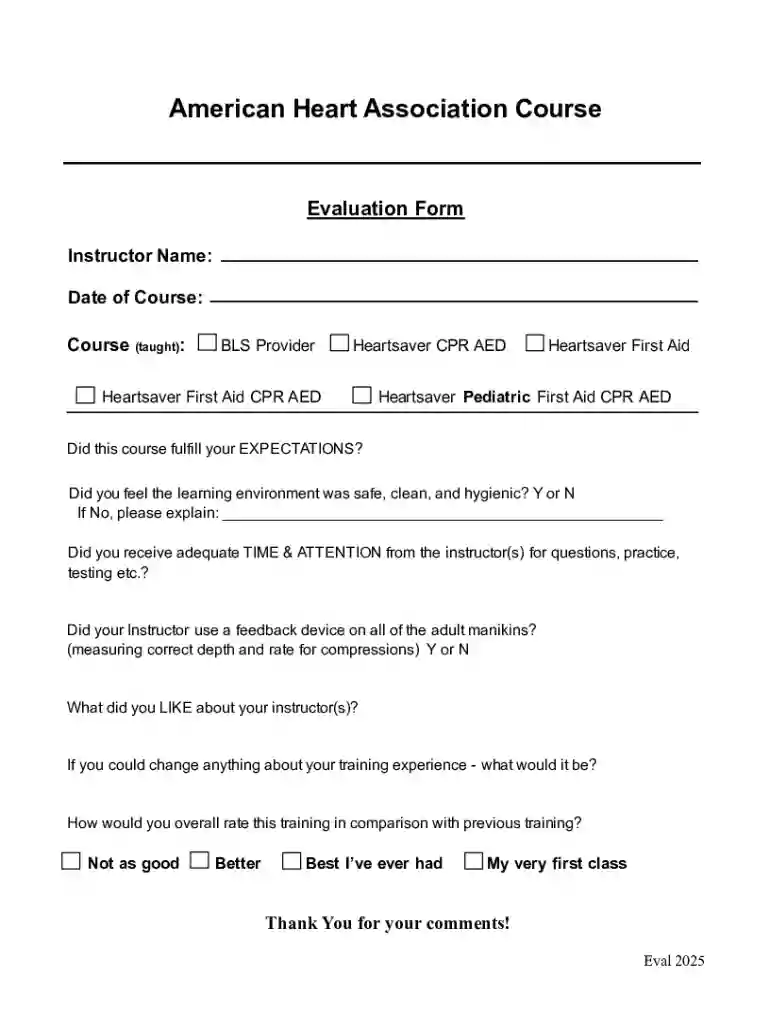
American Heart Association Course Evaluation Form 2026

Get Form
American Heart Association Course Evaluation Form Preview on Page 1

Here's how it works

01. Edit your form online
Type text, add images, blackout confidential details, add comments, highlights and more.

02. Sign it in a few clicks
Draw your signature, type it, upload its image, or use your mobile device as a signature pad.

03. Share your form with others
Send it via email, link, or fax. You can also download it, export it or print it out.

Definition and Meaning of the American Heart Association Course Evaluation Form

The American Heart Association (AHA) Course Evaluation Form is a standardized document designed to gather feedback from participants who have completed various AHA courses, such as the BLS Provider and Heartsaver programs. These courses aim to enhance the knowledge and skills of individuals in cardiovascular care, including cardiopulmonary resuscitation (CPR) and emergency cardiovascular care. The form allows attendees to evaluate the course content, instructor effectiveness, and overall learning environment to assess participant satisfaction and areas for improvement.

Importance of Course Evaluations

  • Quality Assurance: Course evaluations help maintain the quality of educational offerings by providing insights into participant experiences.
  • Instructor Feedback: Constructive feedback allows instructors to refine their teaching methods and improve course delivery.
  • Curriculum Development: Insights from evaluations are used to update and enhance course content, ensuring it remains relevant and effective.

How to Use the American Heart Association Course Evaluation Form

Using the AHA Course Evaluation Form involves several straightforward steps to ensure comprehensive feedback is collected and considered.

  1. Access the Form: Receive the form from course organizers upon completion.

  2. Complete Required Sections: Fill out details such as course type, date, and location before providing feedback.

  3. Provide Honest Feedback:

    • Rate course materials, instructor performance, and training environment.
    • Offer detailed comments on course strengths and areas needing improvement.
  4. Submit the Form: Follow instructions to return the completed form, ensuring that all sections are filled out properly.

Practical Tips for Effective Use

  • Be Specific: Provide specific examples to back up ratings and comments.
  • Consider All Aspects: Evaluate not only the course content but also ancillary services like scheduling and registration.

Steps to Complete the American Heart Association Course Evaluation Form

Completing the AHA Course Evaluation Form involves several key steps to ensure thorough feedback is documented.

  1. Identify the Course: Begin by noting the course title, date, and location clearly at the top of the form.

  2. Rate Each Component:

    • Use the rating scale to assess course components like materials and instructor methods.
    • Ensure each rating is justified with supporting comments.
  3. Fill in Additional Comments:

    • Provide insights into how the course impacted your understanding.
    • Suggest potential improvements or additional topics of interest.
  4. Review Your Input: Ensure clarity and readability before submitting the form to the course provider.

Considerations

  • Anonymity: Check if the form will be submitted anonymously, which might encourage more candid feedback.
  • Feedback Duration: Leave adequate time post-course for reflection before completing the form.

Key Elements of the American Heart Association Course Evaluation Form

The form encompasses several critical sections that capture comprehensive participant feedback.

Course and Instructor Assessment

  • Instructor Effectiveness: Evaluate clarity, engagement, and ability to address questions.
  • Training Materials: Review the quality and usefulness of provided materials.

Learning Environment and Equipment

  • Environmental Conditions: Reflect on the comfort and suitability of the training venue.
  • Equipment Availability: Assess the accessibility and condition of training equipment.

Participant Satisfaction

  • Overall Experience: Gauge overall satisfaction and likelihood of recommending the course to others.
  • Personal Learning Outcomes: Note specific skills or knowledge gained.

Who Typically Uses the American Heart Association Course Evaluation Form

The AHA Course Evaluation Form is primarily utilized by individuals who have completed an AHA-accredited course. These often include:


  • Healthcare Professionals: Nurses, doctors, and EMTs seeking to maintain or enhance their lifesaving skills.
  • Corporate Employees: Workers from organizations with health and safety training requirements.
  • Educational Institutions: Students in healthcare-related programs.
decoration image ratings of Dochub

Stakeholder Use

  • Course Instructors: Use feedback to refine teaching techniques.
  • Training Centers: Analyze data to improve course offerings and logistics.

Legal Use of the American Heart Association Course Evaluation Form

Using the AHA Course Evaluation Form legally involves mindful adherence to protocols that ensure data privacy and proper feedback collection.

Privacy Considerations

  • Data Handling: Follow regulations such as HIPAA to protect participant information.
  • Consent: Clearly indicate how feedback will be used and seek permission if necessary.

Feedback Utilization

  • Anonymous Collection: Consider optional anonymity to improve the honesty of responses.
  • Result Analysis: Use aggregated data to identify trends and implement changes without singling out individuals.

Digital vs. Paper Version of the American Heart Association Course Evaluation Form

Deciding between digital and paper evaluation forms involves understanding their respective benefits.

Digital Forms

  • Efficiency: Allow quicker and more efficient data collection and analysis.
  • Accessibility: Facilitates easy distribution and submission via email or online platforms.

Paper Forms

  • Traditional Use: Sometimes preferred for face-to-face courses or when immediate feedback collection is optimal.
  • Data Entry Requirement: Paper forms need manual data entry, which can be time-consuming.

Digital Form Advantages

  • Environmentally Friendly: Reduces paper waste and storage needs.
  • Automatic Analysis: Leverages software to rapidly process and interpret feedback data.
be ready to get more

Complete this form in 5 minutes or less

Get form

Got questions?

We have answers to the most popular questions from our customers. If you can't find an answer to your question, please contact us.
Contact us
How Do I Become an AHA Training Center? Have a legal business name. Teach AHA courses in ance with the official AHA Guidelines. Maintain at least five AHA Instructors who train at least 250 people collectively each year. Own and maintain all equipment needed for teaching AHA courses.
Individual Professional Certification Certified Professional by the American Heart Association (CPAHA) programs help professionals elevate their careers while building toward a more advanced system of care for patients.
CPR Provider Certification: $75-$150. AHA Instructor Essentials online course: $35 (This is an AHA course that your instructor should send to you before class) Instructor hands-on/classroom course: $250-$600 (varies by location) Monitoring: $0-$150 (Some Training Centers may include this in the classroom course cost)
The instructor class is an 8 hour program. After the instructor training, candidates must be evaluated while they are observed teaching before the certification card can be awarded. The time it takes for an instructor to prepare for each class taught takes between one and two hours.
Potential Income ItemLow CostHigh Cost Training $200 $1000 Certification $100 $300 Equipment Materials $750 $2150 Ongoing Expenses $250 $6501 more row Mar 11, 2024

Security and compliance

At DocHub, your data security is our priority. We follow HIPAA, SOC2, GDPR, and other standards, so you can work on your documents with confidence.
Learn more
ccpa2
pci-dss
gdpr-compliance
hipaa
soc-compliance
be ready to get more

Complete this form in 5 minutes or less

Get form

People also ask

The cost to become an AHA Instructor varies based on the specific course and the materials required for teaching. The cost for a Basic Life Support (BLS) Instructor course typically ranges between $200 and $400. This includes access to online learning modules and hands-on training sessions.
Course completion cards are valid for two years through the end of the month during which the course completion card was issued.
The American Heart Association certifies Healthcare professionals and other providers for two years as the Red Cross Association certifies for 1 or 2 years. The level of certification for the CPR decides whether the person will be certified for one year or two years via the American Red Cross.

Related links