Type text, add images, blackout confidential details, add comments, highlights and more.

02. Sign it in a few clicks
Draw your signature, type it, upload its image, or use your mobile device as a signature pad.

03. Share your form with others
Send it via email, link, or fax. You can also download it, export it or print it out.

How to use or fill out form au 330 2010 with our platform
Ease of Setup
DocHub User Ratings on G2
Ease of Use
DocHub User Ratings on G2
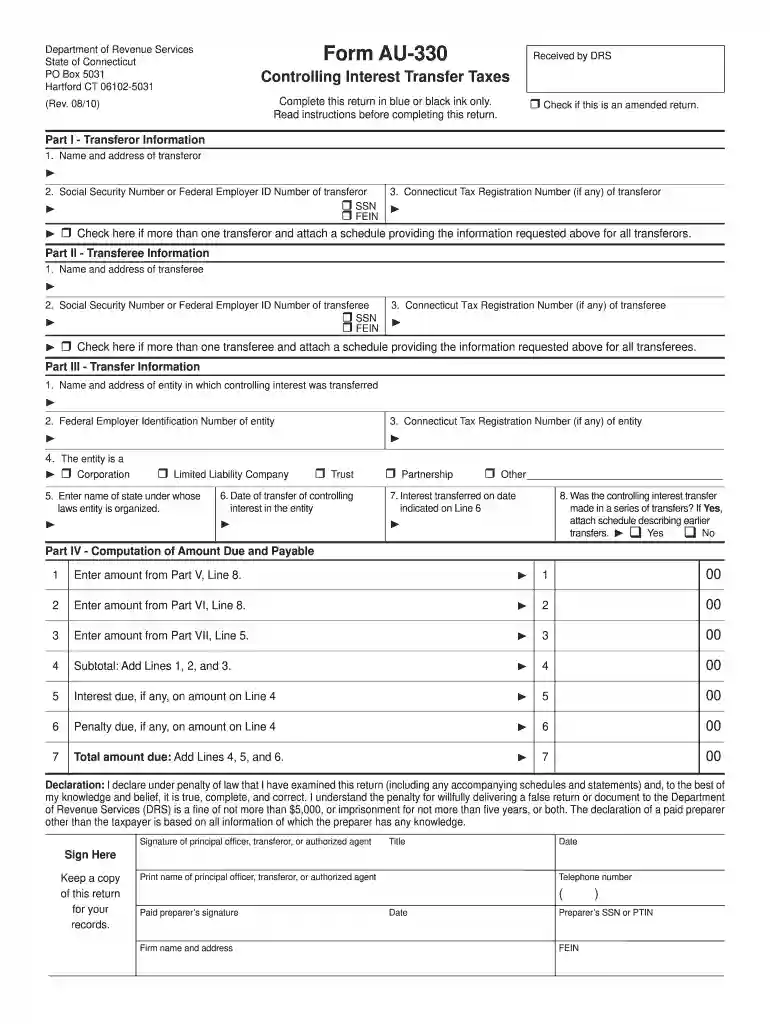
Click ‘Get Form’ to open it in the editor.
Begin with Part I, where you will enter the transferor's information. Fill in the name, address, and either the Social Security Number or Federal Employer ID Number. If there are multiple transferors, check the box and attach a schedule.
Proceed to Part II for transferee information. Similar to Part I, provide the transferee's name, address, and identification numbers. Again, check if there are multiple transferees.
In Part III, detail the transfer information including the entity's name and address where controlling interest was transferred. Specify the type of entity (e.g., Corporation, LLC) and date of transfer.
Move on to Part IV to compute amounts due. Enter figures from Parts V, VI, and VII as instructed to calculate totals including any penalties or interest.
Finally, complete the declaration section by signing and dating it. Ensure all required fields are filled before submitting your form.
Start using our platform today for free to streamline your form completion process!
What is the controlling interest transfer tax in CT?
The controlling interest transfer tax is imposed on the person selling or transferring the controlling interest at the rate of 1.11% of the present true and actual value of the interest in real property possessed, directly or indirectly, by the entity.
Who pays the transfer tax in CT?
The party responsible for paying a real estate transfer tax varies by state. In Connecticut, the seller is responsible, and this tax must be paid before the deed on the property can be recorded.
What is a Connecticut real estate conveyance tax return?
A grantor, grantors attorney or grantors authorized agent must file Form OP-236, Connecticut Real Estate Conveyance Tax Return, to report any real estate transfer of Connecticut real property by deed or other instrument.
Related Searches
Form au 330 2010 instructionsCt form au 330 instructionsForm au 330 2010 onlineForm au 331Special notice 2003 11 2003 legislation affecting the controlling interest transfer taxes
Security and compliance
At DocHub, your data security is our priority. We follow HIPAA, SOC2, GDPR, and other standards, so you can work on your documents with confidence.
AU-330, Form Inst. Controlling Interest Transfer Taxes. AU-330I, Form Inst. Instructions for the Controlling Interest Transfer Taxes. AU-331. Form Inst.Read more
Cookie consent notice
This site uses cookies to enhance site navigation and personalize your experience.
By using this site you agree to our use of cookies as described in our Privacy Notice.
You can modify your selections by visiting our Cookie and Advertising Notice.