




01. Edit your form online
Type text, add images, blackout confidential details, add comments, highlights and more.

Type text, add images, blackout confidential details, add comments, highlights and more.

Draw your signature, type it, upload its image, or use your mobile device as a signature pad.

Send it via email, link, or fax. You can also download it, export it or print it out.
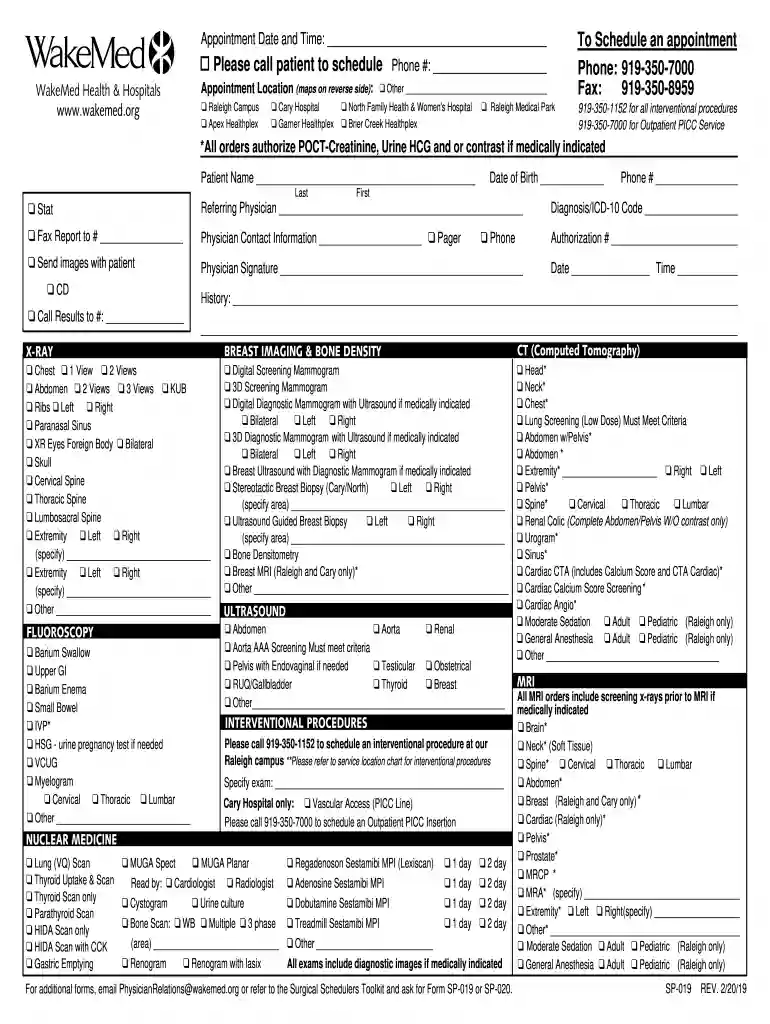
Patient and Physician Forms for WakeMed Health and Hospitals are critical documents used to facilitate the scheduling and coordination of medical services. These forms gather essential information regarding patient demographics, medical history, and specific healthcare needs. They are designed to streamline the process for booking various medical procedures, including diagnostic imaging and interventional services like X-rays, MRIs, and CT scans. By providing a comprehensive overview of patient and physician details, these forms support efficient communication and planning between healthcare providers and patients.
Using these forms involves several steps to ensure all necessary information is accurately captured. Typically, patients are required to fill out personal and insurance details, while physicians provide healthcare directives or specific procedural requests. Here's a simplified process:
These forms can be obtained directly from the WakeMed Health and Hospitals website or by visiting the respective medical facility. They are sometimes provided by healthcare professionals during consultations. For convenience, patients can also request digital copies via email, facilitating easy access and digital submission if necessary.
To accurately complete these forms, adhere to the following step-by-step instructions:
The efficacy of these forms lies in their ability to organize critical information that enhances the quality of care and reduces delays in treatment. By providing a structured format for data collection, they help minimize errors and ensure that both patients and healthcare providers have mutual understanding and agreement on medical procedures and necessities.
These documents are primarily utilized by individuals seeking medical services at WakeMed Health and Hospitals, healthcare providers needing to record patient information and procedural orders, and administrative staff responsible for scheduling and managing patient appointments.
Understanding the terminology can aid in completing the forms accurately. Key terms include:
Legally, these forms serve as a binding agreement between the patient and healthcare provider, affirming that both parties understand the scheduled treatments and procedures. They ensure compliance with healthcare laws, such as HIPAA, by safeguarding patient information and requiring consent for data use and sharing.
The forms typically include sections for:
Different forms might exist depending on specific medical services or departments. For example, there might be dedicated forms for diagnostic imaging versus surgical procedures, each tailored to capture unique sets of data pertinent to the treatment.
At DocHub, your data security is our priority. We follow HIPAA, SOC2, GDPR, and other standards, so you can work on your documents with confidence.


