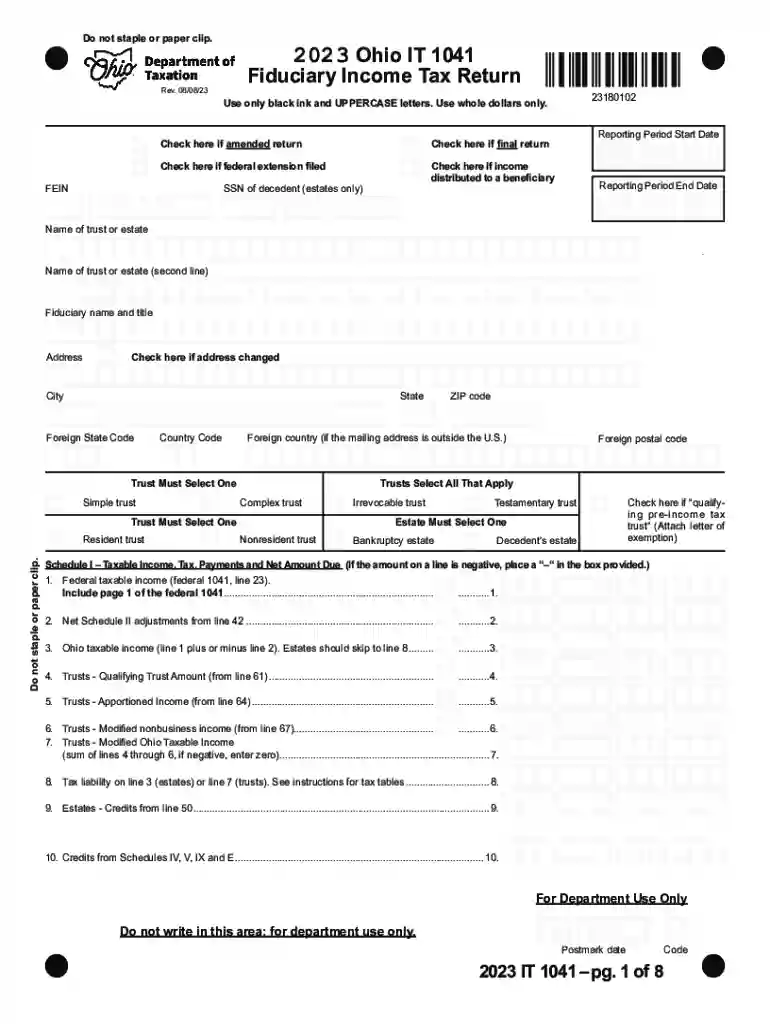
Pass-Through Entity and Fiduciary Income Tax Updates 2026

Get Form
Pass-Through Entity and Fiduciary Income Tax Updates Preview on Page 1

Here's how it works

01. Edit your form online
Type text, add images, blackout confidential details, add comments, highlights and more.

02. Sign it in a few clicks
Draw your signature, type it, upload its image, or use your mobile device as a signature pad.

03. Share your form with others
Send it via email, link, or fax. You can also download it, export it or print it out.

Definition and Meaning

Pass-through entities and fiduciary income tax refer to the taxation mechanisms applied to certain business structures and trusts. Pass-through entities include businesses like partnerships, S corporations, and some LLCs, where income is passed directly to the owners or investors and taxed at their individual tax rates. This tax structure avoids the double taxation scenario commonly found in C corporations, where profits are taxed at the corporate level and again as dividends. Fiduciary income tax applies to estates and trusts, where the fiduciary is responsible for filing and paying taxes on income generated by these entities.

Key Elements of Pass-Through Entity and Fiduciary Income Tax Updates

Key elements of the tax updates include any changes to the taxation rates, deductions, credits, and compliance requirements for pass-through entities and fiduciaries. Updates often involve adjustments to tax brackets or income thresholds, impacting how much tax an entity must remit. They may also include new reporting requirements or documentation necessary to ensure compliance with revisions in tax law.

Detailed Components

  • Income Classification: Determining what constitutes taxable income, such as returns on investments, rental incomes, or royalties for estates and trusts.
  • Deductions and Credits: Identifying applicable deductions such as business expenses for pass-through entities and specific credits for modifying taxable income.
  • Compliance and Reporting: Understanding updated forms and documentation required to file taxes correctly under new regulations.

Steps to Complete the Pass-Through Entity and Fidiciary Income Tax Updates

Completing tax updates involves several steps to ensure accuracy and compliance.

  1. Review Current Tax Laws: Stay informed about any changes in tax legislation affecting pass-through entities and fiduciaries.
  2. Gather Required Documents: Collect all necessary documentation, such as income statements, expense receipts, and prior year tax returns.
  3. Calculate Taxable Income: Determine the total taxable income using updated thresholds and formulas specified in recent updates.
  4. File Appropriate Forms: Use current forms like the IRS Form 1065 for partnerships or Form 1041 for fiduciary income tax filings.
  5. Submit by Deadline: Ensure forms are completed and submitted by the established deadlines to avoid penalties.

Important Terms Related to Pass-Through Entity and Fiduciary Income Tax Updates

Understanding specific terminology is crucial for managing pass-through and fiduciary tax processes.

  • Schedule K-1: A form used by various entities to report the taxpayer's share of income, deductions, and credits.
  • Distributable Net Income (DNI): The taxable amount that a trust or estate can distribute to its beneficiaries.
  • Qualified Business Income (QBI): An income deduction available to eligible pass-through entities under the Tax Cuts and Jobs Act.

Who Typically Uses the Pass-Through Entity and Fiduciary Income Tax Updates

These tax updates apply to individuals and entities involved in managing estates, trusts, and pass-through businesses. Typical users include:


  • Business Owners: Partners in partnerships or shareholders in S corporations.
  • Fiduciaries: Executors or trustees managing estates and trusts.
  • Tax Professionals: CPAs and tax advisors assisting with compliance and tax strategies.
decoration image ratings of Dochub

Legal Use of the Pass-Through Entity and Fiduciary Income Tax Updates

Compliance with updated tax laws ensures lawful operations and avoidance of penalties. Legal usage involves understanding and implementing current tax rules and regulations through accurate documentation and timely submissions.

Compliance Requirements

  • Accurate Reporting: Ensuring all income and deductions are correctly reported according to legal standards.
  • Filing Timeliness: Filing within prescribed deadlines to maintain compliance with state and federal regulations.

State-Specific Rules for the Pass-Through Entity and Fiduciary Income Tax Updates

States may impose additional requirements or distinctions that impact how pass-through entities and fiduciaries handle taxes. Differences in state tax laws can affect:

  • Tax Rates: Variations in state tax rates applied to trust and estate income or qualifying business income.
  • Filing Requirements: Specific state forms or additional information required for accurate tax filings.

Examples of Variations

  • California imposes a greater complexity in its tax code for pass-through entities, introducing minimum tax requirements and additional filing responsibilities.
  • New York may have composite filing options for partnership tax reporting, simplifying tax responsibilities for members.

Penalties for Non-Compliance

Failure to comply with pass-through and fiduciary tax requirements can result in significant penalties.

  • Monetary Fines: Penalties often involve fines calculated as a percentage of taxes owed or flat rates for late submissions.
  • Legal Consequences: Persistent non-compliance may result in increased scrutiny or audits from tax authorities.

Avoiding Penalties

  • Timely Submissions: Adhere to all filing deadlines.
  • Accurate Reporting: Ensure all entries are correct to prevent audits and associated penalties.
be ready to get more

Complete this form in 5 minutes or less

Get form

Got questions?

We have answers to the most popular questions from our customers. If you can't find an answer to your question, please contact us.
Contact us
Pass-through income is only subject to a single layer of income tax and is generally taxed as ordinary income up to the maximum 37 percent rate. However, certain pass-through income is eligible for a 20 percent deduction, which reduces the top tax rate to a maximum of 29.6 percent.
This deduction is commonly referred to as the pass-through deduction or qualified business income (QBI) deduction. Pass-through business owners who qualify can deduct up to 20% of their net business income from their income taxes, reducing their effective income tax rate by 20%.
Since the IRS approved the concept in 2020, three dozen states have enacted laws allowing pass-through entities to use a PTET to avoid the SALT deduction cap. The new tax law increases the limit on the SALT cap to $40,000 annually ($20,000 for married couples filing separately) and will adjust for inflation.
Pass-through entities are businesses that pass their income directly to their owners, shareholders, or investors. Revenues are taxed only on individuals, not on the entity itself.
Because the cap applies to personal income taxes but not business income taxes, many states have enacted entity-level taxes on pass-through businesses, which can deduct that tax fully on their federal returns.

Security and compliance

At DocHub, your data security is our priority. We follow HIPAA, SOC2, GDPR, and other standards, so you can work on your documents with confidence.
Learn more
ccpa2
pci-dss
gdpr-compliance
hipaa
soc-compliance

People also ask

Major Exemptions Real estate investment trusts, regulated investment companies, and real estate mortgage investment conduits. Entities with no qualifying investors. The following individuals and entities are not qualifying investors: Individuals who are residents of Ohio for the entire year.
Pass-through entity income is the income that any partnership, subchapter S corporation, or trust passes through to its partners, shareholders, or beneficiaries. Pass-through entity income is considered earned on the last day of the pass-through entitys tax year.
199A Deduction) The Tax Cuts and Jobs Act (TCJA) created a deduction for households with income from sole proprietorships, partnerships, and S corporations, which allows taxpayers to exclude up to 20 percent of their pass-through business income from federal income tax.

Related links