




01. Edit your form online
Type text, add images, blackout confidential details, add comments, highlights and more.

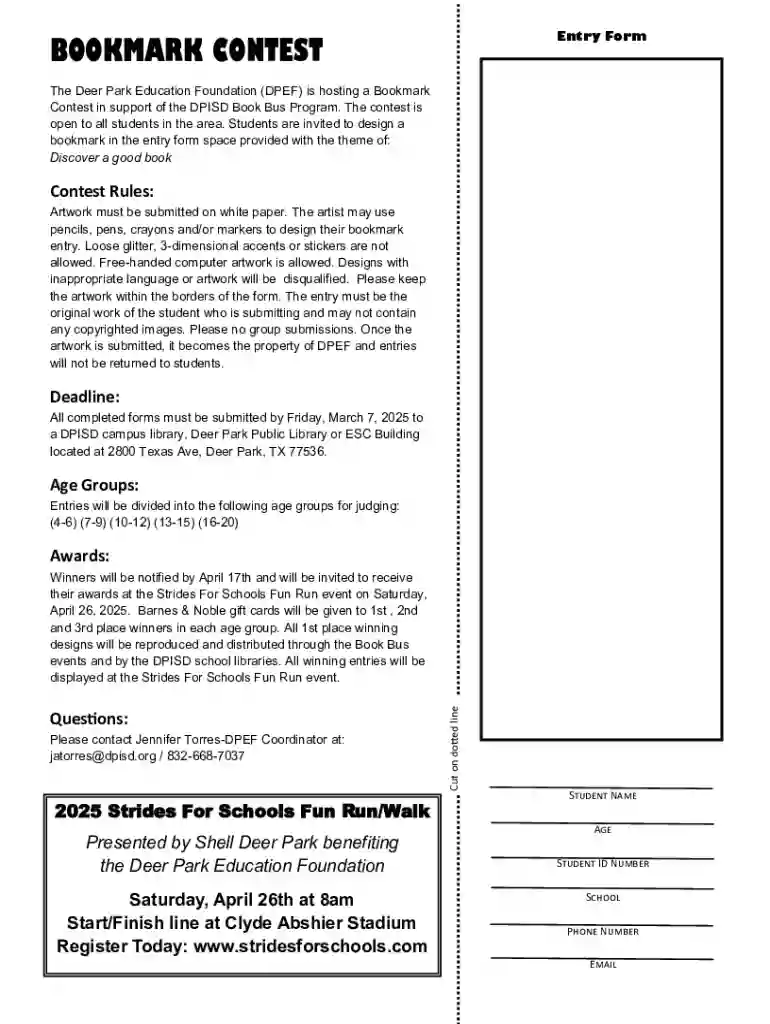
Type text, add images, blackout confidential details, add comments, highlights and more.

Draw your signature, type it, upload its image, or use your mobile device as a signature pad.

Send it via email, link, or fax. You can also download it, export it or print it out.
An entry form is a document that facilitates the collection and submission of information for participation in events, contests, or applications. These forms are utilized across various sectors, such as education, business, and entertainment, to systematically gather necessary data from participants. They serve as a foundational element in organizing events by ensuring that each entry is registered, categorized, and evaluated as per the required criteria.
Entry forms are seen in various real-world scenarios, such as contests, where participants need to submit their details to enter. For example, a photography contest might use an entry form to capture each participant's contact information and photograph details. Additionally, these forms can be crucial in academic contexts, such as competitions or school events, where structured data collection is necessary for managing large volumes of participants.
Utilizing an entry form involves a clear understanding of its structure and the information it seeks to capture. This typically includes sections for personal details, specific responses or attachments corresponding to the contest rules, and any necessary declarations or agreements.
Review Guidelines: Begin by thoroughly reviewing the guidelines attached to the entry form. This ensures comprehension of prerequisite conditions and expectations.
Personal Information: Fill in any requested personal information, such as name, contact details, and address, ensuring precision to avoid discrepancies.
Specific Entries: Depending on the form's purpose, include specific content or attachments, such as writing samples for a literary contest or artwork submissions for art competitions.
Declarations: Conclude by signing any declarations or agreements included in the form to confirm your understanding and acceptance of the terms and conditions.
Submission: Follow the prescribed method for submission, be it digital, mail, or in-person.
Entry forms can be sourced from multiple channels, depending on their intended use and the issuing body. Understanding the preferred method of acquisition can streamline the application process.
Online Portals: Many organizations provide digital access to entry forms through their official websites, allowing for direct download or completion.
Physical Locations: For events organized by local institutions or companies, physical entry forms might be available at designated centers or offices.
Event Mailers: Occasionally, forms might be distributed through newsletters or event mailers, particularly for niche or community-based events.
The availability of entry forms online offers significant advantages, such as ease of access from any location, quick dissemination of up-to-date information, and the ability to facilitate electronic submissions, which expedites processing and reduces paperwork.
Completing an entry form effectively requires attention to detail and adherence to outlined instructions. Each section of the form serves a specific purpose, contributing to the holistic submission process.
Instructions Review: Thoroughly read any accompanying instructions or guidelines to ensure familiarity with all requirements.
Filling Out Details: Carefully enter all personal and required specific information in the appropriate fields. Use legible handwriting if filling out a paper form, or ensure digital entries are accurately typed.
Double-Check Entries: Revisit each entry to verify the accuracy and completeness of the information provided.
Attachments and Additional Information: Include any additional documentation or files as required by the form.
Submission and Confirmation: Submit the entry form through the specified channel and seek confirmation regarding its receipt and completeness.
Securing confirmation on the receipt of the entry form is crucial as it ensures the form has been successfully submitted and will be processed. This step helps prevent miscommunications or lost entries, which could impede participation.
Understanding the various components is essential for correctly completing an entry form. Each element is designed to collect requisite details efficiently and thoroughly.
Personal Details Section: Captures essential identification information such as name, age, contact info, and address.
Event-Specific Sections: Allows participants to provide details directly relevant to the entry, like a title, type, or category of a submission.
Consent and Agreement Clauses: Outlines required legal or procedural acknowledgments which must be signed off by the participant.
Submission Checklists: Ensures completeness by listing all required documents, attachments, or sections that need to be filled.
These components ensure that all necessary information is collected in a uniform manner, facilitating efficient processing and reducing errors or omissions that could affect the entry's validity.
Entry forms often incorporate elements that pertain to legal compliance, especially in terms of data protection, participant consent, and usage rights of submitted materials.
Data Protection: Entry forms must stipulate how participant data will be stored, used, and protected under applicable privacy laws.
Intellectual Property Rights: Where applicable, forms must clarify the intellectual property status of submissions, including any transfer or sharing of rights with the event organizers.
Terms of Participation: Forms usually require participant acknowledgment of competition terms, rules, and any legal responsibilities associated with their submission.
Ensuring legal compliance safeguards both organizers and participants, providing a clear framework for how entries are used, handled, and evaluated under applicable laws and regulations.
Submission of an entry form often requires additional documentation to verify participant details and eligibility, or to supplement the entry itself.
Identification Proofs: May be needed to verify participant's identity and eligibility; typical documents include a driver’s license or passport.
Proof of Eligibility: Could include licenses, certifications, or previous work that aligns with the contest or event's requirements.
Submission Supplements: Depending on the nature of the entry, additional documents such as resumes, portfolios, or reference letters may be required.
Providing necessary documents in conjunction with the entry form ensures that all eligibility and participation criteria are transparently fulfilled, enhancing the legitimacy and completeness of the submission.
The method of entry form submission can significantly impact accessibility, participant convenience, and processing efficiency.
Online Submissions: Allow participants to complete and submit their entries digitally through an online portal or email, offering convenience and rapid acknowledgment.
Mail Submissions: Participants can send physical forms and any required attachments through postal services, which may include proof of postage for security.
In-Person Drop-off: Some organizations may offer on-site submission options, which can ensure direct delivery and immediate feedback regarding the completeness of the entry.
The choice of submission method may depend on factors such as the urgency of submission, access to digital resources, and participant preferences, influencing efficiency and form handling.
We've got more versions of the Entry Form form. Select the right Entry Form version from the list and start editing it straight away!
At DocHub, your data security is our priority. We follow HIPAA, SOC2, GDPR, and other standards, so you can work on your documents with confidence.


