Accident Report for School Vehicles 2026

Get Form
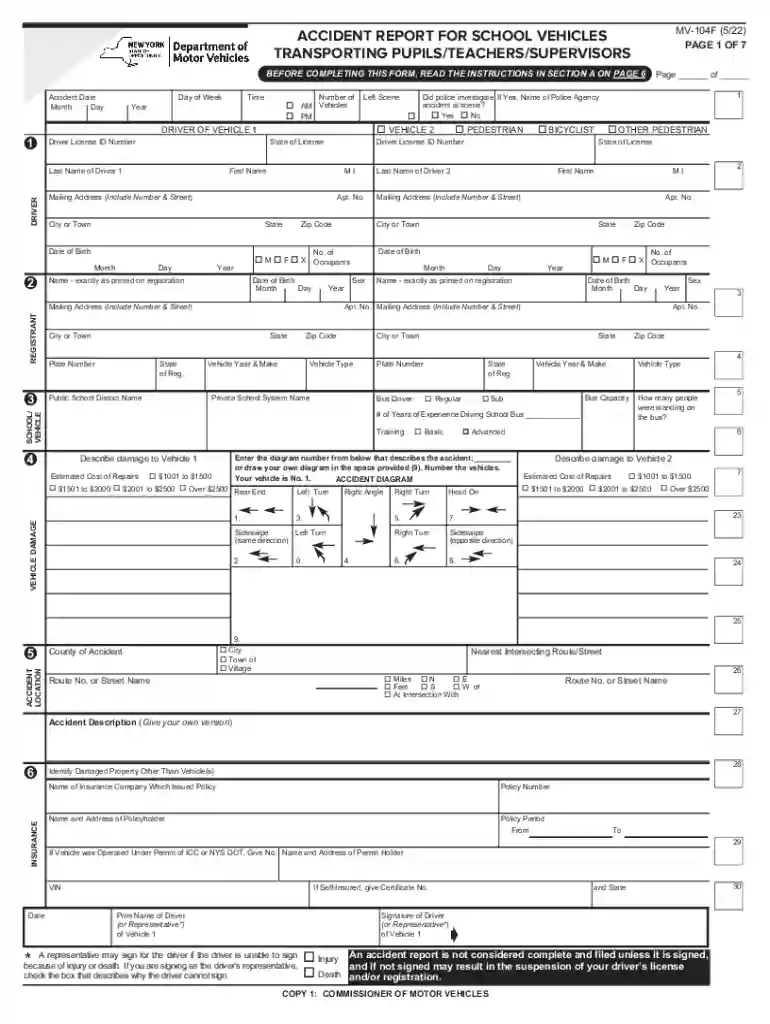
Accident Report for School Vehicles Preview on Page 1

Here's how it works

01. Edit your form online
Type text, add images, blackout confidential details, add comments, highlights and more.

02. Sign it in a few clicks
Draw your signature, type it, upload its image, or use your mobile device as a signature pad.

03. Share your form with others
Send it via email, link, or fax. You can also download it, export it or print it out.

Definition and Meaning

The Accident Report for School Vehicles, known as form MV-104F, is a critical document used to collect comprehensive details about any incident involving school transportation. This form is designed specifically for vehicles that transport students, teachers, and supervisors to ensure their safety and accountability in the event of an accident. The report seeks to gather detailed information surrounding the circumstances of the accident, including data on the drivers, vehicles, damages, injuries, and insurance details. By mandating this comprehensive reporting, the form serves to facilitate legal compliance, aid in insurance claims, and enhance safety procedures.

Steps to Complete the Accident Report for School Vehicles

Completing the MV-104F requires precision and attention to detail to ensure accurate reporting. Below are step-by-step instructions for filling out the form:

  1. Accident Details: Start by providing the date, time, and precise location of the accident. This information sets the context for the entire report.
  2. Vehicle Information: Include details about all vehicles involved, such as make, model, year, and license plate number.
  3. Driver Information: Record the name, address, and driver's license number of each driver involved.
  4. Witness Information: If available, document the names and contact details of any witnesses to the incident.
  5. Accident Description: Provide a clear and detailed description of how the accident occurred, including road and weather conditions.
  6. Damage and Injury Assessment: Clearly describe any injuries to individuals and any damage to vehicles or property involved.
  7. Insurance Information: Supply insurance policy numbers and contact information for all parties involved.

Review and Signature

  • Ensure all parts are filled out completely and accurately.
  • The driver or an authorized representative must sign the form. If the driver is unable to sign due to injury or other circumstances, a representative may do so.

Legal Use of the Accident Report for School Vehicles

The MV-104F form carries legal implications as it serves as official documentation of the incident. It is used by insurance companies, legal entities, and school authorities to determine liability, assist in investigations, and implement preventive measures. Moreover, since the report must be submitted within ten days of the accident, it is crucial for compliance with state laws regarding timely and accurate accident reporting. Failure to submit the report within the specified timeframe can result in legal penalties and complications in claims processing.

Key Elements of the Accident Report for School Vehicles

Several critical elements must be included within the MV-104F to ensure comprehensive documentation:

  • Accident Environment: Captures conditions such as lighting, weather, and road surface at the time of the incident.
  • Driver Behavior: Details actions performed by drivers involved, such as signaling, turning, or abrupt stopping.
  • Injury Classification: Categorizes injuries sustained, ranging from minor to severe, assisting in possible medical claims.
  • Damage Evaluation: Involves assessing vehicle damage regarding severity, which can influence insurance settlements.
  • Collision Type: Describes the manner of collision, whether frontal, rear-end, side-impact, etc.

Who Typically Uses the Accident Report for School Vehicles

The primary users of the MV-104F form include school transportation officials, insurance adjusters, and legal professionals. School administrators and safety officers utilize the form to enhance safety protocols and training. Insurance companies rely on the form to process claims and assess liabilities. Legal professionals may use the document during litigation processes to establish facts and arguments.


decoration image ratings of Dochub

State-Specific Rules for the Accident Report for School Vehicles

While form MV-104F is standardized, individual states may impose specific rules regarding its completion and submission. For instance, jurisdictions may have variations in filing deadlines, additional fields to complete, or distinct submission methods. It is essential for users to familiarize themselves with these localized requirements to ensure compliance and proper documentation.

Important Terms Related to the Accident Report for School Vehicles

Understanding key terms associated with the MV-104F can aid in correctly completing the form:

  • Negligence: A failure to exercise the care that a reasonably prudent person would exercise in similar circumstances.
  • Liability: Legal responsibility for one's actions or omissions.
  • Personal Injury: Harm caused to a person due to an accident, prompting potential medical or legal action.
  • Subrogation: The right for insurers to pursue a third party responsible for an insurance loss to the insured.

Examples of Using the Accident Report for School Vehicles

Consider the following scenario: A school bus carrying 25 students is involved in a minor rear-end collision with a private vehicle. The driver uses the MV-104F form to document the incident, noting the absence of injuries, minor bumper damage to both vehicles, and the road conditions. An accurate and detailed report assists the school district and insurance company in swiftly resolving the claim. Another example might involve an accident occurring during adverse weather conditions, where vehicle speed and driver maneuvers are crucial details in determining liability.

be ready to get more

Complete this form in 5 minutes or less

Get form

Got questions?

We have answers to the most popular questions from our customers. If you can't find an answer to your question, please contact us.
Contact us
What are the five rules of incident report writing? Timeliness: Always report the incident as soon as possible. Accuracy: Make sure all information provided is accurate and detailed. Completeness: Be thorough and provide all important details. Confidentiality: Handle sensitive and personal information carefully.
How to write a workplace incident report Gather essential information. Describe the incident. Include injuries and damages. Interview witnesses. Identify contributing factors. Review company policies and procedures. Attach supporting documents. Maintain objectivity.
What Should I Include In An Accident Report? Date, time, and location. Parties involved, including insurance information. Injuries and damages. Witness statements and contact information. Sequence of events describe what happened. Photographs and sketches.
Does it adequately answer the 5 W and one H questions: what, where, when, who, why, and how? These same questions structure Barry Poyners method of crime analysis by breaking up a larger problem into its constituent parts.
However, if youre at fault, the bus company might seek compensation for damages to their vehicle and for any injured passengers. Whether you hit a bus or were injured as a bus passenger, the key to securing compensation often lies in proving negligence.

Security and compliance

At DocHub, your data security is our priority. We follow HIPAA, SOC2, GDPR, and other standards, so you can work on your documents with confidence.
Learn more
ccpa2
pci-dss
gdpr-compliance
hipaa
soc-compliance

People also ask

Describe the accident clearly and concisely. Include the following: Involved Parties: Names and contact information of all drivers and passengers. Vehicles: Make, model, and license plate numbers. Description of Events: What happened leading up to the accident, the nature of the collision, any weather conditions, etc.
There are five key details of accidents legally required: Full name, address and occupation of the injured person (a) Date and time of the accident (b) Location of the accident (c) Cause and nature of the injury (d) Name, address and occupation of the person giving the notice, if other than the injured person (e).
What to Include in an Incident Report General information. Setting or environment. Affected people. Injuries and the severity. Witnesses. Administered treatment. Property and equipment damages. Events.

Related links