




01. Edit your form online
Type text, add images, blackout confidential details, add comments, highlights and more.

Type text, add images, blackout confidential details, add comments, highlights and more.

Draw your signature, type it, upload its image, or use your mobile device as a signature pad.

Send it via email, link, or fax. You can also download it, export it or print it out.
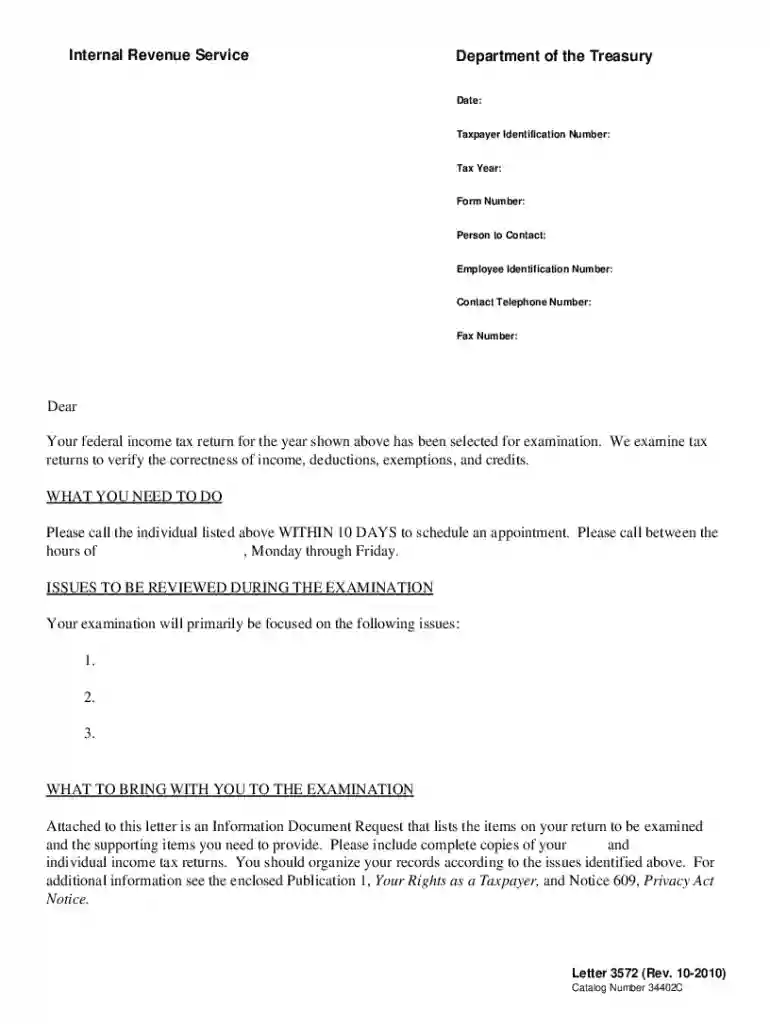
The Letter 3572 (Rev 10-2010) Exam Call-Back Letter is an official communication from the Internal Revenue Service (IRS). It notifies a taxpayer that their federal income tax return has been selected for examination. The letter is a crucial part of the IRS auditing process and contains directives for the taxpayer to follow, including scheduling an appointment and the type of documentation needed for the examination. Understanding this document's role is essential, as it outlines precise steps required to comply with IRS inquiries.
This letter is important because it officially initiates an audit process with the IRS, which requires timely and accurate taxpayer responses. The letter ensures taxpayers provide necessary information and documents to validate their tax return details. Responding appropriately helps avoid penalties and can prevent further complications during the audit. The letter acts as a formal channel of communication, setting the framework for the exchange of information between the taxpayer and the IRS.
Review the Letter Carefully: Understand the scope of the audit and what is required of you. Pay attention to deadlines and instructions provided.
Contact the IRS: Schedule an appointment within ten days as instructed in the letter to comply with IRS requirements and discuss any preliminary questions.
Gather Required Documents: Prepare necessary documentation, such as income records, receipts, and any relevant financial information requested by the IRS.
Attend the Examination: Present yourself at the scheduled appointment with all required documentation and be prepared to address IRS queries regarding your tax return submission.
Follow-Up Action: After the examination, comply with any additional requests from the IRS to resolve outstanding issues concerning your tax return.
The Letter 3572 serves as a legally binding communication tool that enforces compliance in the context of federal tax examination processes. The letter acts as an official notification that demands a taxpayer's response under legal authority. Non-compliance with the instructions could lead to legal consequences, including penalties or further investigation. Understanding the legal implications of this letter helps taxpayers properly address IRS requests.
Typically, this letter is issued to taxpayers whose returns have been selected for examination due to discrepancies or targeted audits. Individuals, businesses, or entities that report unusual financial activity, high deductions, or discrepancies between reported income and third-party reports most often receive such notifications. Understanding the criteria that might lead to receiving this letter can help taxpayers prepare for potential audits in advance.
In preparation for an IRS examination resulting from a Letter 3572 notification, taxpayers should collect:
The IRS letter will likely provide specific guidance on any additional documentation required.
The IRS outlines specific guidelines and procedures for tax examinations. Understanding these can better prepare taxpayers for what to anticipate during the audit. The IRS Examination Guidelines stress the importance of accuracy, timeliness, and cooperation from taxpayers. They include procedures for reviewing tax returns, conducting face-to-face interviews, and detailing how discrepancies will be handled.
Failure to respond to the Letter 3572 or comply with IRS requests can result in significant penalties. Non-compliance might lead to the development of additional tax liabilities, financial penalties, or legal ramifications. Non-cooperation can also prolong the audit process and lead to further scrutiny or interest charges on unpaid taxes. Understanding these risks highlights the importance of responding appropriately to all IRS communications.
The IRS may use both digital and paper versions of the Letter 3572. While traditional mailing is common, digital communication channels may provide a faster, more efficient means for receiving the letter and, where applicable, submitting required documents. Taxpayers should ensure they maintain up-to-date contact information with the IRS to facilitate reliable communication.
Individuals who have experienced income discrepancies between their filed returns and third-party reports are common recipients of this letter. For instance, self-employed individuals might receive this letter if their reported income significantly differs from the amounts reported by clients. Another scenario could involve business entities with exaggerated expense claims compared to industry standards. These examples show the range of situations where the letter might apply and the importance of proactive compliance.
We've got more versions of the Letter 3572 (Rev 10-2010) Exam Call-Back Letter form. Select the right Letter 3572 (Rev 10-2010) Exam Call-Back Letter version from the list and start editing it straight away!
At DocHub, your data security is our priority. We follow HIPAA, SOC2, GDPR, and other standards, so you can work on your documents with confidence.


