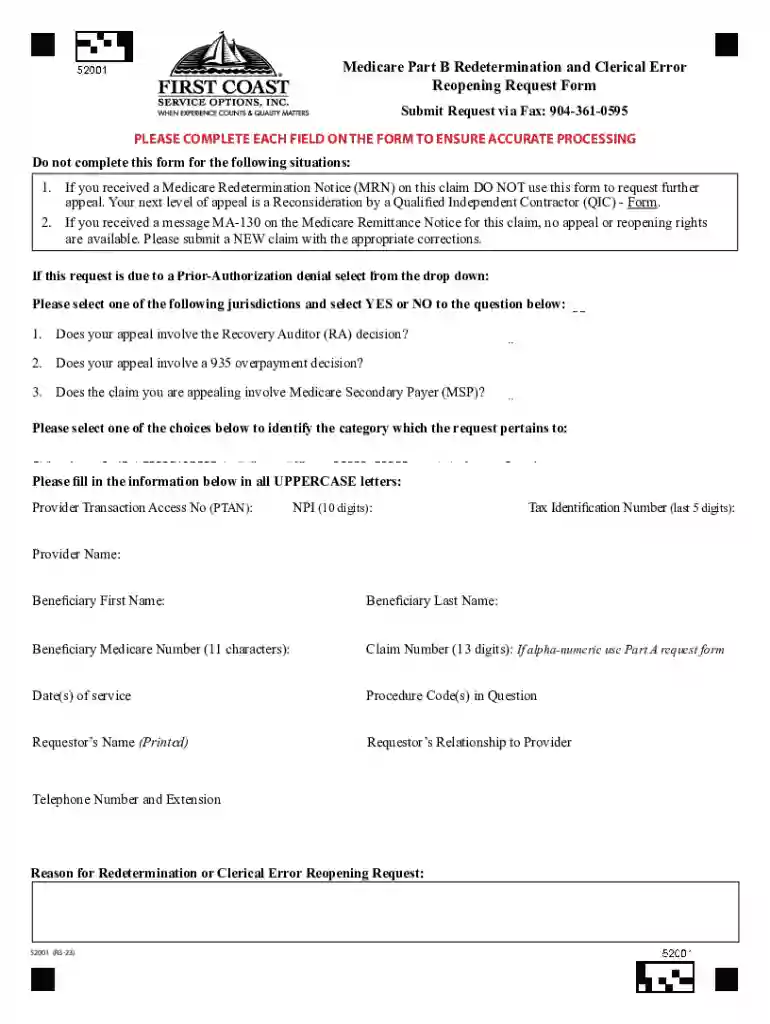
Medicare Part B Redetermination and Clerical Error Reopening Request Form 2026

Get Form
Medicare Part B Redetermination and Clerical Error Reopening Request Form Preview on Page 1

Here's how it works

01. Edit your form online
Type text, add images, blackout confidential details, add comments, highlights and more.

02. Sign it in a few clicks
Draw your signature, type it, upload its image, or use your mobile device as a signature pad.

03. Share your form with others
Send it via email, link, or fax. You can also download it, export it or print it out.

Definition & Meaning

The "Medicare Part B Redetermination and Clerical Error Reopening Request Form" is a specialized document used primarily in the United States healthcare system. It serves as a means for healthcare providers and beneficiaries to request a review or correction of a claim processed under Medicare Part B. This form is essential when a provider believes a claim was denied or paid incorrectly due to a clerical error. The redetermination process allows further examination of the claim decision, ensuring accurate processing and reimbursement. Understanding this form is crucial for both providers and beneficiaries wishing to challenge a decision made by Medicare Part B.

How to Use the Medicare Part B Redetermination and Clerical Error Reopening Request Form

To effectively use the Medicare Part B Redetermination and Clerical Error Reopening Request Form, follow a structured approach:

  1. Identify the Need for Review: Ascertain if your situation warrants a redetermination or clerical error correction. Common scenarios include incorrect payment amounts or unjust claim denials.

  2. Gather Necessary Information: Prepare detailed documentation, such as the original claim details and any relevant communications or notices related to the decision.

  3. Complete the Form: Carefully fill out each section of the form, ensuring accuracy in the information provided. This includes details about the provider, beneficiary, claim, and specific reasons for the redetermination request.

  4. Submit the Form: Utilize appropriate submission methods, such as mailing to the designated Medicare contractor address or electronic submission if available.

  5. Track Your Request: Retain copies of all documentation and monitor the status of your redetermination request to ensure timely processing.

Steps to Complete the Medicare Part B Redetermination and Clerical Error Reopening Request Form

Completing this form requires careful attention to detail. Here’s a step-by-step guide:

  1. Provider Information: Include the provider’s National Provider Identifier (NPI), name, address, and contact information.

  2. Beneficiary Information: Provide the beneficiary’s Medicare number, full name, and address.

  3. Claim Details: Enter the specific claim number related to the redetermination request, along with service dates and any original decision notices.

  4. Reason for Request: Clearly articulate why a redetermination is necessary, citing specific errors or discrepancies observed in the claim processing.

  5. Documentation Support: Attach any supporting documents such as remittance notices and medical records that reinforce the request’s validity.

  6. Signature and Date: Ensure the form is signed and dated by the requesting party, confirming the accuracy of the information provided.

Important Terms Related to Medicare Part B Redetermination and Clerical Error Reopening Request Form

Several key terms are critical in understanding this form:

  • Redetermination: The process of requesting a re-evaluation of a claim decision by Medicare Part B.
  • Clerical Error: Mistakes in processing that can affect claim outcomes, such as data entry errors or misinterpretations.
  • Remittance Notice: A document detailing how a claim was processed, often containing crucial information for redetermination requests.
  • Medicare Contractor: The entity responsible for handling Medicare Part B claims and processing redeterminations.

Key Elements of the Medicare Part B Redetermination and Clerical Error Reopening Request Form

This form comprises several integral components:

  • Provider and Beneficiary Identification: Ensures accurate identification of the parties involved.
  • Claim and Service Details: Critical for pinpointing errors and facilitating proper review.
  • Justification for Redetermination: A narrative or documented explanation supporting the request.
  • Supporting Documentation: Essential for providing evidence and context to substantiate the request.

Form Submission Methods (Online / Mail / In-Person)

Submitting the Medicare Part B Redetermination and Clerical Error Reopening Request Form can be done through various channels:

  • Mail: Traditional mailing to the address specified by the Medicare contractor handling your claims offers a reliable submission method.
  • Online: Some offices may offer electronic submission options, streamlining the process and reducing processing times.
  • In-Person: Direct submission at dedicated service centers may be available in certain locations, allowing for immediate confirmation of receipt.

Eligibility Criteria

Determining eligibility for using this form involves understanding specific criteria:

  • Provider Involvement: Typically, healthcare providers initiate the redetermination process when discrepancies or errors affect their compensations.
  • Beneficiary Requests: Beneficiaries can also trigger a redetermination when claim denials impact their out-of-pocket expenses unjustly.
  • Timing Considerations: Requests must be filed within a particular timeframe following the initial claim decision, ensuring timely review and response.
decoration image ratings of Dochub

Legal Use of the Medicare Part B Redetermination and Clerical Error Reopening Request Form

Legal considerations ensure the form is utilized appropriately:

  • The form must be used to address genuine clerical errors or misjudgments in claims processing, avoiding frivolous or unwarranted requests.
  • Ensuring compliance with the legal frameworks governing Medicare Part B is critical, including adherence to deadlines and proper documentation support.
  • Engaging legal counsel or professional advisors may be beneficial for complex cases or when substantial financial impacts are at stake.
be ready to get more

Complete this form in 5 minutes or less

Get form

Got questions?

We have answers to the most popular questions from our customers. If you can't find an answer to your question, please contact us.
Contact us
Reopening versus Redetermination A reopening is a reprocessing of a claim to fix minor mistakes. A redetermination is an examination of a claim that includes analysis of documentation.
For example, a clerical error can be omitting an appendix from a document, typing an incorrect number, mistranscribing a word, or failing to log a call.
A reopening is a remedial action taken to change a binding determination or decision that resulted in either an overpayment or an underpayment, even though the determination or decision was correct based on the evidence of record. Reopenings are separate and distinct from the appeals process.
Overview. If you made a minor error or omission in filing a claim, you can likely submit a reopening request to correct the error rather than file an appeal/redetermination. The easiest, fastest, and most efficient way to correct or reopen a claim is to utilize the myCGS web portal.
Clerical Error Reopening Requests A reopening is a remedial action taken to correct a decision that resulted in an overpayment or underpayment. This action is applicable when the original decision was incorrect based on the evidence of record.

Security and compliance

At DocHub, your data security is our priority. We follow HIPAA, SOC2, GDPR, and other standards, so you can work on your documents with confidence.

Learn more
ccpa2
pci-dss
gdpr-compliance
hipaa
soc-compliance

People also ask

Next, decide how to file your reconsideration: Fill out a Medicare Reconsideration Request Form and send it to the QIC listed on your Medicare Redetermination Notice (MRN), or. Submit a written request to the QIC that includes: Your name, address, and the Medicare Number on your Medicare card [JPG].
(2) Mathematical or clerical error The term mathematical or clerical error means (A) an error in addition, subtraction, multiplication, or division shown on any return, (B) an incorrect use of any table provided by the Internal Revenue Service with respect to any return if such incorrect use is apparent from the
Redetermination is the first step in the Original Medicare appeals process once you have received a Medicare Summary Notice (MSN) with a denial of coverage or payment. It also refers to the first step in the Part D appeals process after the plan denies your coverage determination or exception request.

Related links