




01. Edit your form online
Type text, add images, blackout confidential details, add comments, highlights and more.

Type text, add images, blackout confidential details, add comments, highlights and more.

Draw your signature, type it, upload its image, or use your mobile device as a signature pad.

Send it via email, link, or fax. You can also download it, export it or print it out.
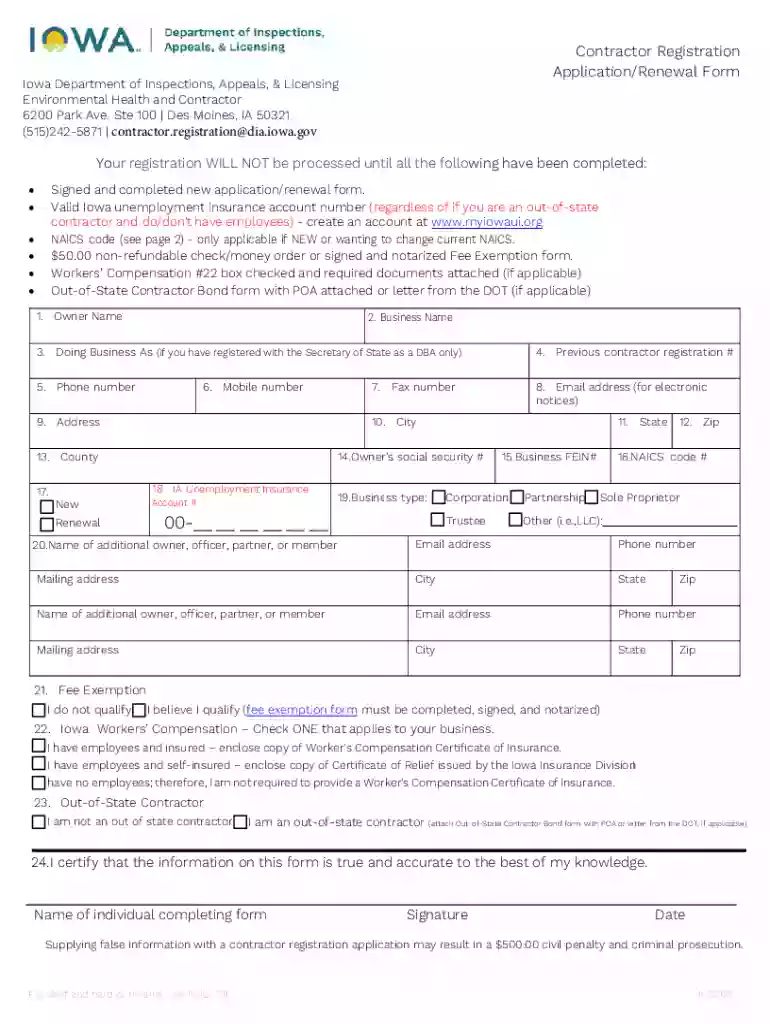
The Contractor Registration Application and Renewal Form is a mandatory document for contractors who wish to operate legally within certain jurisdictions, such as the state of Iowa. This form serves two main purposes: registering new contractors and renewing the registration of existing contractors. It ensures that contractors comply with state regulations by providing necessary documentation, such as proof of insurance, and confirming information such as the contractor’s business type and classification. The form typically requires detailed business and personal information to establish a clear record with the state's Department of Inspections, Appeals, and Licensing.
By ensuring these aspects are thoroughly documented, the form facilitates regulatory compliance while providing essential data to state authorities for oversight and record-keeping.
Gather Necessary Information: Collect essential details about your business, including legal name, business structure, and federal tax ID numbers.
Prepare Insurance Documentation: Secure proof of workers' compensation insurance and any other required insurances from your provider.
Complete the Personal and Business Information Sections: Fill in all relevant fields accurately and ensure that business operations details align with state requirements.
Input Financial and Employment Data: Include your Iowa unemployment insurance account number, if applicable, and verify that employee details are correctly reported.
Review and Attach Supporting Documents: Double-check that all forms are filled accurately, signed where required, and that all supporting documentation is attached.
Submit the Form: Choose your submission method, such as online through the state’s website, or via mail, ensuring that all required sections are completed.
Accurate completion of this form ensures seamless processing and avoids delays that might result in fines or registration issues. Double-checking details and providing complete information is crucial for compliance.
This form is critical for maintaining legal and operational compliance in the contracting industry. By registering, contractors affirm their adherence to state laws regarding business operations, insurance coverage, and tax obligations. It provides a mechanism for state authorities to ensure that contractors operate fairly, protecting both the contractors and the consumers with whom they do business.
The primary users of this form are individual contractors and contracting companies operating or planning to operate within the jurisdiction covered by the form, such as Iowa. This includes general contractors, electricians, plumbers, and other specialized tradespeople. Businesses that employ workers will often require this registration to meet state employment regulations.


The form is also utilized by contracting agencies that require additional permissions due to expanded or new service offerings involving multiple locations or services.
The submission of a Contractor Registration Application and Renewal Form carries legal obligations. Falsifying information or failing to comply with registration requirements can result in penalties, including fines, license suspension, or business closure by state regulatory bodies.
By understanding these legal facets, contractors can navigate the form as part of their broader compliance strategy, ensuring consistency with state requirements.
The form includes several critical sections that require careful attention:
Each of these elements requires accurate and complete details to meet the form's demands, supporting successful registration or renewal.
While many components of the Contractor Registration Application and Renewal Form are standardized, state-specific rules can greatly influence the data requirements and registration process.
Understanding these unique state mandates ensures applicability and effective compliance within Iowa, mitigating potential regulatory challenges.
Filing deadlines and dates directly impact the renewal and registration effectiveness, with missing these dates potentially resulting in business disruptions.
Keeping track of these timelines is vital for continuity in business legitimacy and legal operation, ensuring no lapse in registration status with the state.
By addressing each of these aspects with comprehensive information, the article fully explores the intricacies of the Contractor Registration Application and Renewal Form, illustrating its utility, legal background, and registration process for contractors operating within applicable jurisdictions.
We've got more versions of the Contractor Registration Application and Renewal Form form. Select the right Contractor Registration Application and Renewal Form version from the list and start editing it straight away!
At DocHub, your data security is our priority. We follow HIPAA, SOC2, GDPR, and other standards, so you can work on your documents with confidence.


