Rule 17 200Form 211: Protected Information Disclosure 2026

Get Form
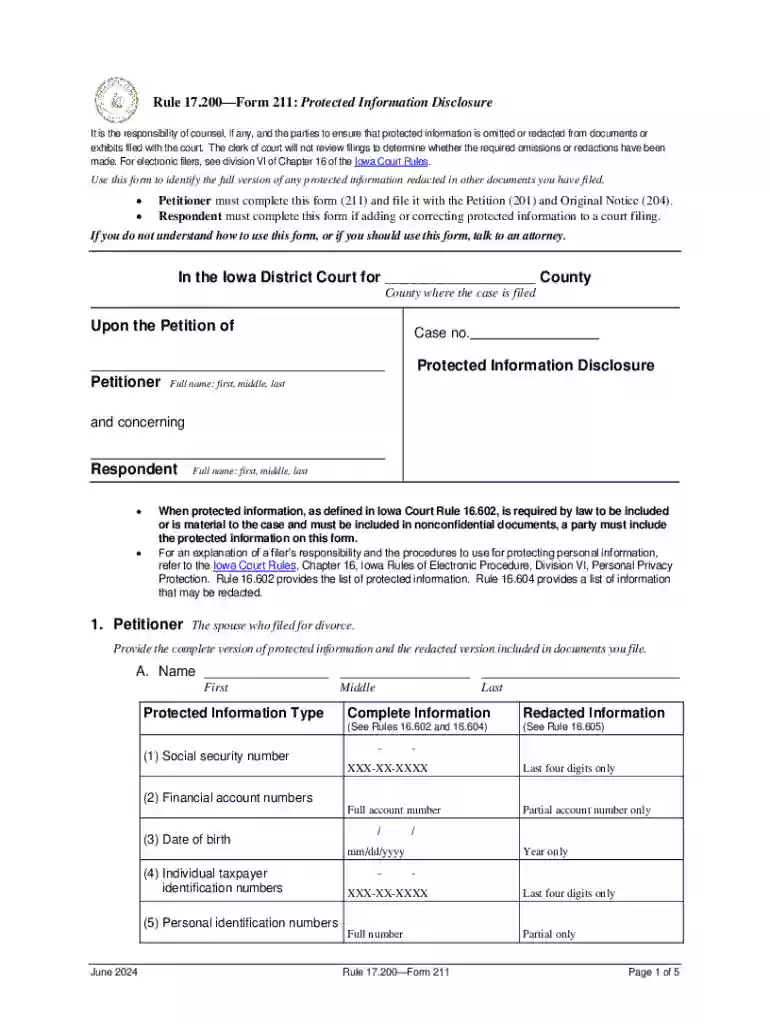
Rule 17 200Form 211: Protected Information Disclosure Preview on Page 1

Here's how it works

01. Edit your form online
Type text, add images, blackout confidential details, add comments, highlights and more.

02. Sign it in a few clicks
Draw your signature, type it, upload its image, or use your mobile device as a signature pad.

03. Share your form with others
Send it via email, link, or fax. You can also download it, export it or print it out.

Definition and Meaning

Rule 17 200Form 211: Protected Information Disclosure is a legal form used in the Iowa District Court system to manage protected information in court filings. This form is part of a broader obligation under Rule 17, ensuring sensitive information like Social Security numbers, financial account details, and personal identifiers are protected from public disclosure. Utilizing this form facilitates the proper disclosure of such information, allowing parties to adhere to the legal requirements for privacy and transparency.

Key Elements of the Form

  • Redaction Responsibility: It is the responsibility of the parties and their legal counsel to redact protected information. The court clerk will not verify filings for compliance with these privacy requirements.
  • Protected Information Types: Includes, but is not limited to, Social Security numbers, financial account numbers, and other sensitive identifiers.
  • Disclosure Process: Parties must submit full versions of redacted information through this form to ensure comprehensive legal records.

How to Use the Rule 17 200Form 211: Protected Information Disclosure

This form is designed to be user-friendly, offering a structured format for detailing protected information that needs redaction in public court documents. Here’s how to effectively use the form:

  1. Identify Redacted Information: Determine which pieces of information in your legal documents need to be redacted to comply with privacy rules.
  2. Complete the Form: Provide complete details of the redacted information in the specific sections dedicated to different entities or individuals involved in the case.
  3. Submission: Submit alongside your court filings to maintain both court privacy standards and the completeness of legal records.

How to Obtain the Rule 17 200Form 211: Protected Information Disclosure

Obtaining this form is straightforward and essential for legal compliance in Iowa courts. Here are steps to acquire the form:

  • Court Website: Visit the official Iowa District Court website to download the latest version of the form. This ensures you have the correct and most current document.
  • Local Court Clerk’s Office: Obtain a physical copy directly from the nearest courthouse. Assistance is often available at clerk’s offices for additional questions.
  • Legal Counsel: Attorneys often maintain copies of necessary forms; consulting with your legal representative can provide direct access to the document.

Steps to Complete the Rule 17 200Form 211: Protected Information Disclosure

Accurate completion of this form is crucial for ensuring legal compliance and safeguarding protected information.

  1. Read Instructions: Before filling out, familiarize yourself with the form’s instructions to prevent errors.
  2. Provide Complete Information: Enter all required details accurately, ensuring every piece of protected information is accounted for within the correct sections.
  3. Review for Accuracy: Double-check each entry for accuracy and completeness to prevent delays or processing issues in court.

Common Errors to Avoid

  • Incomplete Information: Ensure no section is left blank if applicable.
  • Misclassification: Properly categorize information types to fit designated sections.
  • Illegible Entries: If handwriting the form, ensure all information is clear and legible.

Legal Use of the Rule 17 200Form 211: Protected Information Disclosure

The legal implications of the form are significant. Using the form correctly:

  • Ensures Compliance: Helps parties comply with Rule 17’s privacy requirements, protecting sensitive data while maintaining necessary legal record transparency.
  • Prevents Legal Consequences: Inaccurate or incomplete submissions may lead to penalties or adverse rulings due to non-compliance with court standards.

Adhering to State and Federal Guidelines

  • Federal ESIGN Act: Compliance with digital signature standards enhances the form's usability in electronic submissions.
  • State-Specific Protocols: Adheres to Iowa's unique legal system requirements while aligning with broader federal privacy regulations.

Examples of Using the Rule 17 200Form 211: Protected Information Disclosure

Real-world scenarios where this form is applicable include:

  • Family Law Cases: Protecting minors' identities and family financial details from public access.
  • Business Litigation: Safeguarding proprietary or commercially sensitive information involved in court disputes.
  • Personal Injury Claims: Maintaining privacy over medical records and personal identifiers in case documentation.

Penalties for Non-Compliance

Failure to correctly use and submit Rule 17 200Form 211 can result in several penalties:

  • Court Sanctions: Non-compliance can lead to contempt charges or financial penalties.
  • Case Delays or Dismissal: Errors or omissions can stall your legal process or even lead to a case being dismissed if protective measures are not correctly applied.
  • Exposure to Liability: Improperly disclosed personal information can expose parties to identity theft or other privacy-related issues.

State-Specific Rules for the Rule 17 200Form 211: Protected Information Disclosure

Iowa’s legal system mandates specific protocols for this form, which might differ from other jurisdictions:

  • Filing Requirements: Unique state guidelines dictate submission practices and deadlines.
  • Access and Use Policies: Specific rules about who can access the full unredacted forms and under what conditions.
  • Update Notifications: Court websites and legal advisories frequently update protocols and form versions, requiring regular checks for compliance.

Incorporating these comprehensive insights and procedural steps can enhance a user’s capacity to effectively navigate and use Rule 17 200Form 211 to their advantage within the Iowa legal framework.

be ready to get more

Complete this form in 5 minutes or less

Get form

Got questions?

We have answers to the most popular questions from our customers. If you can't find an answer to your question, please contact us.
Contact us
Personal information that should always be kept confidential is called Protected Information. Usually, personal information in case filings is not automatically kept confidential.
Criminal History Request Options Submit Request Online. Criminal history record checks can be requested through our online portal. Submit Request By Mail or Fax. There are two options to make a request by mail, fax, or email. Submit Request In Person. You may visit our office to request an Iowa record check.
A small claims case is a civil action for a money judgment in which the amount of damages is $6,500 or less.
Free access to public case information Anyone with Internet access can view the public docket. Registration or subscription is not required.
Confidential records in- clude records or information contained in records that the agency is prohibited by law from making available for examination by members of the public, and records or information contained in records that are specified as confidential by Iowa Code section 22.7, or other provision of law, but

Security and compliance

At DocHub, your data security is our priority. We follow HIPAA, SOC2, GDPR, and other standards, so you can work on your documents with confidence.

Learn more
ccpa2
pci-dss
gdpr-compliance
hipaa
soc-compliance

People also ask

Every person has the right to examine, copy and disseminate a public record, unless it falls under the limited exceptions spelled out in Ch. 22.7 or another law. Records custodians are required to respond to requests made in person, in writing, by telephone or electronically.
Iowa Judicial Branch records are available for public inspection and copying pursuant to this policy unless otherwise provided by the Iowa Court Rules or state statute.
In rare cases, the court may waive the 90-day waiting period if it finds good cause, such as domestic abuse or other urgent circumstances, but such waivers are not common.

Related links