






Definition and Meaning
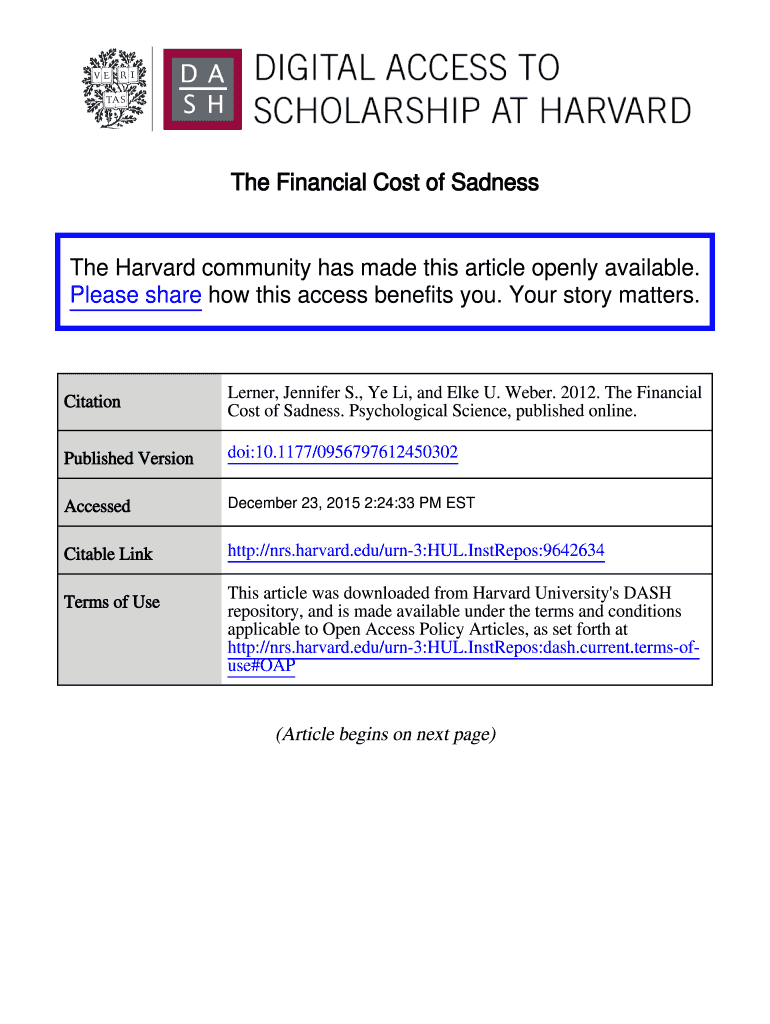
The Financial Cost of Sadness refers to the economic impact sadness can have on individuals' financial decisions. This concept, explored through psychological experiments, highlights how feelings of sadness can lead to increased impatience in financial decision-making. Individuals experiencing sadness may opt for immediate, smaller financial rewards rather than waiting for larger, future benefits. This tendency contradicts the traditional view that sadness leads to wiser, more cautious decision-making.
Key Elements of The Financial Cost of Sadness
Understanding the key elements involved in the Financial Cost of Sadness helps unpack how emotions influence economic behavior. The three main components studied are:
-
Myopic Misery: A term used to describe how sadness can cause people to prefer immediate rewards, focusing on short-term satisfaction over long-term gain.
-
Intertemporal Choices: These choices refer to decisions where people must weigh immediate versus future outcomes. Sadness tends to skew these decisions towards short-term benefits.
-
Mood Impact on Decisions: Experiments demonstrate that sadness can significantly alter financial choices compared to neutral or other emotional states, like disgust.
How to Use The Financial Cost of Sadness
This concept can be utilized in both personal finance and broader economic policies. Individuals can apply these insights to cautious financial planning, recognizing when emotions might cloud judgment. Educators and policymakers might also leverage this knowledge to design programs that mitigate the emotional impact on financial decision-making during times of economic downturn or personal crisis.
Who Typically Uses The Financial Cost of Sadness
Various stakeholders might find the concept useful:
- Psychologists aiming to understand the links between emotion and behavior.
- Economists exploring the non-rational elements of economic decision-making.
- Financial Advisors helping clients make more informed, less emotionally-driven choices.
- Behavioral Scientists studying human decision patterns.


Steps to Complete The Financial Cost of Sadness Study
Conducting a study on the Financial Cost of Sadness involves several methodological steps:
-
Participant Selection: Choose a diverse group of individuals to ensure varied emotional responses.
-
Mood Induction: Employ techniques like video or music exposure to induce sadness in a controlled environment.
-
Decision-Making Tasks: Present participants with financial scenarios where they must choose between immediate and future rewards.
-
Data Analysis: Compare choices made by sad participants to those in neutral or other emotional states to understand how sadness impacts financial decisions.
Important Terms Related to The Financial Cost of Sadness
- Myopic Misery: The inclination to prioritize immediate gratification when sad.
- Intertemporal Choice: Decisions that involve trade-offs among costs and benefits occurring at different times.
- Temporal Discounting: The decrease in perceived value of a future reward compared to an immediate one.
Legal Use of The Financial Cost of Sadness
While not directly a legal document or form, the research findings regarding the Financial Cost of Sadness can influence legal considerations. For instance, in financial disputes or settlements, legal professionals might use psychological insights about emotional impacts on decision-making to argue for undue emotional influence or impaired judgment at the time of financial decisions.
Examples of Using The Financial Cost of Sadness
The findings from studying the Financial Cost of Sadness can be applied in various contexts:
-
Personal Finance Management: Individuals can be taught to identify emotional triggers that might lead to impulsive financial decisions.
-
Corporate Training Programs: Corporations can offer training on emotional intelligence and stress management to improve employee decision-making.
-
Economic Policy Development: Governments might consider emotional well-being as a factor in economic policy planning, recognizing how emotional states influence consumer behavior.
State-Specific Rules for The Financial Cost of Sadness
While the Financial Cost of Sadness itself isn't subject to rules, the implications of the concept might vary by state, particularly in areas like consumer protection laws or financial counseling services. States may have different approaches to integrating psychological insights into economic and financial regulations.
Versions or Alternatives to The Financial Cost of Sadness
While the Financial Cost of Sadness is a specific area of study, alternative concepts and theories also explore the intersection of emotion and economic behavior, such as:
- Behavioral Economics: A broad field examining the effects of psychological, cognitive, emotional, and social factors on economic decisions.
- Affective Forecasting: Anticipating future emotional states can impact decision-making processes differently than current emotional states.
Through these insights, individuals and organizations can better comprehend, predict, and mitigate the impacts of emotions on financial decisions, ultimately leading to more rational and beneficial economic outcomes.