




01. Edit your form online
Type text, add images, blackout confidential details, add comments, highlights and more.

Type text, add images, blackout confidential details, add comments, highlights and more.

Draw your signature, type it, upload its image, or use your mobile device as a signature pad.

Send it via email, link, or fax. You can also download it, export it or print it out.
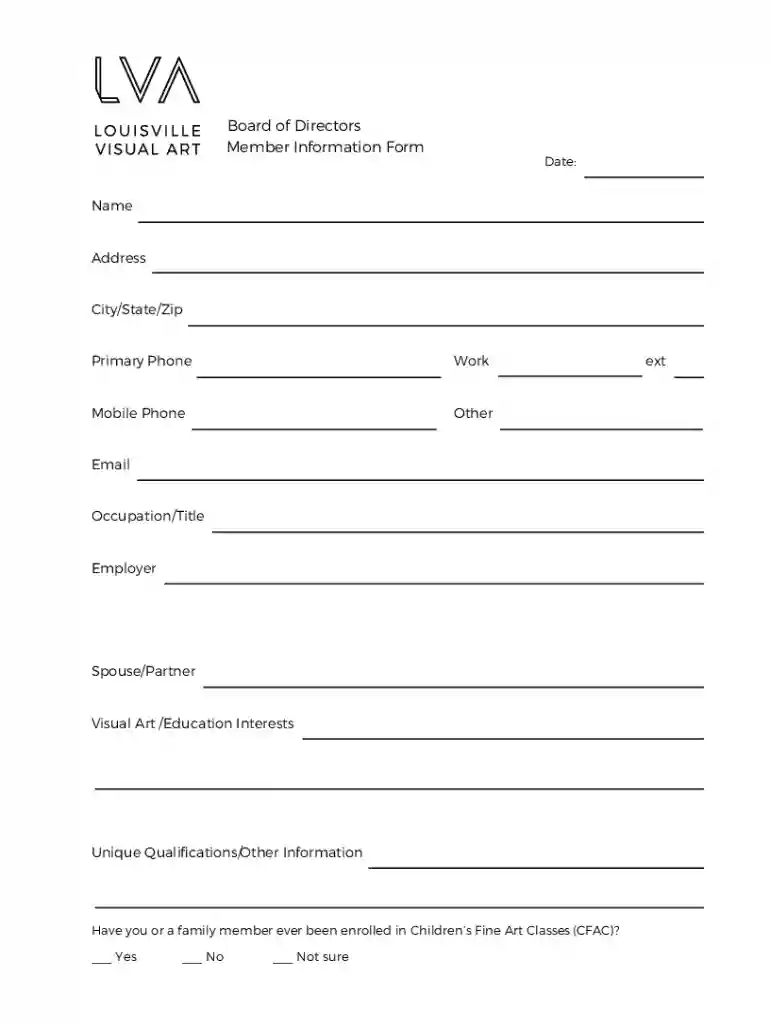
The Member Information Form is a structured document used primarily by organizations to gather essential personal and professional details from potential board members. Typically, this form includes sections for contact information, professional background, and areas of interest, specifically aimed at visual arts or education sectors. It serves as a foundational tool for evaluating and selecting individuals suited for board roles, ensuring they align with the organization's mission and objectives.
The form is designed to facilitate the structured collection of data from applicants interested in board membership. Organizations usually distribute the form during the recruitment process, either digitally or in paper format, allowing applicants to fill in their details. The form ensures consistent data collection, enabling fair and thorough evaluation of candidates.
The form is commonly utilized by non-profit organizations, educational institutions, and arts councils that seek active and well-suited individuals to join their boards. It's a vital resource for committees responsible for recruiting, vetting, and electing board members who can contribute positively to the organization's goals.


The collection and maintenance of personal data through the Member Information Form must comply with relevant privacy laws and organizational guidelines to ensure the secure handling and storage of sensitive information.
While the form itself is standardized, certain state-specific regulations can influence its use. These variations generally pertain to privacy laws and legal requirements for board composition and member selection processes.
Organizations like children’s art foundations and community education centers utilize the Member Information Form to streamline their board member nomination processes. By examining successful scenarios, organizations can adapt strategies to refine their form usage.
Organizations have the option to choose between digital or paper versions of the Member Information Form, each with distinct advantages and limitations.
For organizations using DocHub, seamless integration with existing software systems fosters an efficient workflow by allowing form editing, signing, and storage through compatible platforms like Google Workspace and major cloud services.
We've got more versions of the Member Information Form form. Select the right Member Information Form version from the list and start editing it straight away!
At DocHub, your data security is our priority. We follow HIPAA, SOC2, GDPR, and other standards, so you can work on your documents with confidence.
Membership Information Preferred Name CSU ID Number Cell Phone Date of Invitation to Join/Begin Education Guardian Email Guardians PhoneRead more
The New Member Enrollment Form allows a newly hired employee to apply for membership in a public retire- ment system. The form must be completed by any newRead more
Member information system: Any electronic or physical method used to access, collect, store, use, transmit, protect, or dispose of member information. Overview.Read more


