






Definition and Meaning
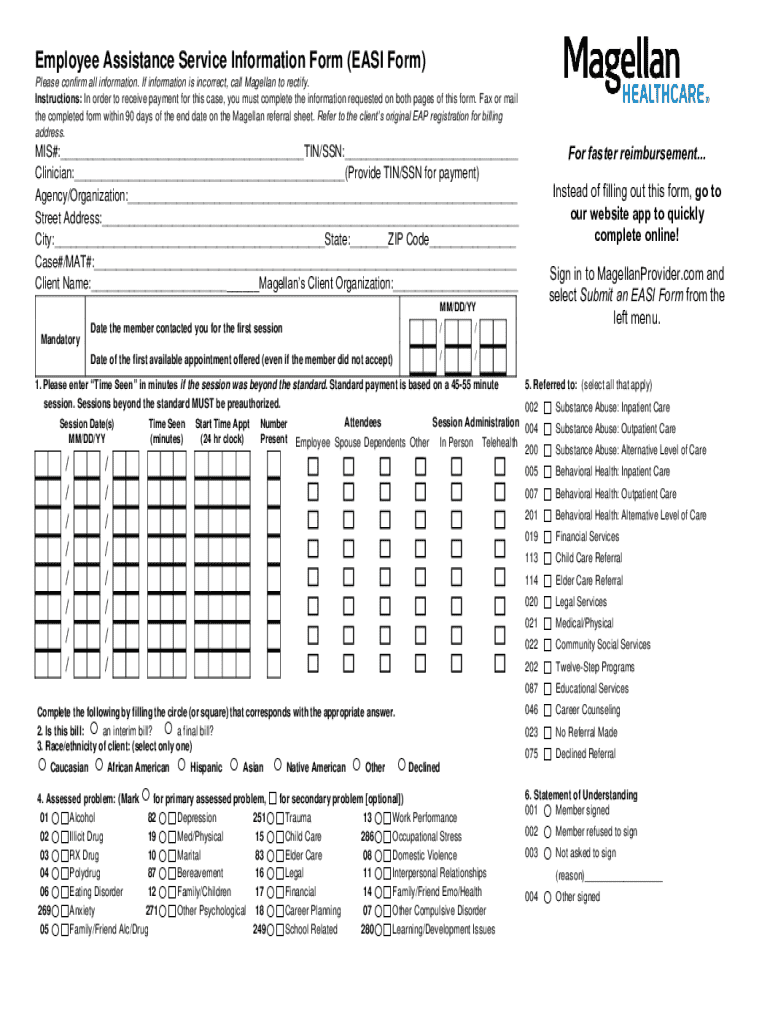
The Employee Assistance Service Information Form, commonly referred to as the EASI Form, is a crucial document used to facilitate the processing of payments for mental health services provided by clinicians. It serves as an official record containing necessary details about the services rendered to clients. This form is essential for both administrative purposes and ensuring clinicians are compensated accurately for their work. Clinicians must fill out this form to document client information, session details, billing instructions, and relevant assessments.
Key Elements of the EASI Form
Understanding the components of the EASI Form is vital for accurate completion. Key sections include:
- Client Details: Capture client name, contact information, and unique identification number, if applicable.
- Session Information: Document the date, duration, and type of session conducted.
- Billing Instructions: Specify payment methods, rates, and any discounts or adjustments applied.
- Assessment Information: Clinicians should include mental health assessments and evaluations related to the client’s functioning.
Each section plays a critical role in ensuring the form captures all needed information for the processing of payments.
Steps to Complete the EASI Form
Completing the EASI Form involves a methodical approach to ensure all information is accurately recorded:
- Gather Client Information: Begin by collecting personal and contact details from the client.
- Detail Session Information: Log the specifics of each session, including the type and duration.
- Add Billing Instructions: Outline payment protocol, including rates and applicable discounts.
- Include Assessments: Enter findings and evaluations from the mental health assessment.
These steps guide clinicians to fulfill the form’s requirements comprehensively.
How to Obtain the EASI Form
Clinicians can access the EASI Form through various means:
- Online Services: Digital copies are often available on platforms used by mental health service providers.
- Clinician Portals: Some organizations provide the form directly on their intranet or member portals.
- Request from Employers: Employers may distribute this form to clinicians as part of their service agreements.
Obtaining the form through these channels ensures clinicians have ready access when needed.
Legal Use of the EASI Form
The EASI Form serves multiple legal and administrative functions:
- Payment Processing: Provides essential documentation for remuneration of services.
- Record Keeping: Acts as a formal record for both clinicians and employers.
- Compliance: Helps maintain adherence to service and billing regulations.
Legal use encompasses a combination of documentation and compliance verification, supporting both clinicians and organizations.
Who Typically Uses the EASI Form
The primary users of the EASI Form include:
- Clinicians: Use the form to document services and assessments.
- Mental Health Organizations: Rely on the form for processing and record-keeping.
- Administrative Staff: Assist in compiling and submitting the form for payment authorization.
Understanding the roles of these users ensures the form is completed accurately and efficiently.


Important Terms Related to the EASI Form
Familiarity with essential terminology aids in accurately completing and understanding the EASI Form:
- Client ID: A unique identifier assigned to each client.
- Session Type: Refers to the nature of the service provided, such as individual therapy or group sessions.
- Assessment: Evaluations conducted to ascertain the client’s mental health status.
- Billing Rate: The established monetary value of the services rendered.
These terms are central to ensuring the form is completed with clarity and precision.
Form Submission Methods
Submitting the EASI Form can be done through several methods:
- Online Submission: Through secure clinician portals or email.
- Mail: Traditional postal service for organizations preferring paper-based records.
- In-Person Delivery: Direct submission to administrative offices in specific cases.
Each method of submission offers different benefits, such as convenience or security, depending on the organization’s preference.