




01. Edit your notice of appeal form ny online
Type text, add images, blackout confidential details, add comments, highlights and more.

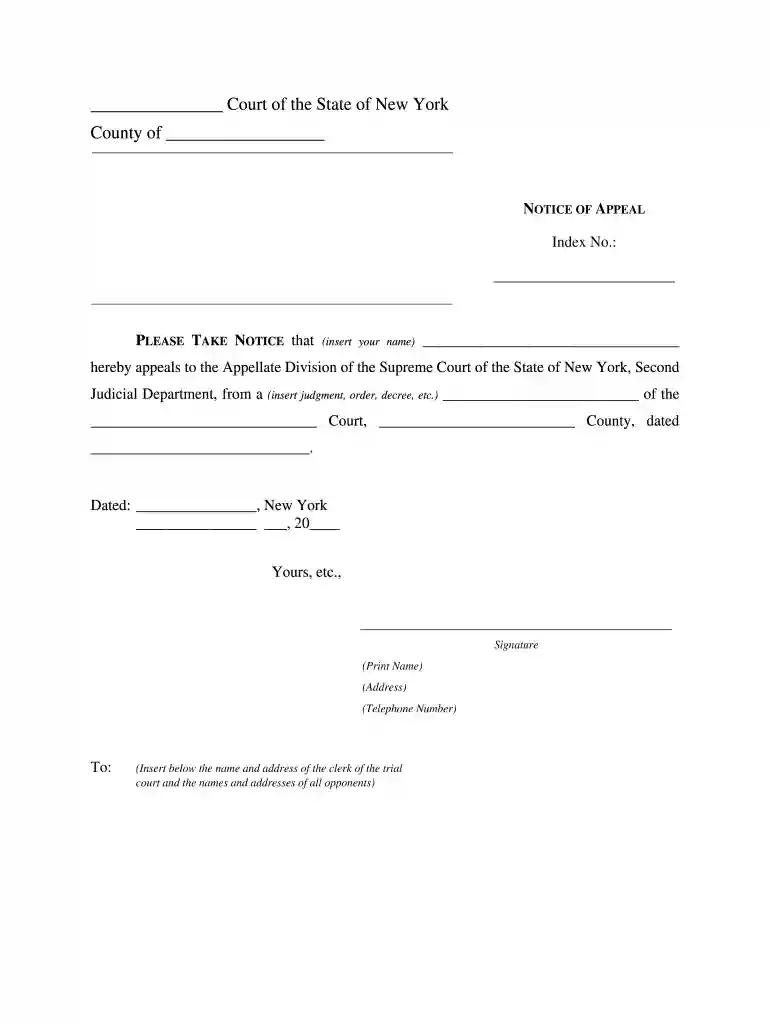
Type text, add images, blackout confidential details, add comments, highlights and more.

Draw your signature, type it, upload its image, or use your mobile device as a signature pad.

Send notice of appeal form via email, link, or fax. You can also download it, export it or print it out.
The New York State Unified Court System Notice of Appeal Form serves as an official document to initiate an appeal in the state's legal system. This form notifies the court and opposing parties that a party intends to challenge a decision made by a lower court. The notice outlines the specific judgment or order being appealed and includes essential information such as the names of the parties involved, the case number, and the date of the decision being contested.
Understanding the form's purpose is crucial for individuals looking to navigate through New York's appellate court system effectively.
Completing the New York State Unified Court System Notice of Appeal Form involves several steps to ensure that all necessary information is accurately filled out.
Understanding these steps ensures a smoother process in submitting a notice of appeal.
The Notice of Appeal Form is primarily utilized by individuals or entities dissatisfied with a decision from a lower court. The following groups commonly find themselves in need of this form:
Understanding the diverse user base of the notice of appeal form can help clarify its widespread significance.
Familiarity with the legal terminology associated with the Notice of Appeal Form is crucial for effective navigation within the appellate system. Key terms include:
Understanding these terms provides clarity and context when engaging with the appeals process.
Each state has its own distinct guidelines governing the submission and processing of Notice of Appeal Forms. In New York, the following state-specific rules apply:
Being aware of these rules is critical to avoid any pitfalls that could jeopardize the appeal.
Practical examples of using the Notice of Appeal Form can enhance understanding of its application:
These scenarios illustrate the diverse contexts in which the Notice of Appeal Form is relevant and necessary in the legal landscape.
We've got more versions of the notice of appeal form ny form. Select the right notice of appeal form ny version from the list and start editing it straight away!
| Versions | Form popularity | Fillable & printable |
|---|---|---|
| 2010 | 4 Satisfied (37 Votes) |
Yes, electronically drawing your signature is appropriate, but only if you utilize a tool that complies with industry laws and regulations. Consider DocHub, which ensures eSignature validity under ESIGN and UETA requirements. All you need to approve your new york state unified court system notice of appeal form electronically is an account with DocHub and an internet connection. Once you open your file in our editor, click Sign and choose the Draw tool.
In addition to a comprehensive toolset for editing PDFs on mobile devices, DocHub enables you to sign your new york state unified court system notice of appeal form along the way. Open our editor in your browser, make modifications using DocHub’s toolset, and finish your editing by eSigning the finished form.
At DocHub, your data security is our priority. We follow HIPAA, SOC2, GDPR, and other standards, so you can work on your documents with confidence.
Feb 28, 2026 We intend to appeal any adverse outcome to the United States Court of Appeals for the Federal. Circuit, and we believe that any reliefRead more
Mar 17, 2025 Includes orders to show cause, affidavit of service, affirmation, appellants brief, notice of appeal and notice of motion. Appellate DivisionRead more


