




01. Edit your form online
Type text, add images, blackout confidential details, add comments, highlights and more.

Type text, add images, blackout confidential details, add comments, highlights and more.

Draw your signature, type it, upload its image, or use your mobile device as a signature pad.

Send it via email, link, or fax. You can also download it, export it or print it out.
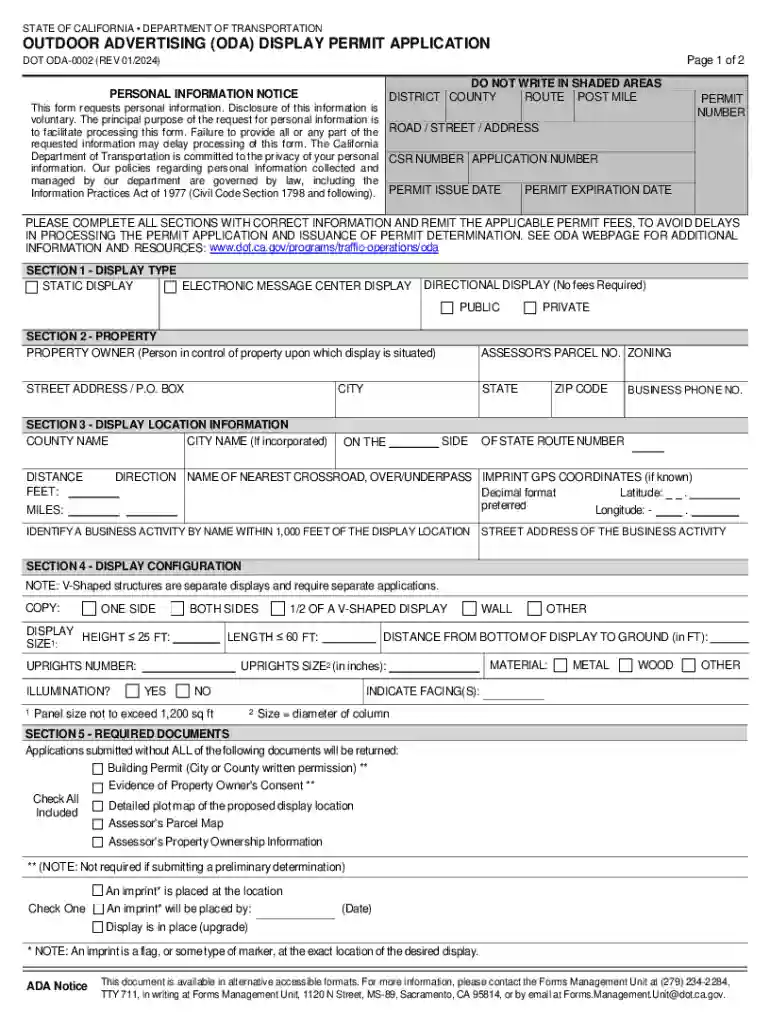
The Outdoor Advertising Display Permit Application is a formal document required by the California Department of Transportation for individuals or businesses seeking permission to install outdoor advertisements. This permit ensures that all advertising displays meet state regulations, safety standards, and zoning requirements, contributing to orderly development and minimizing visual clutter in public spaces. Understanding and correctly filing this application is crucial for businesses that rely on advertising as a significant source of visibility and customer engagement. Ensuring compliance not only aids in lawful marketing practices but also helps avoid potential legal issues or fines.
To secure a copy of the Outdoor Advertising Display Permit Application, businesses or individuals should visit the California Department of Transportation's website. The application is typically available in both digital and paper formats, catering to various preferences. Applicants need to download the form from the site or request a paper version through mail services if necessary. It's essential to check for the latest version to ensure that all recent regulatory updates are reflected in the application. Government offices may also provide copies if visiting a field office aligns with the applicant's convenience.
Filling out the Outdoor Advertising Display Permit Application is a structured process that requires careful attention to detail. Follow these steps to complete the form:
Gather Required Information: Collect personal or business details, including contact information, legal business name, and tax identification number.
Describe the Display: Include comprehensive details about the type of advertisement, size, materials, and intended display location. A sketch or photo may be required.
Property and Configuration Details: Provide precise information about the property where the advertisement will be displayed, thus confirming ownership or lease agreements.
Documentation Submission: Attach all required documents, like property deeds, design plans, and environmental assessments, to ensure the application is processed seamlessly.
Fee Payment: Calculate and submit the appropriate fees outlined in the application's guidelines, keeping a receipt for records.
Applicant Certification: Sign and date the application form, affirming the truthfulness and completeness of the information provided.
Several critical components must be accurately completed within this application:
The legal backdrop of the Outdoor Advertising Display Permit Application ensures that advertisements adhere to state laws and regulations. It supports compliance with local zoning ordinances and helps maintain aesthetic standards. Legal ramifications can be significant if compliance is not met, including fines or removal orders. The permit's issuance confirms that all legal prerequisites have been considered, mitigating the risks associated with unauthorized advertising placements.
The California Department of Transportation governs outdoor advertising laws, with specific rules varying from other states. California specifies requirements for distance from highways, restrictions near schools, and limits on digital billboard brightness. Some regions may have stricter regulations concerning environmental impact and community aesthetics. Understanding the California-specific standards is essential for anyone seeking to display advertisements to avoid legal complications and fines.
A local restaurant planning to erect a roadside billboard might use this permit to comply with state regulations, ensuring their advertisement reaches commuters without infringing on legal norms. Alternatively, a company launching a new product might apply to display an advertisement with dynamic digital content, requiring adherence to specific electronic display guidelines. Successful application requires provision of detailed sketches and compliance with location-based rules, serving as examples of using this form effectively.
Several supporting documents are crucial for a successful application submission:
These documents provide the foundational proof needed for the Department to review requests efficiently and grant permits where appropriate.
We've got more versions of the Outdoor Advertising Display Permit Application form. Select the right Outdoor Advertising Display Permit Application version from the list and start editing it straight away!
At DocHub, your data security is our priority. We follow HIPAA, SOC2, GDPR, and other standards, so you can work on your documents with confidence.
Jan 7, 1988 We are called upon to apply a provision of the Outdoor Advertising Act ・ that permits the placement of billboards along certain types of
Permits can be obtained by submitting a completed Outdoor Advertising Display Permit application. View the Permit Requirements tab for more information. How doRead more


