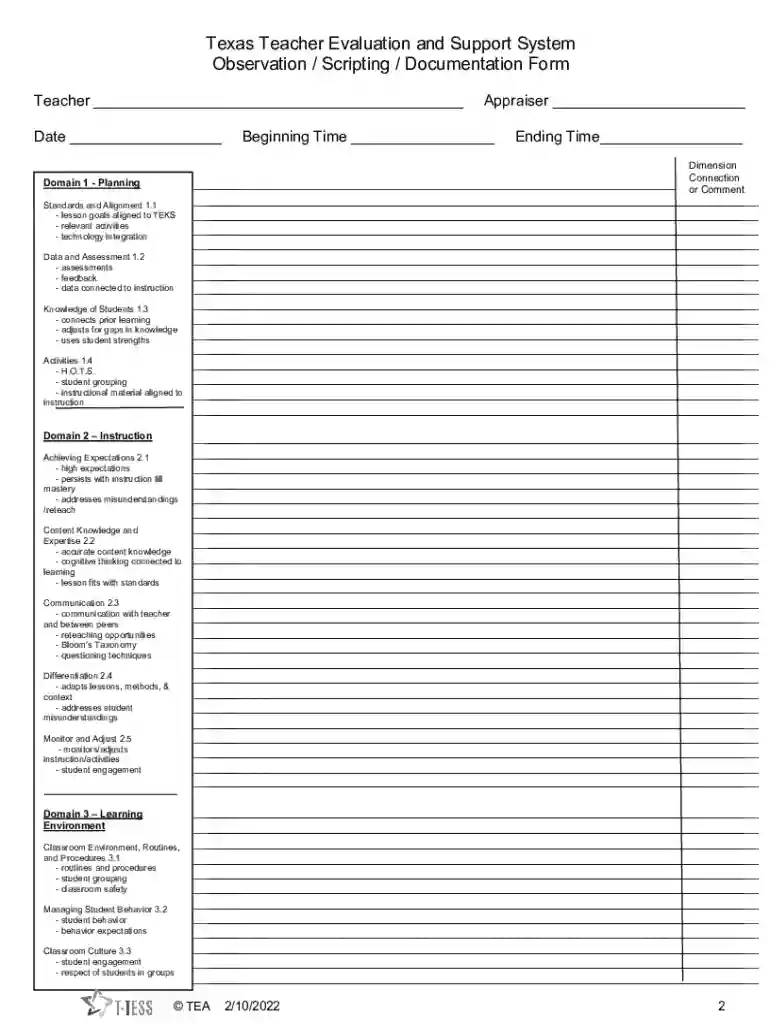
Definition & Purpose of the Texas Teacher Evaluation and Support System Observation Form
The Texas Teacher Evaluation and Support System Observation Scripting Documentation Form is a critical tool in evaluating the performance of educators within Texas. This form is structured to assist appraisers in assessing teachers across key areas, ensuring that educational standards and teaching effectiveness meet the state's expectations. It primarily focuses on the domains of Planning, Instruction, and the Learning Environment, providing a comprehensive overview of a teacher's capabilities and instructional impact.
How to Use the Observation Form
To effectively utilize the Texas Teacher Evaluation and Support System Observation Scripting Documentation Form, appraisers should follow a systematic approach:
- Prepare for Observation: Review the criteria and objectives outlined in the form before conducting any classroom evaluations.
- Conduct Classroom Observations: Focus on capturing detailed, objective notes on lesson planning, instructional strategies, student engagement, and classroom management.
- Document Findings: Use the form to document qualitative observations, ensuring that each dimension of the planning, instruction, and learning environment is thoroughly assessed.
- Compile and Analyze Data: After completing observations, analyze the data to identify patterns or areas of strength and improvement in teaching practices.
- Provide Feedback: Use the documented observations to give constructive feedback to teachers, aiding their professional development and fostering an environment of continuous improvement.
Obtaining the Observation Form
The Texas Teacher Evaluation and Support System Observation Scripting Documentation Form can be acquired through several channels:
- School District Administration: Most educational institutions in Texas distribute this form directly to appraisers and educational supervisors.
- Texas Education Agency (TEA): The form and additional resources are available through the TEA's official website or by direct request from the agency.
- Professional Development Workshops: Workshops focused on teacher evaluations may also provide copies of the form as part of their training materials.
Completing the Observation Form: Step-by-Step
When completing the Texas Teacher Evaluation and Support System Observation Scripting Documentation Form, follow these steps for accuracy and comprehensiveness:
- Read Each Section Carefully: Understand what each section is asking for in terms of observations and documentation.
- Gather Necessary Data: Ensure that all relevant data, such as lesson plans or classroom materials, are available to supplement observations.
- Fill Out the Form Timely: Complete each section immediately after an observation to ensure accuracy and preserve detail.
- Review for Completeness and Accuracy: Double-check all entries for clarity, ensuring no section is left incomplete.
Typical Users of the Form
The primary users of the Texas Teacher Evaluation and Support System Observation Scripting Documentation Form include:
- Educational Supervisors and Administrators: Responsible for evaluating teacher performance and ensuring adherence to educational standards.
- Instructional Coaches: Utilize the form to provide targeted support and mentorship to teachers.
- Human Resource Personnel: Use the form for making informed decisions related to teacher development and employment evaluations.
Key Elements of the Observation Form
The observation form contains several essential components that guide the evaluation process:
- Domain-Specific Criteria: Sections dedicated to evaluating Planning, Instruction, and Learning Environment, each with specific dimensions and criteria.
- Documentation of Observations: Spaces for narrative scripting and quantitative scoring to provide a detailed account of the observation.
- Feedback and Recommendations: Areas for offering suggestions and strategies for teacher improvement and professional growth.
Legal and Ethical Use
When using the Texas Teacher Evaluation and Support System Observation Scripting Documentation Form, it's essential to adhere to legal and ethical standards:
- Confidentiality: Protect the privacy of both teachers and students by keeping observations and evaluations confidential.
- Non-Discriminatory Practices: Ensure that evaluations are unbiased and not influenced by personal relationships or prejudices.
- Compliance with State Regulations: Follow all Texas state guidelines and educational policies regarding teacher evaluations and documentation.
Practical Examples of Use
Examples of practical use for the observation form include:
- Monthly Evaluations: Used by administrators to provide consistent feedback to teachers throughout the school year.
- Annual Reviews: Integral to end-of-year reviews, helping inform decisions regarding teacher promotions or contract renewals.
- Professional Development Planning: Data from the form can highlight commonly needed areas for teacher training and skill enhancement sessions.