




01. Edit your form online
Type text, add images, blackout confidential details, add comments, highlights and more.

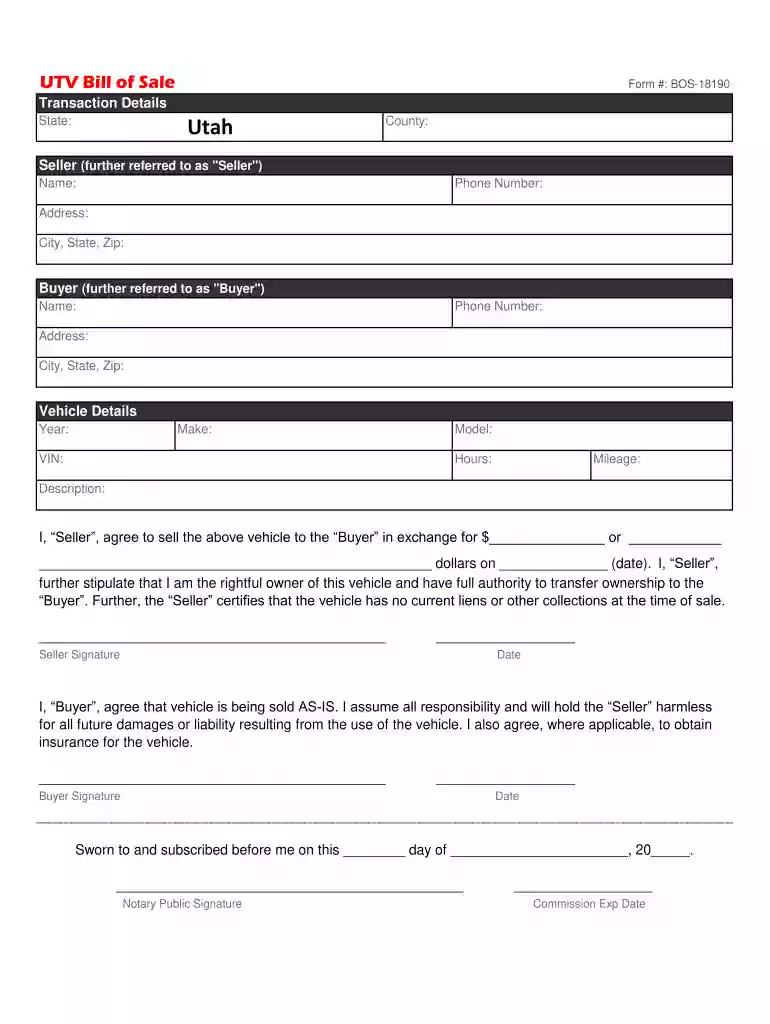
Type text, add images, blackout confidential details, add comments, highlights and more.

Draw your signature, type it, upload its image, or use your mobile device as a signature pad.

Send it via email, link, or fax. You can also download it, export it or print it out.
The UTV Bill of Sale is a legal document used during the sale of a Utility Terrain Vehicle (UTV) in the United States, specifically tailored for transactions in Utah. This form serves as a written record that details the terms and conditions agreed upon between the seller and buyer during the transfer of ownership. Its primary function is to certify the change of possession and provide proof of sale, which is crucial for both parties to avert potential disputes over vehicle ownership or responsibility for liabilities that arise post-sale. Using this form helps bolster legal protection and ensures a smooth transition of ownership, marking it as an indispensable tool in the sale process.
Utilizing the UTV Bill of Sale correctly ensures compliance with legal stipulations surrounding vehicle sales. This document acts as tangible evidence of a change in ownership, shielding sellers from future liabilities associated with the vehicle. Meanwhile, it provides buyers with a verified record of their purchase, vital for registration and titling purposes. While not every state mandates a bill of sale for UTVs, having one can prevent misunderstandings and offer a layer of legal assurance.
Primarily, individuals engaged in private UTV sales, whether sellers or buyers, utilize this document. It serves private sellers looking to transfer vehicle ownership without the involvement of a dealership. Additionally, buyers seeking an extra layer of security in their purchase often request a bill of sale to confirm the transaction details and verify the seller’s ownership rights.


Although the UTV Bill of Sale is used nationwide, certain state-specific rules might affect its application. In Utah, for instance, it's critical to ensure that the form aligns with the state's requirements, potentially requiring notarization. Understanding these state regulations helps both parties stay compliant and ensures the document holds up under scrutiny if ever contested.
Consider a scenario where a seller, Jane, decides to sell her used UTV to a buyer, Paul. Using the UTV Bill of Sale, Jane details the vehicle's specifications, confirming the absence of liens. Paul uses the signed document to register the UTV in his name, avoiding potential disputes and liabilities. Whether dealing with friends, family, or unfamiliar parties, this document is instrumental in clarifying and validating the transaction.
At DocHub, your data security is our priority. We follow HIPAA, SOC2, GDPR, and other standards, so you can work on your documents with confidence.
Aug 14, 2026 This article may require cleanup to meet AVIDs quality standards. The given reason is: The subpages that contain subpages need to be mergedRead more
I am aware of the sales and odometer information that the seller provided, above. I DocHub, to the best of my knowledge, that the above information is correct.Read more


