Definition and Meaning of Diploid and Haploid
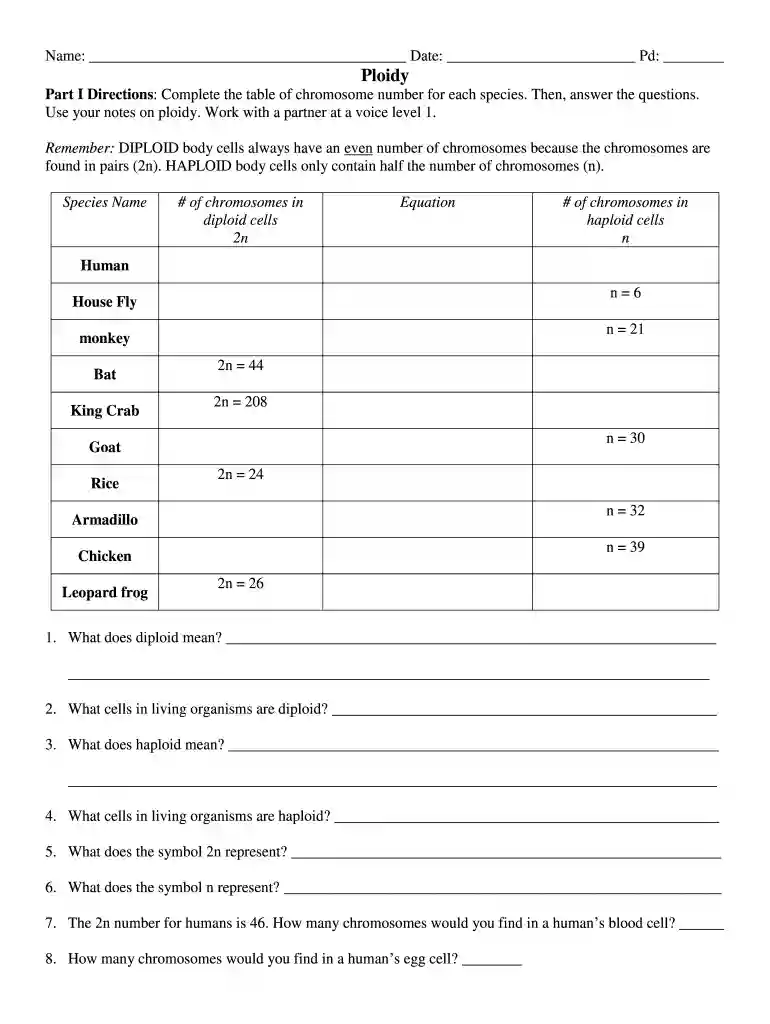
The diploid and haploid worksheet serves as an educational tool to deepen understanding of chromosome numbers in different organism types. Diploid refers to the presence of two sets of chromosomes in a cell, typically found in body cells, whereas haploid denotes a single set of chromosomes, primarily present in sex cells. This worksheet assists students in correlating these scientific concepts with real-world biological examples, providing a structured activity to grasp fundamental genetic differences.
- Diploid Cells: Found in somatic cells, each diploid cell contains two sets of chromosomes, one inherited from each parent. In humans, diploid cells contain a total of 46 chromosomes.
- Haploid Cells: Present in gametes or sex cells, these cells contain only one set of chromosomes. In humans, haploid cells have 23 chromosomes.
- Applications: Understanding diploid and haploid is essential in fields like genetics, biology, and evolutionary studies, making this worksheet a pivotal learning resource.
How to Use the Diploid and Haploid Worksheet
To maximize the utility of the diploid and haploid worksheet, follow specific steps that encourage interactive learning and comprehension. The worksheet is designed to prompt students to actively engage with the material through filling tables, defining terms, and applying knowledge to answer questions.
- Initial Review: Begin by reading through the worksheet to familiarize yourself with the structure and expectations.
- Table Completion: Fill out tables with chromosome counts for various species, enhancing your understanding of genetic variations among different organisms.
- Definition Section: Clearly define diploid and haploid, using examples to solidify conceptual understanding.
- Question Response: Answer questions related to human and rat karyotypes to test your comprehension of the topics discussed in the worksheet.
Steps to Complete the Diploid and Haploid Worksheet
The worksheet provides a systematic approach to learning through targeted activities. Follow these sequential steps for successful completion:
- Gather Required Materials: Ensure you have access to textbooks or online resources to assist with answering specific questions.
- Identify Chromosome Numbers: Utilize verified sources to determine the haploid and diploid numbers for common species listed in the worksheet.
- Answer Definitions and Questions: Provide detailed definitions and responses by integrating information from educational resources or class notes.
- Double-Check Work: Review your answers for accuracy and completeness, ensuring the information aligns with reliable data points.
- Submit for Feedback: Depending on the educational setting, submit the worksheet to your instructor or peers for evaluation and feedback.
Key Elements of the Diploid and Haploid Worksheet
Understanding the significant components of the worksheet elevates its educational value:
- Tables and Charts: Include sections for filling in chromosome numbers, aiding in visualizing the differences between diploid and haploid states.
- Definitions: Precise terminology definitions help cement core concepts.
- Applied Questions: Questions that relate knowledge to real-world organisms like humans and rats, facilitating practical application.
- Karyotype Examples: Engage with karyotype illustrations to physically observe chromosome distributions, enhancing comprehension.
Important Terms Related to Diploid and Haploid Worksheet
Familiarize yourself with essential terms to enhance understanding:
- Somatic Cells: Diploid cells that make up most body tissues and organs.
- Gametes: Haploid sex cells such as sperm and eggs involved in reproduction.
- Meiosis: A type of cell division that results in haploid cells, crucial in sexual reproduction.
- Karyotype: An organized profile of an organism's chromosomes, used to study chromosomal abnormalities and other genetic issues.
Examples of Using the Diploid and Haploid Worksheet
Practical application examples provide context for the worksheet's utility:
- Student Exercises: Students complete worksheets as homework or in-class activities to reinforce lecture materials.
- Educational Projects: Used in project-based learning scenarios to analyze genetic information in practical contexts.
- Exam Preparation: Acts as a study guide for examinations covering topics related to genetics and cell biology.
Digital vs. Paper Version
Choosing between digital and paper formats depends on individual and institutional preferences:
- Digital Advantages: Facilitates easy collaboration and editing. Compatible with document workflow solutions like DocHub, enabling seamless integration with cloud storage and editing tools.
- Paper Benefits: Offers a tactile learning experience, preferred in environments where physical interaction aids learning comprehension.
- Integration with Technology: Digital versions can easily incorporate multimedia elements and hyperlinks to supplementary resources, enhancing the learning experience.