




01. Edit your form online
Type text, add images, blackout confidential details, add comments, highlights and more.

Type text, add images, blackout confidential details, add comments, highlights and more.

Draw your signature, type it, upload its image, or use your mobile device as a signature pad.

Send it via email, link, or fax. You can also download it, export it or print it out.
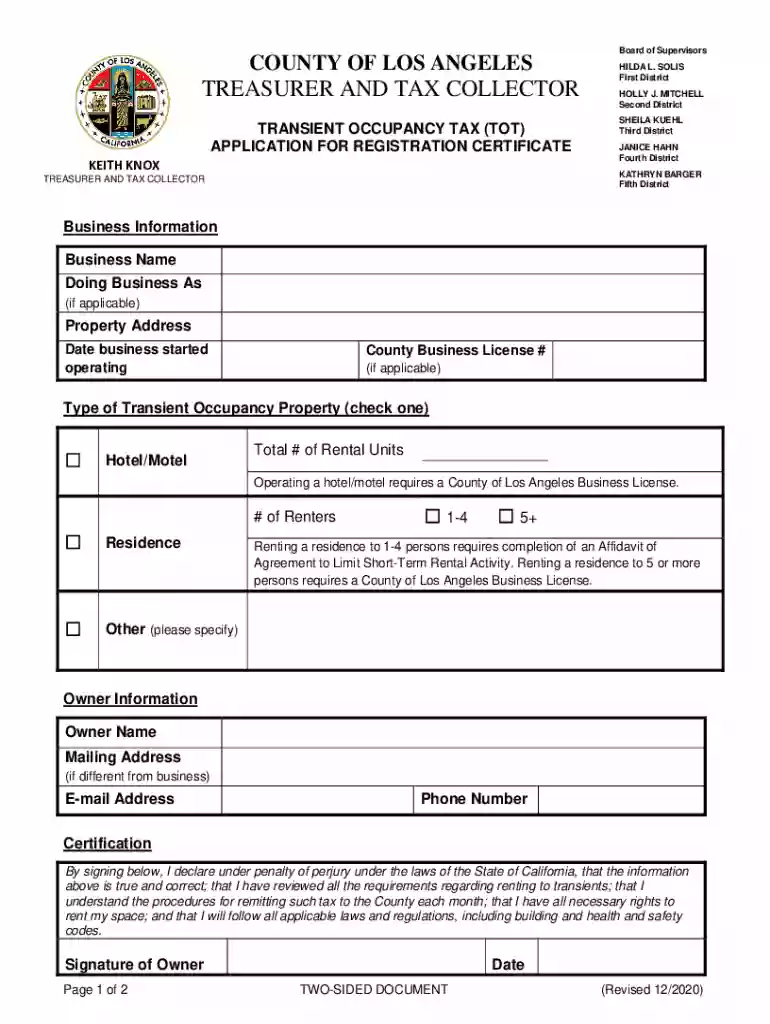
The Transient Occupancy Tax Registration Application is a formal document required for property owners or operators who provide short-term rental accommodations to register with the local tax authority. This application primarily serves to register for the Transient Occupancy Tax (TOT), often mandated by municipalities or counties, such as Los Angeles. The TOT is essentially a tax imposed on lodgers who stay in hotels, motels, inns, short-term rentals, or similar accommodations for less than a month. By completing this registration process, property operators declare their intent to collect and remit this tax on behalf of their guests.
To properly utilize the Transient Occupancy Tax Registration Application, follow these detailed steps:
Download the Form: Obtain the latest version of the application from the pertinent local tax authority's website.
Fill in Business Information: Provide comprehensive business details, including the business name, address, and contact information. Mention all locations if you have multiple properties.
Owner Information: Include thorough information about the property owner or operator, such as name, address, tax identification number, and contact details.
Property Type Specification: Detail the nature of the transient occupancy property, which could be a hotel, short-term rental, bed and breakfast, etc.
Certifications and Legal Compliance: Affirm that the business complies with local rental laws and zoning requirements to operate transient accommodations.
Submit the Application: Choose the most convenient method for you - online, mail, or in-person submission, based on the options provided by the issuing authority.
This critical process involves several clear steps:
Preparation:
Completion of Application:
Review:
Submission:
Follow-up:
Transient Occupancy Tax (TOT): A tax levied on individuals occupying a lodging space for a period of 30 days or less.
Property Operator: The individual or entity responsible for managing the transient accommodations.
Certificate of Registration: An official document proving that a property operator is registered to collect and remit TOT to the appropriate tax authority.
Submission Methods: Options include online submission through official portals, mail-in forms, or in-person submissions at designated locations.
Zoning Requirements: Local regulations defining how a property can be used, significant for operators providing transient accommodations.
The application serves several legal functions:
Compliance: Ensures that property operators are legally registered to collect and remit TOT, fulfilling local tax obligations.
Liability Protection: By registering, operators can demonstrate due diligence in legal compliance, potentially reducing liability in cases of disputes or audits.
Record-Keeping: Provides a legal record of compliance actions, which is vital during audits or legal assessments.
Identification Details: Accurate business and owner identification, crucial for processing the application.
Property Designation: Clear designation of the type of property and its use for transient accommodations.
Compliance Agreements: Sections where the operator agrees to abide by local laws and regulations governing transient rentals.
While the core purpose of the form remains consistent, specific rules might vary:
Rates: TOT rates can differ significantly from one locale to another, influenced by local governance.
Additional Fees: Some jurisdictions may impose supplementary fees or assessments on top of the basic TOT.
Exemptions: Certain exemptions, such as non-profit accommodations or government employee stays, may apply differently depending on state or local laws.
Documentation Requirements: Variations in required supporting documentation might exist based on location-specific regulations.
When filling out the Transient Occupancy Tax Registration Application, you may need:
Non-compliance can result in:
We've got more versions of the Transient Occupancy Tax Registration Application form. Select the right Transient Occupancy Tax Registration Application version from the list and start editing it straight away!
At DocHub, your data security is our priority. We follow HIPAA, SOC2, GDPR, and other standards, so you can work on your documents with confidence.
Applications for a Transient Occupancy Registration Certificate may be submitted: Online through the Transient Occupancy Registration System.
Please complete this form and present it to the hotel/motel at time of registration or reservation if prepaid.


