






Definition and Meaning of "The Ideal Chemistry Student"
"The Ideal Chemistry Student" refers to individuals who embody the qualities and skills essential for success in the field of chemistry. These students excel in both academic understanding and practical application of chemical theories. Their proficiency is not only limited to textbook knowledge but extends to hands-on laboratory experiences, problem-solving capabilities, and an aptitude for critical thinking. An ideal chemistry student is also characterized by their ability to integrate knowledge from various scientific disciplines, contributing to their comprehensive understanding of chemistry.
Steps to Develop Into an Ideal Chemistry Student
-
Gain Robust Academic Foundation: Focus on mastering fundamental chemistry concepts. This includes understanding atomic structure, chemical reactions, thermodynamics, and organic chemistry.
-
Engage in Laboratory Work: Participate actively in laboratory sessions to practice experimentation and enhance your ability to handle chemical apparatus safely and efficiently.
-
Cultivate Analytical Skills: Work on developing strong analytical and critical thinking skills to solve complex chemical problems and conduct detailed research.
-
Integrate Interdisciplinary Knowledge: Apply knowledge from physics, biology, and mathematics to deepen your understanding of chemical phenomena.
-
Participate in Group Projects and Discussions: Enhance collaborative skills by engaging in team-based projects, which help in exchanging diverse ideas and approaches.
-
Attend Workshops and Seminars: Regularly attend chemistry workshops and seminars to stay updated with the latest research developments and innovations in the field.
Why Pursuing the Path of an Ideal Chemistry Student Is Beneficial
Pursuing excellence in chemistry opens up numerous career opportunities in academia, industry, and research. Students with a solid grounding in chemistry can venture into fields such as pharmaceuticals, environmental science, and biochemical engineering. Additionally, the problem-solving and critical thinking skills gained during this pursuit are valuable in a wide range of professions beyond chemistry.
Key Elements of Becoming an Ideal Chemistry Student
- Curiosity and Passion for Science: A deep and genuine curiosity about how chemical processes work is essential.
- Discipline and Work Ethic: Consistent study habits and the discipline to conduct precise experiments are critical.
- Communication Skills: The ability to effectively communicate scientific findings through written reports and oral presentations.
- Teamwork and Collaboration: Openness to working alongside peers in collaborative settings to achieve shared goals.
- Adaptability: Remaining flexible and open to new ideas and technologies in a constantly evolving scientific landscape.
Practical Applications and Examples
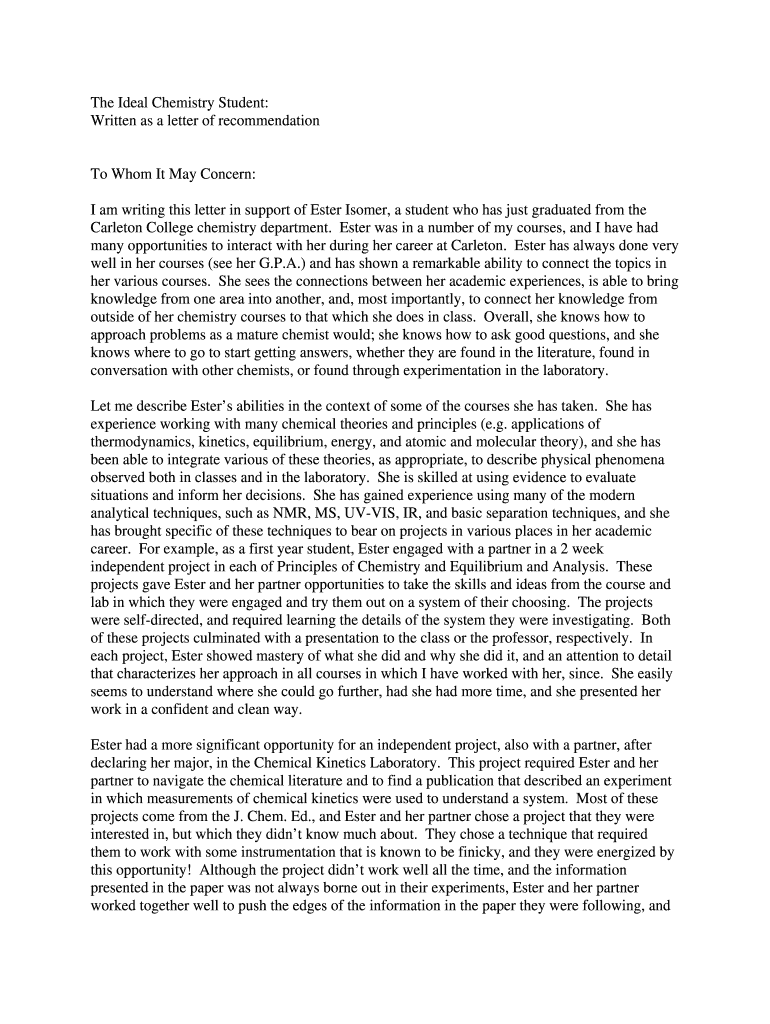
Ester Isomer, a recent chemistry graduate, exemplifies qualities of the ideal chemistry student. Having excelled academically, she successfully applied her knowledge in various interdisciplinary projects and demonstrated maturity in her problem-solving approach. Her readiness to tackle challenges in graduate studies or medical fields highlights the profound impact of embodying the ideal chemistry student persona.
Important Terms Related to Ideal Chemistry Students
- Stoichiometry: Understanding the quantitative aspects of chemical reactions.
- Spectroscopy: Learning how to analyze substances based on their interaction with different spectrums of light.
- Synthesis: The ability to create complex chemical compounds from simpler substances.
- Titration: A key laboratory technique to determine the concentration of a dissolved substance.
- Quantum chemistry: Studying the behavior of matter on the atomic and subatomic levels.
Legal and Ethical Considerations in Chemistry Education
Students are expected to adhere to ethical standards in research and experiments. This includes honesty in reporting results, ensuring accurate data collection, and maintaining safety protocols in the laboratory to prevent accidents. Ethical considerations also extend to respecting intellectual property rights and giving credit to original ideas sourced during research.
Eligibility Criteria for Aspiring Chemistry Students
Prospective chemistry students typically need a strong background in science and mathematics from high school. Key prerequisites often include courses like biology, physics, mathematics, and introductory chemistry. Additionally, some programs may require entrance exams or interviews to assess the candidate's aptitude for advanced studies in chemistry.


Software and Tools for Chemistry Students
- ChemDraw: A popular tool for creating chemical structure diagrams.
- ChemicAl Dynamics Simulator: Used for simulating chemical kinetics and reaction dynamics.
- SPARTAN: Software for molecular modeling and computational chemistry tasks.
- Labster: Virtual reality tool for conducting experiments in a safe and controlled digital environment.
- SciFinder: A comprehensive database for searching chemical information and literature.