







Definition & Meaning
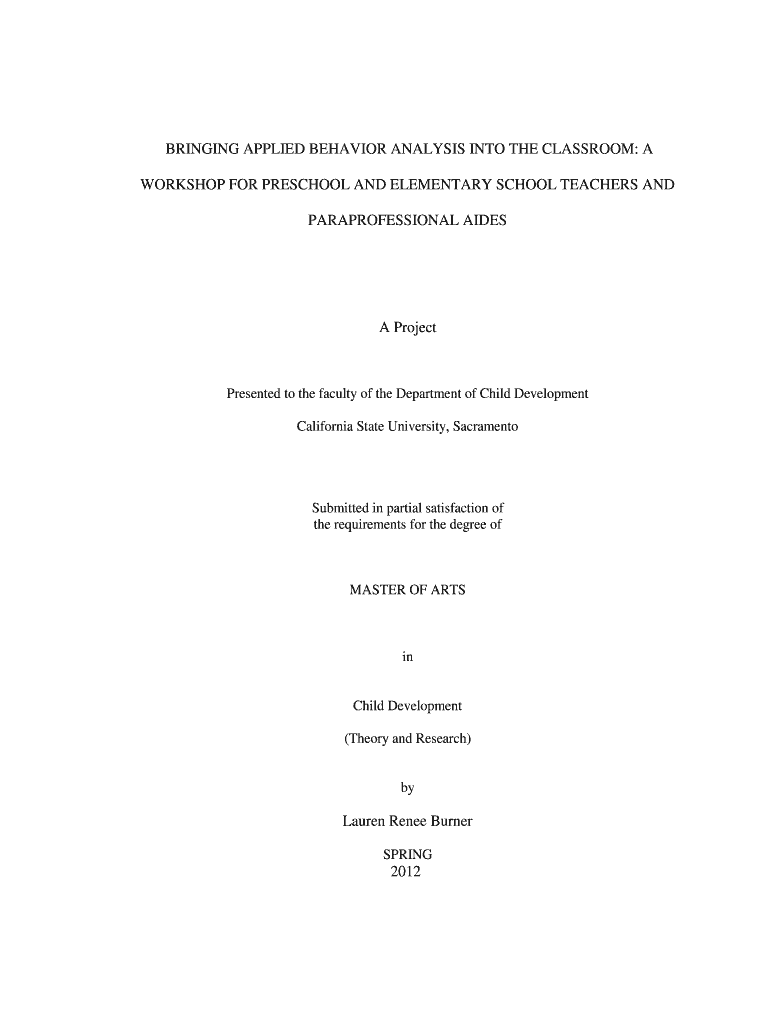
Applied Behavior Analysis (ABA) is a scientific discipline concerned with applying techniques based on learning principles to bring about meaningful and positive changes in behavior. The form "BRINGING APPLIED BEHAVIOR ANALYSIS INTO THE - csus-dspace calstate" refers to incorporating ABA techniques into educational settings, primarily focusing on supporting students diagnosed with autism spectrum disorder (ASD). This structured approach aims to improve social behaviors, communication, and learning skills using data-driven methods.
How to Use the Form
The form serves as a guide for educational professionals who wish to implement ABA strategies in their teaching environments. It provides a framework for creating individualized plans based on observed behaviors and evaluated outcomes. Educators can reference the specific techniques and modifications necessary to tailor their approach to meet the diverse needs of students with ASD. By documenting these strategies, the form ensures consistency and accountability in applying ABA principles.
Steps to Complete the Form
-
Identify Target Behaviors: Begin by clearly defining which behaviors need to be addressed. These might include communication, social skills, or reducing disruptive actions.
-
Set Objectives: Establish measurable goals related to the identified behaviors, ensuring they are specific, achievable, and time-bound.
-
Select Interventions: Choose appropriate ABA strategies and interventions that align with the goals. These might include positive reinforcement, modeling, or discrete trial training.
-
Implement Strategies: Apply the selected interventions consistently across different settings, like classrooms or home environments.
-
Monitor Progress: Regularly assess the student’s progress towards achieving the objectives. Use data collection tools provided within the form.
-
Adjust Plans: Based on the collected data and observations, modify the interventions and strategies as needed to ensure optimal outcomes.
Why Should You Use This Form
Using this form helps educators integrate structured behavior support plans into their teaching practices. It ensures that interventions are evidence-based and systematically applied, improving educational outcomes for students with ASD. The form provides a comprehensive approach to documenting and assessing the effectiveness of ABA strategies, promoting continuous improvement and accountability.
Important Terms Related to the Form
-
Reinforcement: A technique to increase the likelihood of a desired behavior by offering positive consequences or rewards.
-
Prompting: Using cues or assistance to encourage a specific response from a student.
-
Data Collection: Systematically recording information to measure progress and evaluate the effectiveness of interventions.
-
Generalization: Ensuring that learned behaviors can be applied across different contexts and situations.
Legal Use of the Form
The use of ABA is legally supported in educational settings as a valuable approach for students with ASD. The form acts as a compliance document, demonstrating that interventions are applied ethically and according to established guidelines, supporting transparency and legal adherence in educational practices. It is crucial for educators to maintain detailed records of interventions and outcomes as evidence of support provided.
Key Elements of the Form
-
Behavioral Assessment: The foundation of any ABA plan is a thorough assessment of the student’s behaviors and needs, guiding the subsequent intervention strategies.
-
Intervention Plans: Detailed strategies tailored to individual students, addressing specific behavioral challenges.
-
Outcome Evaluation: Regularly assessing if interventions are effective, ensuring that goals are being met, and adjustments are made for continuous progress.
State-Specific Rules for the Form
While ABA principles are universally applicable, the implementation might vary slightly based on state educational guidelines. Some states may have additional requirements for documentation or specific criteria for evaluating success, which the form should address to ensure compliance. Understanding state-specific rules is crucial for educators to align their practices with local standards.
Examples of Using the Form
For a practical example, consider a classroom where a student with ASD struggles with social interactions and following instructions. Using this form, an educator might set an objective for the student to increase the number of successful peer interactions over a month. The educator could implement a reinforcement strategy by providing stickers for each interaction, gradually weaning off the tangible rewards as the behavior becomes more natural. This systematic approach enables consistent progress tracking and adapting strategies as needed.




