Type text, add images, blackout confidential details, add comments, highlights and more.
02. Sign it in a few clicks
Draw your signature, type it, upload its image, or use your mobile device as a signature pad.
03. Share your form with others
Send n laundering anti via email, link, or fax. You can also download it, export it or print it out.
How to use or fill out the Anti-Money Laundering Questionnaire
Ease of Setup
DocHub User Ratings on G2
Ease of Use
DocHub User Ratings on G2
Click ‘Get Form’ to open it in the editor.
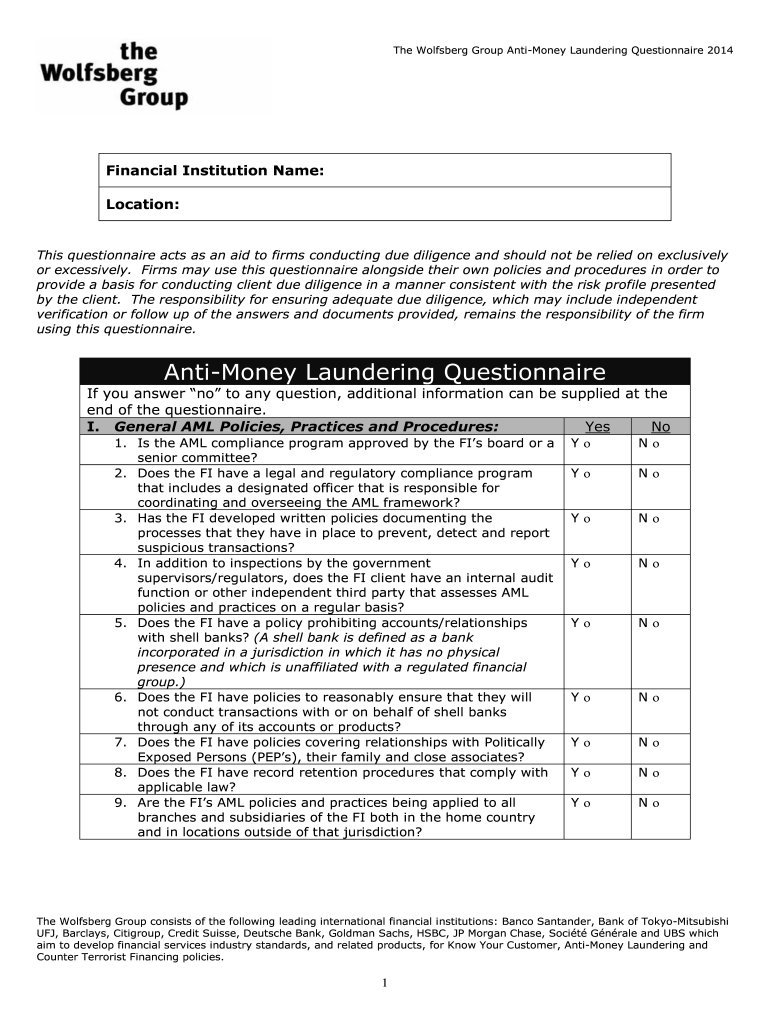
Begin by entering the Financial Institution Name and Location at the top of the form. This sets the context for your responses.
Proceed to Section I, where you will answer questions regarding general AML policies. Select 'Yes' or 'No' for each question based on your institution's practices.
Continue to Section II, focusing on Risk Assessment. Ensure you provide accurate responses that reflect your institution's risk management strategies.
In Section III, address Know Your Customer and Due Diligence practices. Collect necessary information about customer identification and business activities.
Move to Section IV, which covers reportable transactions. Confirm that your institution has appropriate policies in place for identifying suspicious activities.
Finally, complete Section VI regarding AML training provided to employees. Document any relevant training records as required.
Start filling out your Anti-Money Laundering Questionnaire today using our platform for free!
Some examples of placement methods, including blending funds with legitimate income (for example, cash business), paying debt with dirty money, gambling, real estate investments and foreign currency smuggling and exchanges.
What is AML and ATF?
The Government of Canada appreciates the work of the Committee and welcomes its analysis, views and recommendations, which we recognize are based on consultations with stakeholders and experts in the field of anti-money laundering and anti-terrorist financing (AML/ATF).
What is anti-laundering?
Antimoney laundering (AML) refers to a set of policies and practices to ensure that financial institutions and other regulated entities prevent, detect, and report financial crime and especially money laundering activities.
What is the meaning of anti laundering?
Anti-money laundering (AML) refers to the activities financial institutions perform to achieve compliance with legal requirements to actively monitor for and report suspicious activities. History.
What are the 4 pillars of AML?
These include the principles consistent with an institutions risk profile, which include risk assessments, customer due diligence (CDD), monitoring for suspicious activity, and sound AML compliance programs.
wolfsberg group questionnaire
Anti money launderingAnti money laundering exampleAnti money laundering ActWhat are the 3 stages of Anti money launderingAnti money laundering Certificateanti-money laundering act of 2020Anti money laundering stagesAnti money laundering Act USA PDF
People also ask
Is it AML or AMLA?
In Malaysia, the Anti-Money Laundering, Anti-Terrorism Financing and Proceeds of Unlawful Activities Act 2001 (AMLA) is the primary statute which governs the AML/CFT/CPF regime in Malaysia.
What are the 4 stages of AML?
The four stages are placement, layering, integration, and extraction. AMLA, Fraud and Anti-Fraud tools, Data analytics for compliance, and Regulatory compliance risk software are effective tools that are docHub in countering such risks.
wolfsberg form
Anti-Money Laundering 2023: Risks, Due Diligence and
Money laundering is a global issue. Anti-Money Laundering (AML) / Counter-Financing of Terrorism (CFT) regulation and enforcement continues to evolve
This site uses cookies to enhance site navigation and personalize your experience.
By using this site you agree to our use of cookies as described in our Privacy Notice.
You can modify your selections by visiting our Cookie and Advertising Notice.... Read more...Read less