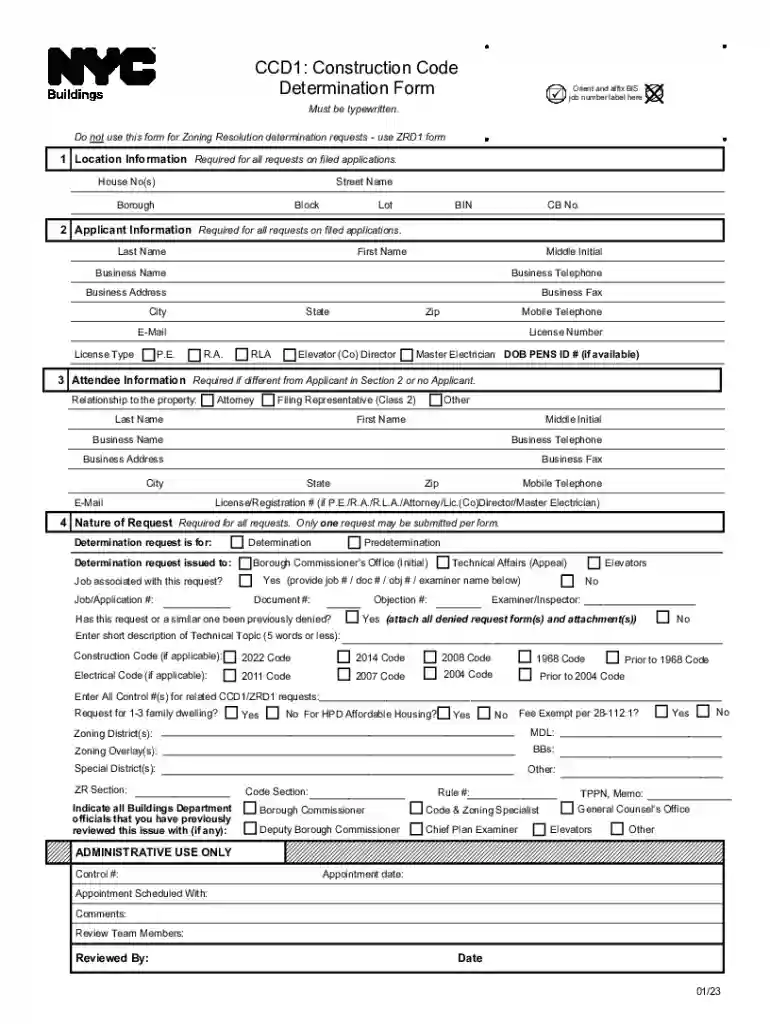
A Clarification of the NYC Determination Request 2026

Get Form
A Clarification of the NYC Determination Request Preview on Page 1

Here's how it works

01. Edit your form online
Type text, add images, blackout confidential details, add comments, highlights and more.

02. Sign it in a few clicks
Draw your signature, type it, upload its image, or use your mobile device as a signature pad.

03. Share your form with others
Send it via email, link, or fax. You can also download it, export it or print it out.

Definition & Meaning of the A Clarification of the NYC Determination Request

The "A Clarification of the NYC Determination Request" pertains to the CCD1, a specialized form used to solicit interpretations or clarifications related to the construction codes in New York City. This document is crucial for applicants dealing with construction projects that may require deviations or clarifications concerning established building codes. The form serves as a formal method for seeking official input from the city's Department of Buildings on how specific rules apply to unique or complex circumstances. Understanding this form is essential for professionals in the construction and legal fields to ensure compliance and to avoid potential legal repercussions.

How to Use the A Clarification of the NYC Determination Request

To effectively use the "A Clarification of the NYC Determination Request," applicants must begin by reviewing their specific project details to determine if a clarification is truly necessary. The form is typically used when the language in the existing construction codes is ambiguous or when a project requires specific interpretation or variation that isn't explicitly covered by the current regulations. Users should:

  1. Identify the specific construction code or regulation in question.
  2. Clearly articulate the nature of the request, including any particular interpretations sought, in the dedicated section of the form.
  3. Attach any necessary supporting documents, such as project plans or previous determinations, to bolster the request.
  4. Submit the completed form through the prescribed channels, ensuring all sections are filled accurately to prevent delays.

Steps to Complete the A Clarification of the NYC Determination Request

Completing the form requires meticulous attention and accurate information. Follow these steps for a successful submission:

  1. Gather Information: Compile all relevant details about the site, applicant, and nature of the request. Include precise citations or references to the codes in question.
  2. Detailed Explanation: Provide a comprehensive explanation in the designated section about why clarification is needed, specifying any areas of ambiguity in the existing codes.
  3. Supporting Documentation: Attach any maps, diagrams, or previous correspondences that provide context or support the clarification request.
  4. Contact Information: Ensure that all contact fields, such as phone numbers and email addresses, are accurately filled to facilitate communication between the applicant and the Department of Buildings.
  5. Review and Submit: Double-check the form for completeness and accuracy before submission. Any errors or omissions could result in processing delays or outright rejection.

Key Elements of the A Clarification of the NYC Determination Request

The CCD1 form includes several critical components:

  • Applicant Information: Names, addresses, and professional credentials of those submitting the request.
  • Site Details: Exact location and description of the construction site requiring code interpretation.
  • Code References: Specific sections of the building codes under scrutiny.
  • Rationale for Clarification: A clear and concise explanation of the issue at hand and the desired outcome or clarification.
  • Supporting Materials: Any additional documentation that supports the need for clarification.

Legal Use of the A Clarification of the NYC Determination Request

Legally, the CCD1 form ensures that any deviation from standard building practices receives formal approval from the NYC Department of Buildings. This process is essential to uphold safety standards and maintain regulatory compliance. Utilizing this form legally sanctions requested variances, thereby protecting the applicant from legal actions related to unauthorized construction practices.

Penalties for Non-Compliance

Failing to secure the appropriate clarifications or interpretations through this request can lead to significant legal and financial consequences. Possible penalties include:

  • Fines imposed by the Department of Buildings for non-compliance.
  • Mandatory cessation of construction activities until compliance is achieved.
  • Potential legal action if non-compliance results in structural failures or safety hazards.

Who Typically Uses the A Clarification of the NYC Determination Request

The CCD1 is predominantly used by professionals within the construction industry, including:

  • Architects: Seeking code interpretations needed for design compliance.
  • Construction Managers: Needing assurance on building permits and regulatory compliance.
  • Legal Consultants: Providing clarity and support in regulatory adherence.
  • Developers: Ensuring that new projects meet all necessary legal criteria before commencement.
decoration image ratings of Dochub

Required Documents for the A Clarification of the NYC Determination Request

Preparation of the form involves assembling a variety of documents to support the request:

  • Project Blueprints: Offering detailed site plans and architectural layouts.
  • Previous Correspondence: Any communication with city officials regarding past code clarifications or interpretations.
  • Code Excerpts: Copies or references pointing to the specific codes in question.

Form Submission Methods (Online / Mail / In-Person)

The Department of Buildings offers several methods for submitting the CCD1 form, accommodating different applicant preferences:

  • Online: Via the NYC Department of Buildings website, allowing for faster processing.
  • Mail: Ensuring that all accompanying documents are physically submitted alongside the form.
  • In-Person: Directly handing in the form at a Department of Buildings office for those who prefer face-to-face interactions.
be ready to get more

Complete this form in 5 minutes or less

Get form

Got questions?

We have answers to the most popular questions from our customers. If you can't find an answer to your question, please contact us.
Contact us
The resolution was the first change to New Yorks zoning since the first zoning code was passed in 1916. It was created to suit the changing economy, an increasing population, and the growth of automobile use. The 1961 Zoning Resolution divided New York City into residential, commercial, and manufacturing areas.
The City is divided into three basic zoning districts: Residential (R), Commercial (C), and Manufacturing (M), which are then further divided into low, medium, and high density districts. There may be different zoning districts within the same neighborhood or city block.
12-00 Rules for Construction of Language.
The NYC Department of Buildings (NYC Buildings) is primarily responsible for enforcing NYCs zoning rules. For example, NYC Buildings: Reviews building plans and issues building permits.
The primary permit applications are: New Building (NB) and Alterations Type-1, 2, and 3: NB: Construction of new structures. ALT1: Major alterations that will change use, egress or occupancy. ALT2: Multiple types of work, not affecting use, egress or occupancy.

Security and compliance

At DocHub, your data security is our priority. We follow HIPAA, SOC2, GDPR, and other standards, so you can work on your documents with confidence.

Learn more
ccpa2
pci-dss
gdpr-compliance
hipaa
soc-compliance
be ready to get more

Complete this form in 5 minutes or less

Get form

People also ask

ZRD1 Zoning Resolution Determination Form and CCD1 Construction Code Determination Form are used to document official Determination Requests for Department review. Department officials will review the request form and issue an appropriate determination.
The 1916 Zoning Resolution in New York City was the first citywide zoning code in the United States. The zoning resolution reflected both borough and local interests, and was adopted primarily to stop massive buildings from preventing light and air from docHubing the streets below.
To request a Letter of No Objection, go to the DOB Borough Office where your property is located. Bring any property-related materials you have that demonstrate the longstanding use of the property. Examples of such materials include: Old property surveys.

Related links