Texas Assessments Standards (STAAR) Fifth Grade Mathematics 2026

Get Form
Texas Assessments Standards (STAAR) Fifth Grade Mathematics Preview on Page 1

Here's how it works

01. Edit your form online
Type text, add images, blackout confidential details, add comments, highlights and more.

02. Sign it in a few clicks
Draw your signature, type it, upload its image, or use your mobile device as a signature pad.

03. Share your form with others
Send it via email, link, or fax. You can also download it, export it or print it out.

Definition and Meaning

The Texas Assessments Standards (STAAR) for Fifth Grade Mathematics are designed to evaluate the proficiency and understanding of students in critical math concepts. This assessment aims to ensure that students have mastered necessary skills, laying a solid foundation for future academic success. The test covers various mathematical domains, including number operations, algebraic reasoning, geometry, measurement, and data analysis. By assessing these areas, the STAAR test provides insights into students’ strengths and identifies areas needing improvement.

Key Elements of the STAAR Fifth Grade Mathematics

The STAAR Fifth Grade Mathematics test encompasses several core elements crucial for comprehensive evaluation:

  • Number Operations and Place Value: Evaluates students’ abilities to perform operations with whole numbers, fractions, and decimals.
  • Algebraic Reasoning: Tests understanding of patterns, relationships, and functions.
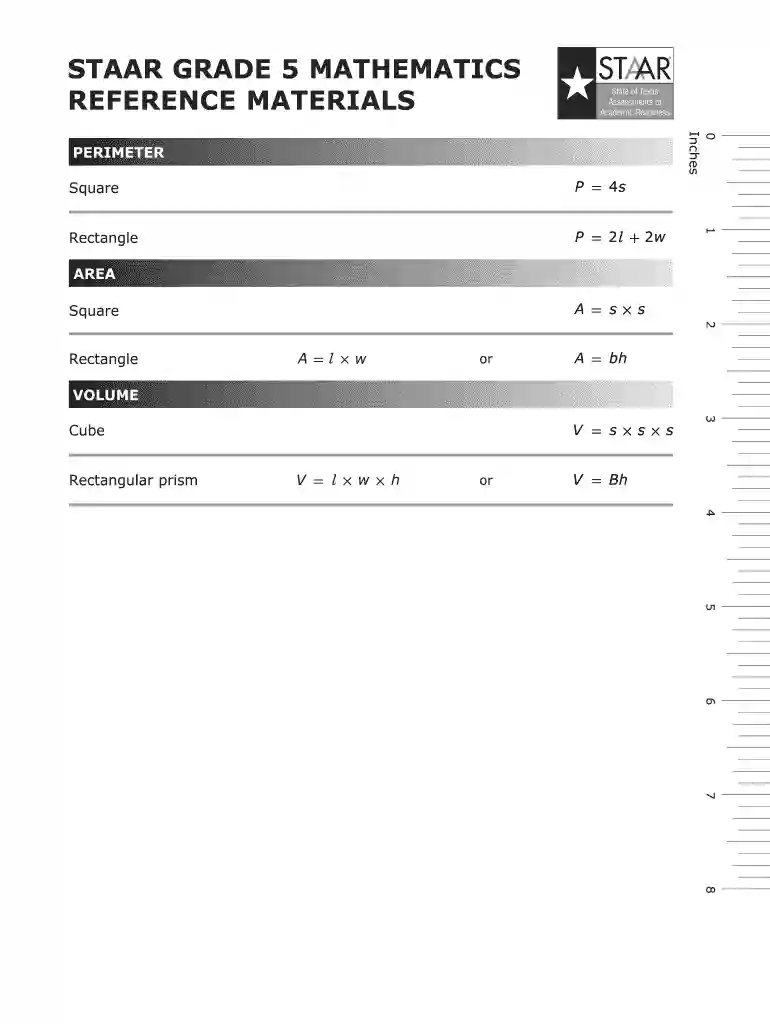
  • Geometry and Measurement: Assesses knowledge of shapes, geometric properties, and measurement techniques.
  • Data Analysis: Examines skills in interpreting and analyzing data using graphs and charts.

Students are expected to demonstrate practical applications of these elements, employing critical thinking and problem-solving skills.

How to Use the STAAR Fifth Grade Mathematics

Educators and students use the STAAR Fifth Grade Mathematics as both a benchmark and a guide:

  1. Curriculum Alignment: Teachers align classroom instruction with STAAR standards to ensure students are prepared for the assessment.
  2. Practice Tests: These are administered to familiarize students with the test format and question types.
  3. Targeted Review: Based on practice test outcomes, specific areas are identified for further instruction and review.

By integrating these practices, students can build confidence and competence in mathematics.

How to Obtain the STAAR Fifth Grade Mathematics Form

The STAAR Fifth Grade Mathematics test is typically distributed through educational institutions, such as public and private schools in Texas. Schools receive testing materials directly from the Texas Education Agency (TEA). Students enrolled in these schools are automatically registered for the assessment. For those outside the traditional school system, such as homeschooled students, parents can request testing materials through the TEA, ensuring they comply with state education requirements.

Steps to Complete the STAAR Fifth Grade Mathematics

Successful completion of the STAAR Fifth Grade Mathematics assessment involves several steps:

  1. Preparation: Engage in a comprehensive review of the test materials and standards.
  2. Practice Tests: Complete practice exams to get accustomed to the test format and time constraints.
  3. Test Day Strategies: Ensure adequate rest the night before and a nutritious breakfast on test day.
  4. Time Management: During the test, allocate time wisely to answer all questions and double-check responses.

Adhering to these steps can help enhance performance and reduce test-related anxiety.

Who Typically Uses the STAAR Fifth Grade Mathematics

The primary users of the STAAR Fifth Grade Mathematics assessment are students in the fifth grade attending public schools across Texas. Additionally, educators, school administrators, and policymakers utilize the results to gauge educational effectiveness and student progress. The data collected can inform instructional strategies and resource allocation to support student learning.


decoration image ratings of Dochub

Examples of Using the STAAR Fifth Grade Mathematics

Examples of how the STAAR Fifth Grade Mathematics assessment is used include:

  • Student Progress Monitoring: Teachers can track individual student progress over time, tailoring instruction to address learning gaps.
  • Curricular Adjustments: Educators might adjust syllabi to focus on weak areas identified through assessment results.
  • Policy Development: Administrators use aggregated test data to inform policy decisions and educational initiatives at the state and local levels.

These examples highlight the multifaceted utility of the STAAR assessment in driving educational improvements.

Important Terms Related to STAAR Fifth Grade Mathematics

Understanding key terms related to the STAAR Fifth Grade Mathematics helps clarify the assessment's scope:

  • TEKS (Texas Essential Knowledge and Skills): The state standards that outline what students should know and be able to do at each grade level.
  • Benchmark Tests: Evaluative tests that provide data on student progress throughout the academic year.
  • Scaffolded Instruction: Teaching strategies designed to support students’ varying levels of understanding and skills.
  • Problem-Solving Strategies: Techniques and approaches used to solve mathematical problems effectively.

These terms provide context and deepen one’s understanding of the educational framework supporting the STAAR assessment.

be ready to get more

Complete this form in 5 minutes or less

Get form

Got questions?

We have answers to the most popular questions from our customers. If you can't find an answer to your question, please contact us.
Contact us
The 100-Point Scale is defined using percentiles, which represent the percentage of students across the state that took the assessment and received a scale score less than the scale score of interest. Percentiles are based on the performance of students who took the assessment during the spring administration.
What tests are required? Grade 3: Math Reading. Grade 4: Math Reading. Grade 5: Math, Reading Science. Grade 6: Math Reading. Grade 7: Math Reading. Grade 8: Math, Reading, Science Social Studies. Grade 9-12: Algebra I, Biology, English I, English II US History (these are the End-of-Course exams, or STAAR EOCs)
Lol Annnd, TWO of my students scored perfect scores!! Yes perfect! 100% Didnt miss ANYTHING!! Another one scored 99% When i tell yall Im beyond proud!!
Yes. TEC 28.0211 requires any student who does not receive a passing score on a STAAR assessment to receive accelerated instruction. Refer to the Accelerated Instruction webpage for more information.
Practice a Lot: Practice is the key to mastery. Dedicate regular study sessions to practice Math STAAR-style questions. Utilize official practice tests, textbooks, online resources, and worksheets to hone your skills. Consistent practice not only enhances proficiency but also builds stamina for the actual test.

Security and compliance

At DocHub, your data security is our priority. We follow HIPAA, SOC2, GDPR, and other standards, so you can work on your documents with confidence.

Learn more
ccpa2
pci-dss
gdpr-compliance
hipaa
soc-compliance

People also ask

In Grade 5, instructional time should focus on three critical areas: (1) developing fluency with addition and subtraction of fractions, and developing understanding of the multiplication of fractions and of division of fractions in limited cases (unit fractions divided by whole numbers and whole numbers divided by unit
To pass STAAR, students must score in approaches grade level or higher. That might sound like it requires getting at least half the answers right, but in reality, the bar is much lower. In most cases, students only need to answer a little over a third of the questions correctly.

Related links