




01. Edit your form online
Type text, add images, blackout confidential details, add comments, highlights and more.

Type text, add images, blackout confidential details, add comments, highlights and more.

Draw your signature, type it, upload its image, or use your mobile device as a signature pad.

Send it via email, link, or fax. You can also download it, export it or print it out.
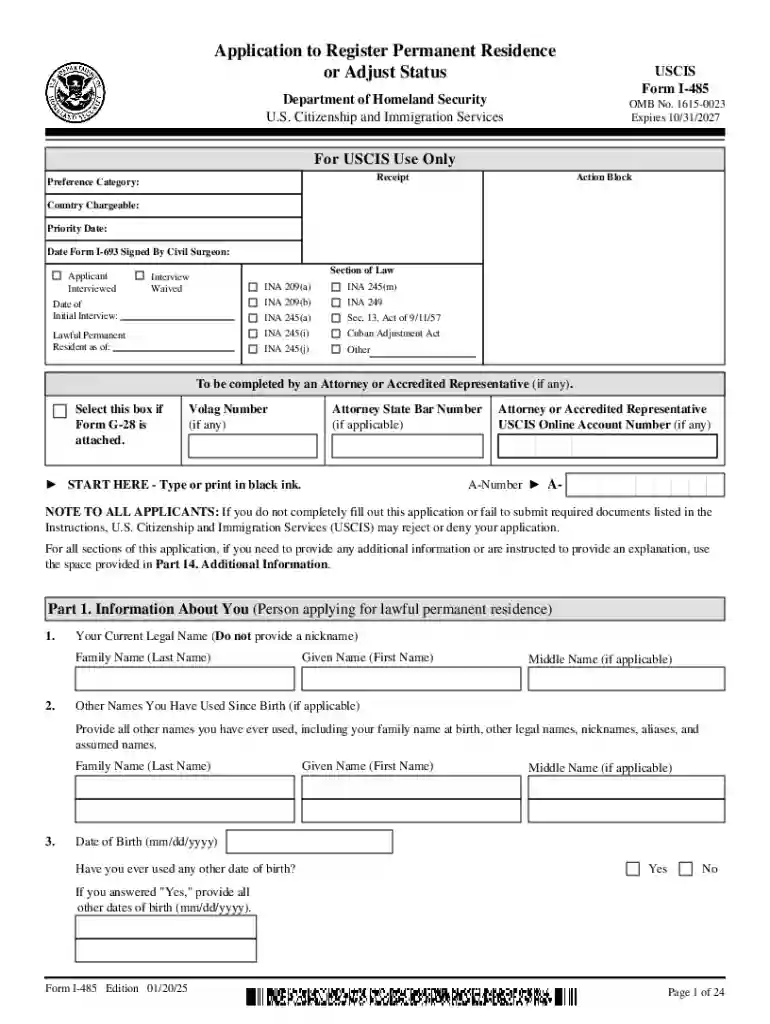
Form I-485, Application to Register Permanent Residence or Adjust Status, is crucial for individuals residing in the United States who seek to obtain lawful permanent resident status, commonly known as a Green Card. Issued by U.S. Citizenship and Immigration Services (USCIS), its primary purpose is to allow eligible foreign nationals to adjust their status without leaving the country. This form is typically part of a broader immigration process and is often used in conjunction with other applications or petitions depending on the applicant's specific situation, such as family sponsorship or employment-based Green Card applications.
Eligibility for Form I-485 involves meeting specific criteria based on the immigrant category under which you apply. Common categories include family-based petitions, employment-based petitions, or special immigrant categories such as refugees and asylees. Applicants must be physically present in the U.S. and have an approved immigrant petition, like Form I-130 for family-related adjustments. Understanding the requirements for each category is crucial, as errors in eligibility assessment can result in application delays or denials.


Completing Form I-485 involves several steps, each requiring careful attention to detail to ensure accuracy and completeness.
Accurate document submission is crucial for the Form I-485 process. Applicants must submit documents substantiating their eligibility and supporting their application claims.
Applicants can choose from various submission methods when filing Form I-485, considering the nature of their application.
Form I-485 plays a pivotal role in securing legal residency in the United States, carrying significant legal implications. A successful application grants the right to live and work permanently in the U.S., access to public benefits, and a path to citizenship. Conversely, errors or misrepresentations can lead to legal challenges or deportation.
The timeframe for processing Form I-485 can vary widely based on category, volume of applications, and specific USCIS office. On average, the process can take from a few months to more than a year.
Various real-world scenarios illustrate the use of Form I-485 in the adjustment of status:
Understanding these examples helps applicants navigate similar personal situations effectively.
We've got more versions of the Form I-485, Application to Register Permanent Residence or Adjust Status form. Select the right Form I-485, Application to Register Permanent Residence or Adjust Status version from the list and start editing it straight away!
| Versions | Form popularity | Fillable & printable |
|---|---|---|
| 2025 | 4.3 Satisfied (42 Votes) | |
| 2024 | 4.5 Satisfied (58 Votes) | |
| 2024 | 4.1 Satisfied (39 Votes) | |
| 2023 | 4.3 Satisfied (55 Votes) | |
| 2022 | 4.3 Satisfied (27 Votes) | |
| 2021 | 4.8 Satisfied (70 Votes) | |
| 2021 | 4.4 Satisfied (91 Votes) | |
| 2020 | 4.2 Satisfied (117 Votes) | |
| 2019 | 4.4 Satisfied (177 Votes) | |
| 2017 | 4.3 Satisfied (78 Votes) | |
| 2017 | 4.3 Satisfied (217 Votes) | |
| 2015 | 4.3 Satisfied (64 Votes) | |
| 2013 | 4.4 Satisfied (72 Votes) | |
| 2011 | 4.4 Satisfied (583 Votes) | |
| 2011 | 4 Satisfied (41 Votes) |
At DocHub, your data security is our priority. We follow HIPAA, SOC2, GDPR, and other standards, so you can work on your documents with confidence.




Jan 20, 2025 1. Have you ever applied for an immigrant visa to obtain permanent resident status at a U.S. Embassy or. U.S. Consulate abroad? No. Yes.Read more
Jun 16, 2026 Use this form to replace your Permanent Resident Card (also known as your Green Card). I-485, Application to Register Permanent Residence or


