




01. Edit your form online
Type text, add images, blackout confidential details, add comments, highlights and more.

Type text, add images, blackout confidential details, add comments, highlights and more.

Draw your signature, type it, upload its image, or use your mobile device as a signature pad.

Send it via email, link, or fax. You can also download it, export it or print it out.
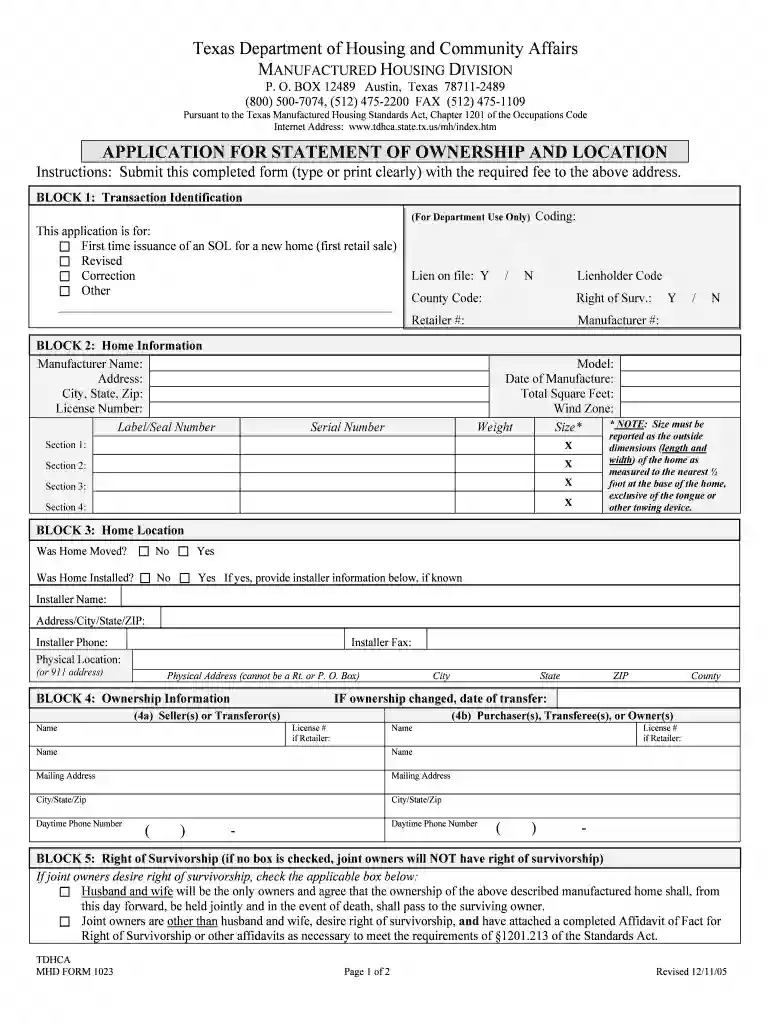
The Application for Statement of Ownership and Location (SOL) is a critical document issued by the Texas Department of Housing and Community Affairs, required for registering the ownership or change of ownership for manufactured homes within Texas. This form consolidates essential details about the home’s ownership, location, and status as real or personal property. The SOL application ensures that all necessary information about the home is recorded accurately, facilitating legal recognition and official documentation.
Completing the SOL application requires careful attention to several sections, each capturing different aspects of ownership and home details:
Transaction Identification: Clarify the nature of the transaction, whether an original statement or a subsequent update due to resale or location change.
Home Information: Record specifics such as the make, model, dimensions, and identification numbers of the manufactured home to ensure precise identification.
Ownership Details: Provide the current owner's full details and the sale date, if applicable, to trace the home’s ownership history.
Property Election and Designated Use: Decide and state whether the home is classified as real or personal property and declare its intended use, such as residential or storage.
Liens and Special Instructions: Record any existing financial claims on the property and indicate any special mailing requirements.
Certification: The final section requires a signature from all listed owners or an authorized agent, affirming the form's accuracy.
To apply, access the form through the Texas Department of Housing and Community Affairs’ official website or request it by mail. It’s critical to acquire the latest version to ensure compliance with the most current regulations. The form often accompanies specific instructions related to fee submission and additional documentation requirements, such as proof of title or previous SOL statements.
The application consists of crucial components to ensure it serves its purpose effectively:
These elements form the core data necessary for processing the application and finalizing official records.
Filing an Application for SOL ensures compliance with Texas law regarding manufactured homes' ownership and location documentation. It provides legal protection and clarity for homeowners, simplifies transactions by making ownership details clear, and supports both buyers and sellers by safeguarding their interests. Additionally, the document aids financial institutions in understanding lien positions and improves trust by maintaining transparent public records.
Several terms are crucial for understanding the SOL application:
Understanding these terms helps applicants accurately complete the form and ensures the appropriate handling of the manufactured home’s classification and legal standing.
In Texas, the SOL has state-specific regulations ensuring the accurate registration of manufactured homes:
Comprehending these rules ensures compliance with state mandates and avoids potential legal issues.
Consider a scenario where Jane Doe purchases a manufactured home in Houston. She must complete the SOL application to officially register her ownership and declare its personal property status, complying with Texas laws. Another case involves Mark Smith, who relocates his San Antonio-based manufactured home. He needs to update the SOL to reflect the new address, maintaining public records' integrity.
These examples illustrate the application’s practical significance and its role in managing ownership records accurately.
Supporting documents are often necessary:
Including these documents helps avoid processing delays and reduces the risk of application rejection due to incomplete submissions.
Failing to file an SOL or update changes can lead to complications:
Understanding these penalties emphasizes the importance of maintaining accurate registry information.
The SOL application may be submitted:
Selecting the appropriate method ensures timely processing and avoids unnecessary delays for the applicant.
At DocHub, your data security is our priority. We follow HIPAA, SOC2, GDPR, and other standards, so you can work on your documents with confidence.




Completed applications must be submitted to the Division within sixty (60) days of the date of sale.
If the housing to be replaced is an MHU, a Statement of Ownership and Location (SOL) for the MHU; draft loan documents or grant agreements to issue SOL;
During the Conversion phase, the developer must complete a Declaration of Commerciality and Application of Conversion, as well as receive a Certificate ofRead more


