
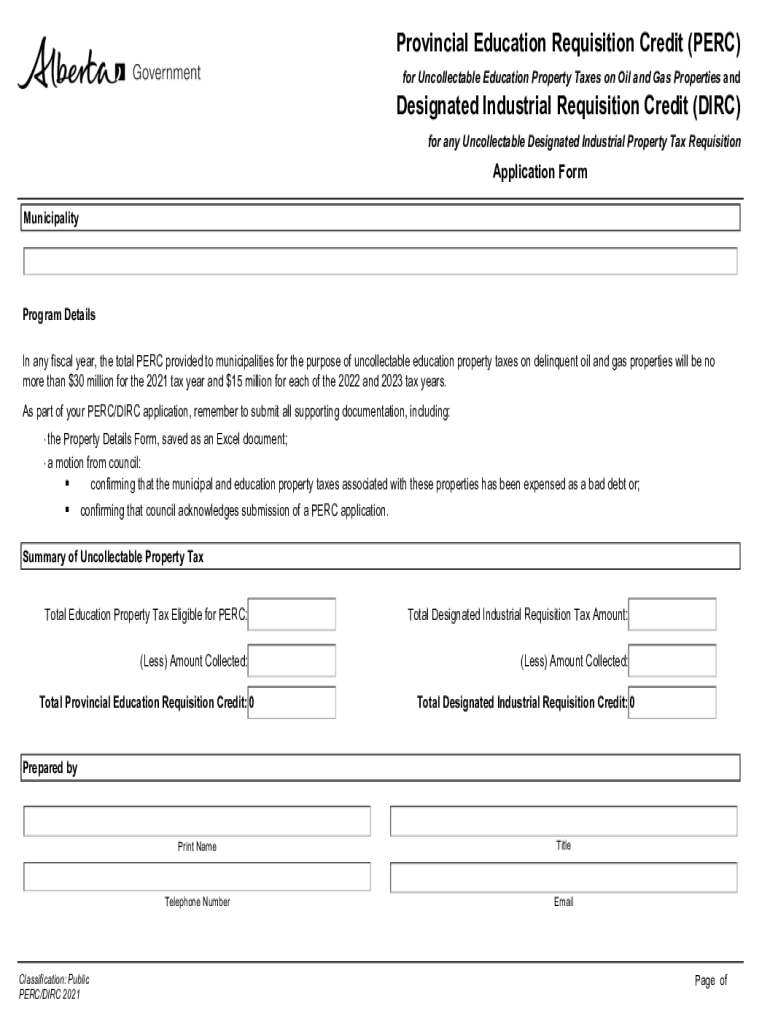







Definition and Purpose of the Provincial Education Requisition Credit and Designated Industrial Requisition Credit Application App
The Provincial Education Requisition Credit (PERC) and Designated Industrial Requisition Credit (DIRC) Application App is a specialized tool designed to streamline the application process for municipalities in dealing with uncollectable education property taxes, specifically concerning oil and gas properties and designated industrial properties. The PERC and DIRC aim to provide financial relief for municipalities by offsetting some of the burdens associated with non-recoverable taxes. This app is essential for managing tax-related documentation efficiently, ensuring timely submission, and maintaining compliance with regulations from 2021 to 2023, aligning with specific funding limits and legal requirements.
How to Use the Application App
Accessing the Application App
To effectively use the PERC and DIRC Application App, ensure you have the most current version of the software. The app can be accessed online, making it essential to have a stable internet connection. Begin by logging in with your authorized credentials, which ensures that only eligible entities can initiate the application process.
Step-by-Step Application Process
- Initial Setup: Start by gathering all necessary documents, including municipal identification numbers and details of eligible properties.
- Form Navigation: Navigate through the app's user interface to locate the specific application form. The intuitive design aids users in quickly finding relevant sections without unnecessary complexity.
- Data Entry: Carefully input accurate figures related to unpaid property taxes on eligible properties. Utilize auto-save features to prevent data loss.
- Document Upload: Upload supporting documentation directly into the application. Ensure that each file is correctly formatted and legible.
- Review and Submit: Before finalizing, review the entire application for completeness and accuracy. Once verified, submit the application through the app's secure transmission capabilities.
Required Documents for Submission
Municipalities need to provide several key documents when submitting the PERC and DIRC application. These include:
- Proof of uncollectable tax amounts.
- Legal documentation proving property designations (e.g., oil and gas or designated industrial).
- Certification statements confirming the accuracy and completeness of the information provided.
- In some cases, additional financial records may be necessary for comprehensive verification.
Eligibility Criteria for Applicants


Municipal Eligibility Requirements
To qualify for the PERC and DIRC, a municipality must meet specific criteria, including:
- Representing regions with designated oil and gas or industrial properties subject to education property taxes.
- Demonstrating attempted collections that resulted in tax amounts deemed uncollectable.
- Compliance with all legal statutes and requirements related to the collection and remission of property taxes.
Application Process and Approval Time
Standard Approval Timeline
The approval process for submissions generally follows these standard stages:
- Preliminary Review: Initial screening for completeness and eligibility, typically taking up to 14 business days.
- In-depth Analysis: Detailed evaluation of submitted documents, which can vary based on the complexity of the application but generally lasts up to 30 days.
- Final Decision: Official notification of the credit’s approval or rejection, sent to the municipality's designated contact.
Expedited Processing Scenarios
Certain circumstances might allow for an expedited review process, such as imminent fiscal deadlines or revisions based on previously approved applications. In such cases, providing additional supporting documentation upfront can help facilitate faster processing.
Key Elements to Include in the Application
- A detailed breakdown of the uncollected tax amounts, distinguishing between different property types.
- Accurate record of all actions taken to collect property taxes, including correspondence and legal notices.
- Clear distinctions between provincial and local tax obligations to ensure correct filing and credit application.
- Certification by authorized municipal representatives confirming the truthfulness and accuracy of submitted data.
Legal Considerations and Compliance
Ensuring legal compliance in the application process is crucial. This includes adhering to privacy laws concerning the collection of personal information, understanding the legal implications of falsifying data, and maintaining records to support claims of uncollectibility. The app provides a legal framework embedded within its guidelines to assist municipalities in meeting these requirements effectively.
Form Submission Methods: Online vs. Traditional
The application app offers flexibility in submission methods:
- Online Submission: Preferred for its efficiency and quicker processing times. The app's secure platform supports direct uploads and submissions.
- Traditional Methods: While less common, physical submissions via mail or in-person drop-offs are accepted if accompanied by all requisite documentation and envelopes clearly marked with the specific application type.
State-by-State Differences
While the app is designed for national application, specific state regulations may affect how municipalities qualify for credits. Differences can arise in eligible property designations, required documentation, and legal compliance measures. Therefore, municipalities must check with state-specific guidelines to ensure their submissions are valid and complete.
Practical Examples and User Scenarios
Case Study: Municipality Success Story
One example of successful app utilization is a midwestern municipality that efficiently navigated the application process by leveraging the app's document management and smart filing capabilities. By submitting all required data and additional supporting information through the app, the municipality secured substantial credits that alleviated financial pressure from uncollectable property taxes.
Common User Scenarios
Municipalities frequently face challenges in proving uncollectible tax amounts. The app aids by allowing clear, methodical documentation of collection attempts, satisfying auditors and ensuring compliance with statutory obligations.
This extensive coverage provides in-depth insight into how municipalities can effectively utilize the PERC and DIRC Application App to manage education property tax credits and remain in compliance with applicable laws.




