Request for RTDRS Fee Waiver and Statement of Finances Clients who are unable to pay the RTDRS filin 2026

Get Form
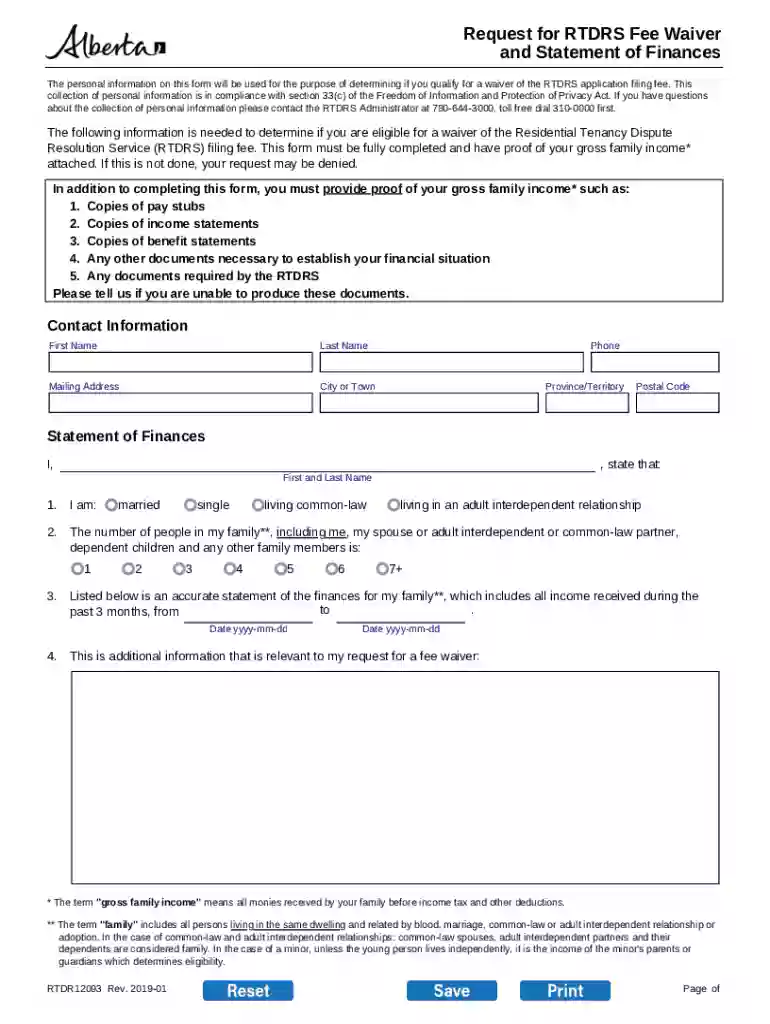
Request for RTDRS Fee Waiver and Statement of Finances Clients who are unable to pay the RTDRS filin Preview on Page 1

Here's how it works

01. Edit your form online
Type text, add images, blackout confidential details, add comments, highlights and more.

02. Sign it in a few clicks
Draw your signature, type it, upload its image, or use your mobile device as a signature pad.

03. Share your form with others
Send it via email, link, or fax. You can also download it, export it or print it out.

Definition and Purpose of the RTDRS Fee Waiver

The Request for Residential Tenancy Dispute Resolution Service (RTDRS) Fee Waiver and Statement of Finances form is a crucial document for individuals who are unable to afford the application filing fee for RTDRS. This form allows applicants to provide detailed information about their financial situation in order to qualify for a waiver of this fee. The waiver aims to make the dispute resolution process accessible to all tenants and landlords, regardless of their financial standing.

How to Use the RTDRS Fee Waiver Form

To effectively use the RTDRS Fee Waiver form, applicants must thoroughly complete each section with accurate and detailed information. It is essential to carefully read the instructions provided with the form to ensure that all necessary parts are filled out. The form includes sections on personal details, family income, and declarations of financial status that are vital for assessing the eligibility for the fee waiver.

Steps to Complete the RTDRS Fee Waiver Form

  1. Personal Information: Begin by entering your full name, contact details, and any other personal information required by the form.
  2. Income Declaration: Accurately report all sources of income, including wages, social assistance, or other forms of financial support.
  3. Family Income Sources: Detail the income sources for each member of your household to provide a complete financial overview.
  4. Declaration of Finances: Complete this section by declaring your financial obligations and any other relevant financial information.
  5. Proof of Income: Attach the necessary documentation, such as pay stubs or benefit statements, to support your income declaration.

Importance of Requesting an RTDRS Fee Waiver

Requesting an RTDRS Fee Waiver is important for individuals experiencing financial hardship, as it ensures that they can participate in the dispute resolution process without the burden of additional costs. This access is fundamental to upholding tenants’ rights and facilitating fair dispute resolutions regardless of economic status.

Eligibility Criteria for the RTDRS Fee Waiver

Applicants must demonstrate genuine financial difficulty to qualify for the RTDRS Fee Waiver. This involves meeting specific income thresholds, which vary based on household size. Documentation proving income and financial obligations is typically required to assess eligibility accurately.


decoration image ratings of Dochub

Key Elements of the RTDRS Fee Waiver Form

  • Personal Details: Name, contact information, and other identifying information.
  • Income Section: Sources and amounts of income.
  • Financial Obligations: Details of monthly expenses and financial liabilities.
  • Documentation: Required proofs, such as tax returns or bank statements.

Legal Implications of Using the RTDRS Fee Waiver

Using the RTDRS Fee Waiver involves providing honest and accurate financial information to avoid any legal repercussions. Falsifying information could result in penalties or denial of the waiver. Applicants must adhere to the legal standards outlined in the form to maintain eligibility.

Required Documents for the RTDRS Fee Waiver Application

When submitting the RTDRS Fee Waiver form, it is critical to include:

  • Proof of income (pay stubs, benefit letters)
  • Tax return copies if available
  • Any other documents that demonstrate financial hardship

Form Submission Methods

The completed RTDRS Fee Waiver form can be submitted through various channels depending on the applicant’s convenience:

  • Online Submission: Via email or dedicated online portals if available.
  • Mail: Sending the completed form and documents to the designated address.
  • In-Person: Delivering the form directly to an RTDRS office if physical submission is preferred or required.
be ready to get more

Complete this form in 5 minutes or less

Get form

Got questions?

We have answers to the most popular questions from our customers. If you can't find an answer to your question, please contact us.
Contact us
If the applicant or respondent believes the Tenancy Dispute Officer made an error of law or jurisdiction they may appeal to the Court of Kings Bench within 30 days of the date that the order is filed. An example of an error of law is that the Tenancy Dispute Officer did not interpret the legislation correctly.
The adjudicators decision is binding on both parties. There is no automatic right of appeal against the adjudicators decision. However, in limited circumstances a decision can be reviewed.
When to write an appeal letter? Scan your denial letter carefully. Think of what reason you want to address and how. Address the appeal letter. First paragraph: Ask for reconsideration. Second paragraph: State your case. Third paragraph: Offer possible concessions. Conclusion: Dont forget to sign.
If the issue still is not resolved, you can apply to the Residential Tenancy Dispute Resolution Service (RTDRS). Landlords and tenants involved in a dispute can apply to this service for certain remedies listed in the RTA . Alternatively, landlords and tenants may choose to take their matter to court.
If any party to the Order believes that there was an error in law or jurisdiction they may appeal to the Court of Queens Bench within 30 days of the date that the Order is filed. hearing. Appellants must pay for and arrange the transcript through a private transcription business.

Security and compliance

At DocHub, your data security is our priority. We follow HIPAA, SOC2, GDPR, and other standards, so you can work on your documents with confidence.

Learn more
ccpa2
pci-dss
gdpr-compliance
hipaa
soc-compliance
be ready to get more

Complete this form in 5 minutes or less

Get form