




01. Edit your form online
Type text, add images, blackout confidential details, add comments, highlights and more.

Type text, add images, blackout confidential details, add comments, highlights and more.

Draw your signature, type it, upload its image, or use your mobile device as a signature pad.

Send it via email, link, or fax. You can also download it, export it or print it out.
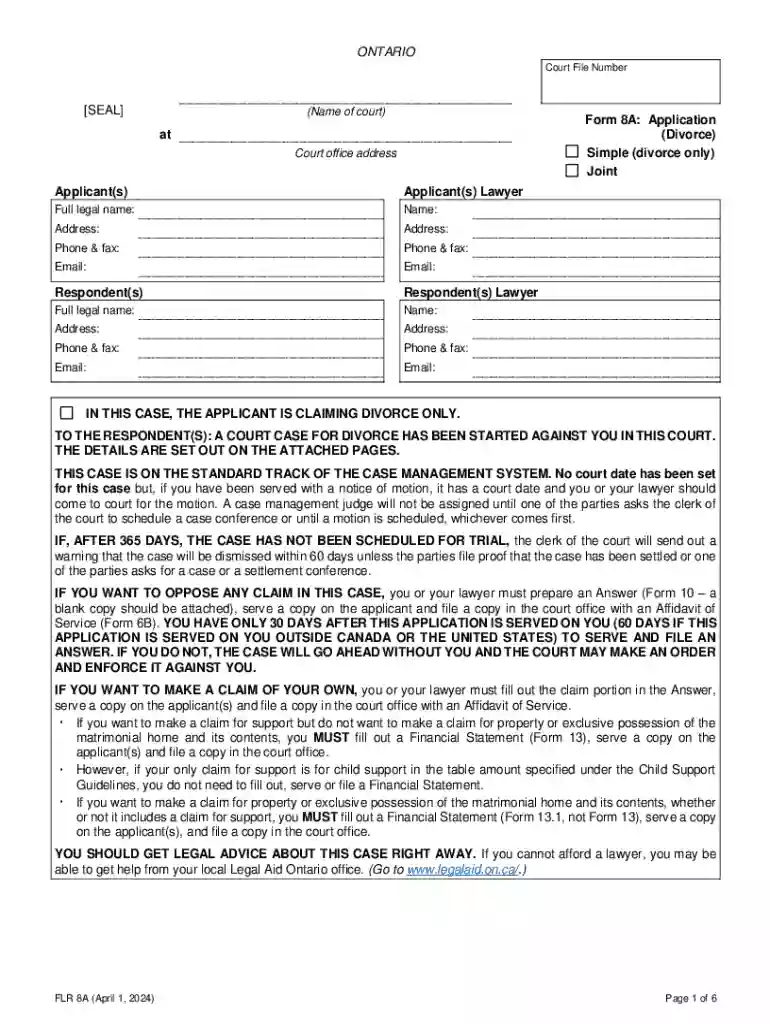
Form 8A, known as the Application for Divorce in Ontario, is a legal document utilized within the Canadian legal system to initiate divorce proceedings. This form outlines the necessary steps and legal requirements for individuals looking to dissolve their marriage and seek an official divorce decree. It gathers comprehensive information about both applicants and respondents involved in the divorce, detailing respective responsibilities and expectations. Understanding the importance and function of Form 8A is crucial for anyone navigating the complexities of divorce law in Ontario, ensuring they are adequately prepared for the process.
Acquiring Form 8A can be accomplished through several channels, each suited to individual preference and access needs:
Online Access: The form can often be downloaded directly from the Ontario Court website or legal aid services, providing a convenient digital option for those with internet access.
Court Offices: Visiting the local courthouse or family law information center remains a traditional but reliable method, where staff can also offer guidance on form completion.
Legal Services: Through family law attorneys or legal aid organizations, individuals can not only obtain the form but also receive professional advice on its use and the whole divorce process.
These methods ensure that all individuals, regardless of their technological capability or geographical location, have access to this vital legal document.
Completing Form 8A involves several carefully structured steps to ensure accuracy and adherence to legal standards:
Personal Information: Begin by accurately filling out personal details for both parties, including names, addresses, and marriage details, ensuring no errors in critical identification information.
Grounds for Divorce: Clearly specify the reasons for seeking divorce, typically including separations of more than one year, adultery, or cruelty, ensuring the grounds align with legal acceptability in Ontario.
Custody and Support: If applicable, detail any claims for child custody, child support, or spousal support, providing all relevant financial and personal information to support these claims.
Property Disclosure: Include comprehensive information regarding any shared property or assets, facilitating fair division according to Ontario’s divorce laws.
Review and Submit: Carefully review the completed form for accuracy before submission. Submissions can typically be made in person at the local family law court or mailed to the appropriate legal office.
These steps assist individuals in systematically completing Form 8A, reducing errors and ensuring compliance with all legal requirements.
Form 8A is primarily used by:
This diverse user base underscores the form’s utility in facilitating legal processes for a variety of individuals and professionals involved in family law.


The essential components of Form 8A include:
Understanding these core elements aids in the comprehensive preparation and filing of the form, ensuring all necessary information is included.
The legal application of Form 8A is governed by the family law statutes of Ontario, ensuring that divorce proceedings are initiated according to provincial laws. This form is integral to the legal dissolution of a marriage, serving as the formal request for a divorce decree. It requires thorough completion and is often accompanied by supplementary documents, such as affidavits or financial statements, to validate claims regarding custody, support, and property division. Correct legal use of Form 8A ensures compliance with judicial requirements, providing a framework for equitable resolution of marital dissolution.
Understanding and adhering to filing deadlines is crucial for ensuring the smooth progression of a divorce case:
Separation Requirement: A mandatory separation period of at least one year is generally required, except for grounds such as adultery or cruelty.
Response Timelines: After filing, the respondent typically has thirty days to respond if they reside in Ontario, or sixty days if outside the province.
Hearing Schedules: Upon submission, applicants will receive instructions on court hearing dates, which are essential to track in order to prepare and attend court proceedings effectively.
These timelines and deadlines are vital for maintaining legal compliance and ensuring timely processing of the divorce application.
The use of Form 8A is specifically tailored to the legal requirements of Ontario, Canada. This includes legislative guidelines unique to the Ontario Family Law Act and Divorce Act, which dictate the necessary conditions for which a divorce can be granted. They also establish jurisdictional rules around residency and permissible grounds for divorce. Familiarity with these state-specific rules ensures that legal documents are appropriately tailored to meet the unique legal landscape of Ontario, providing clarity and direction for applicants navigating the divorce process within this province.
We've got more versions of the Form 8a form. Select the right Form 8a version from the list and start editing it straight away!
At DocHub, your data security is our priority. We follow HIPAA, SOC2, GDPR, and other standards, so you can work on your documents with confidence.



Form 8A Request for Certificate of Compliance Massachusetts Wetlands Protection Act. Provided by DEP A.
Form 8-A, for registration of certain classes of securities pursuant to section 12 (b) or (g) of the Securities Exchange Act of 1934.
Form 8A (transposition within constituency) accepted online but not reflected in the roll. Online status on voters.


