






Definition and Meaning
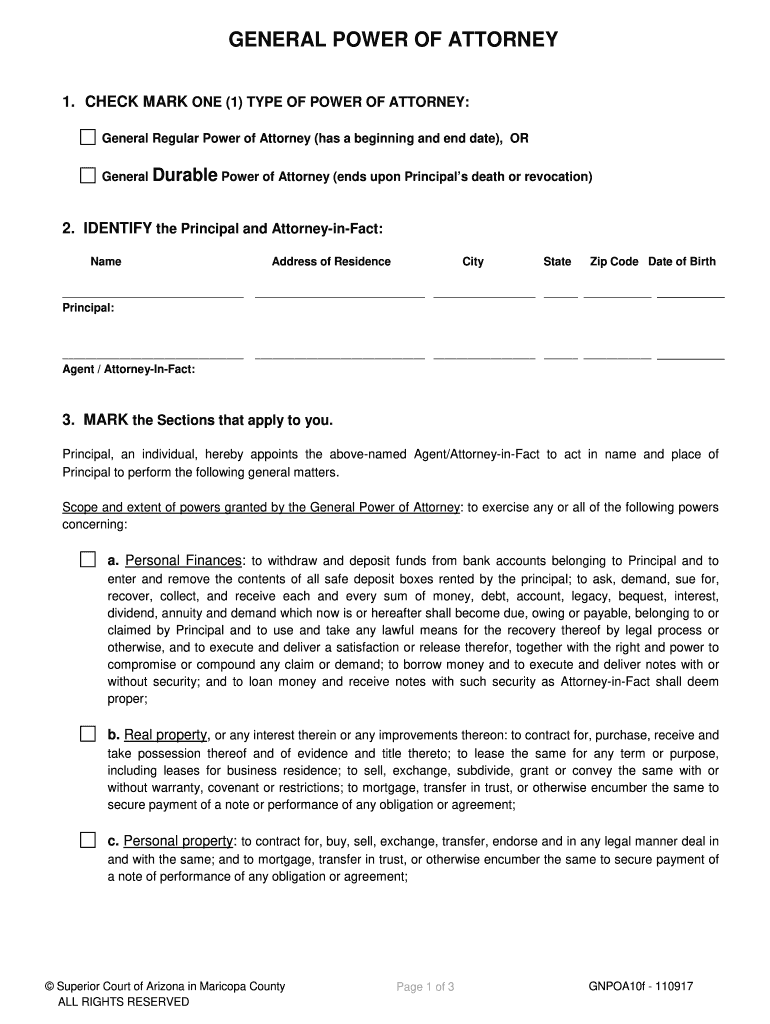
A General Power of Attorney, specifically the "GENERAL POWER OF ATTORNEY GNPOA10i," is a legal document that enables the Principal to appoint an Attorney-in-Fact. This appointed individual is authorized to manage various aspects of the Principal's personal, financial, and legal matters. The GNPOA10i form is pivotal for empowering the Attorney-in-Fact to make decisions on behalf of the Principal, encompassing personal finances, property transactions, and other business activities. The Power of Attorney can be tailored to be either General Regular or General Durable, with distinctions in their validity period and scope, underscoring its flexibility.
Key Elements of the GENERAL POWER OF ATTORNEY GNPOA10i
The GENERAL POWER OF ATTORNEY GNPOA10i includes crucial sections that outline:
- Powers Granted: Specifies the types of decisions and actions the Attorney-in-Fact can undertake, such as managing bank accounts, real estate transactions, and executing contracts.
- Effective Date: Details when the power commences, whether immediately upon signing or at a future specified date.
- Revocation Process: Explains how the power can be revoked by the Principal or naturally terminates due to specific conditions, providing clarity and a safeguard for the Principal.
- Signatures: Requires signatures from the Principal, Attorney-in-Fact, and a witness, along with notarization, to authenticate the document's legality.
Steps to Complete the GENERAL POWER OF ATTORNEY GNPOA10i
- Identify the Principal and Attorney-in-Fact: Clearly state the names and addresses of the involved parties.
- Specify Powers: List the specific powers granted to the Attorney-in-Fact, ensuring it aligns with the Principal’s requirements.
- Determine the Type: Decide whether it will be a General Regular or Durable form depending on the need for it to remain in effect if the Principal becomes incapacitated.
- Detail the Effective Date: Decide when the document takes effect.
- Finalize with Signatures and Notarization: Ensure the document is signed by necessary parties and properly notarized to validate its enforceability.
How to Obtain the GENERAL POWER OF ATTORNEY GNPOA10i
To secure the GENERAL POWER OF ATTORNEY GNPOA10i, individuals can:
- Consult Legal Professionals: Obtain guidance from attorneys to ensure the form meets specific legal requirements and personal needs.
- Access Legal Document Services: Use online platforms that generate customizable power of attorney documents guided by current legal standards.
- Visit Local Government Offices: Check with local county or state offices where standardized forms might be available.
Legal Use of the GENERAL POWER OF ATTORNEY GNPOA10i
In the United States, the GNPOA10i may be used for:
- Financial Transactions: Managing bank accounts, stocks, and retirement accounts.
- Real Estate Management: Buying, selling, or leasing properties on behalf of the Principal.
- Legal Decisions: Engaging in legal proceedings, filing taxes, or representing in legal matters.
Each state may carry specific statutes regulating the use and execution of power of attorney documents, so ensuring compliance with local laws is critical.
Important Terms Related to GENERAL POWER OF ATTORNEY GNPOA10i
- Principal: The individual granting powers to another through the power of attorney.
- Attorney-in-Fact: The designated agent receiving the authority to act on the Principal's behalf.
- Durable: The characteristic of a power of attorney to remain effective even if the Principal becomes incapacitated.
- Notarization: The formal validation requiring a notary to acknowledge the authenticity of the signing parties.
State-Specific Rules for the GENERAL POWER OF ATTORNEY GNPOA10i
Each state may introduce specific requirements such as:
- Notary Requirements: Some states require the document to be notarized, while others may not.
- Witness Specifications: Certain jurisdictions mandate specific witness requirements.
- Registration: In some states, filing the Power of Attorney with a local court may be necessary for real estate transactions.
Who Typically Uses the GENERAL POWER OF ATTORNEY GNPOA10i
Common users include:
- Elderly Individuals: Those planning for future health conditions or incapacity.
- Business Professionals: Entrepreneurs who need others to manage business affairs when abroad.
- Military Personnel: Service members preparing for deployment who need someone to handle their civilian affairs.
- Individuals with Impending Medical Procedures: Those anticipating a temporary inability to manage their affairs.
Understanding the purpose and breadth of powers granted through the GENERAL POWER OF ATTORNEY GNPOA10i can help individuals make informed choices about their personal and financial security.